2 Essential Healthcare Stories for Canadian Professionals


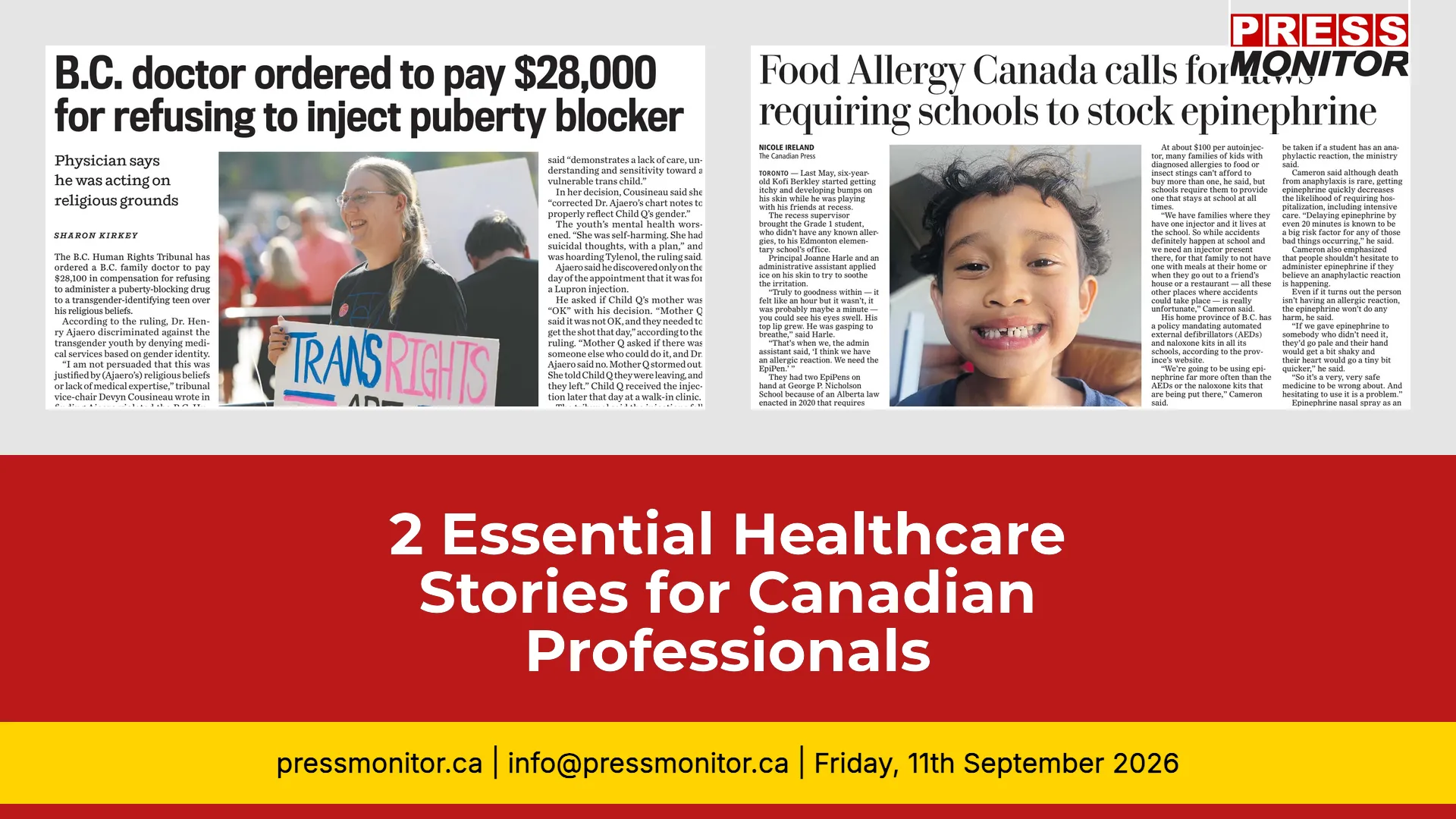
According to Press Monitor's tracking of Canadian publications, this press review brings media monitoring insights on two significant healthcare stories shaping national conversations — from a landmark medical ethics ruling to a critical public health policy push. These developments underscore why print media monitoring remains essential for delivering media intelligence. Stay informed with news on healthcare from Canada's print media landscape.
3. B.C. Human Rights Tribunal Fines Doctor for Trans Care Refusal
{source_name} reports that the B.C. Human Rights Tribunal ordered a family doctor to pay $28,000 in compensation for refusing to administer a puberty blocker to a transgender teen based on religious beliefs. The tribunal found Dr. Henry Ajaero discriminated against the youth by denying medical services based on gender identity, rejecting his claim that religious beliefs or lack of expertise justified his actions. The ruling noted the teen's mental health deteriorated after the incident, including self-harm and suicidal thoughts.
Why it matters: The ruling sets a precedent for physician obligations under human rights law, affirming that religious beliefs cannot override a patient's right to gender-affirming care. This case has sparked national debate about the boundaries of medical conscience clauses.
Key detail: The tribunal ordered Dr. Henry Ajaero to pay C$28,100 in compensation after finding he violated the B.C. Human Rights Code by denying a transgender teenager access to puberty-blocking treatment. The ruling noted the teen's mental health deteriorated significantly, including self-harm and suicidal ideation.
Source: Vancouver Sun, reported by Sharon Kirkey, with cross-referencing from National Post, Ottawa Citizen, and Calgary Herald.
Next step: Healthcare providers across Canada should review their policies on gender-affirming care to ensure compliance with provincial human rights codes.
Closing: How will this ruling influence physician conduct policies in other provinces? Share your perspective.
6. Food Allergy Canada Urges School Epinephrine Laws
Times Colonist reports that Food Allergy Canada is urging all Canadian provinces to legislate mandatory stocking of unassigned epinephrine devices in schools. The advocacy group highlights an Alberta law enacted in 2020 as a successful model, citing Edmonton student Kofi Berkley’s severe allergic reaction where readily available medication prevented serious complications. Medical experts emphasize that timely administration of epinephrine drastically reduces hospitalization risks, making standardized provincial policies essential for student wellness.
Why it matters: Standardized epinephrine access in schools could save lives, as allergic reactions can escalate rapidly without immediate treatment. This advocacy effort builds on a successful Alberta model that has already proven effective.
Key detail: Food Allergy Canada is urging all Canadian provinces to legislate mandatory stocking of unassigned epinephrine devices in schools, citing the 2020 Alberta law and the case of Edmonton student Kofi Berkley, whose severe allergic reaction was managed with readily available medication.
Source: Times Colonist, reported by Nicole Ireland from Toronto.
Next step: Provincial governments should consider adopting standardized epinephrine policies to protect students with severe allergies nationwide.
Closing: Should every Canadian school be required to stock epinephrine devices? Let us know your thoughts.