21 Essential Stock Markets Stories for Investors


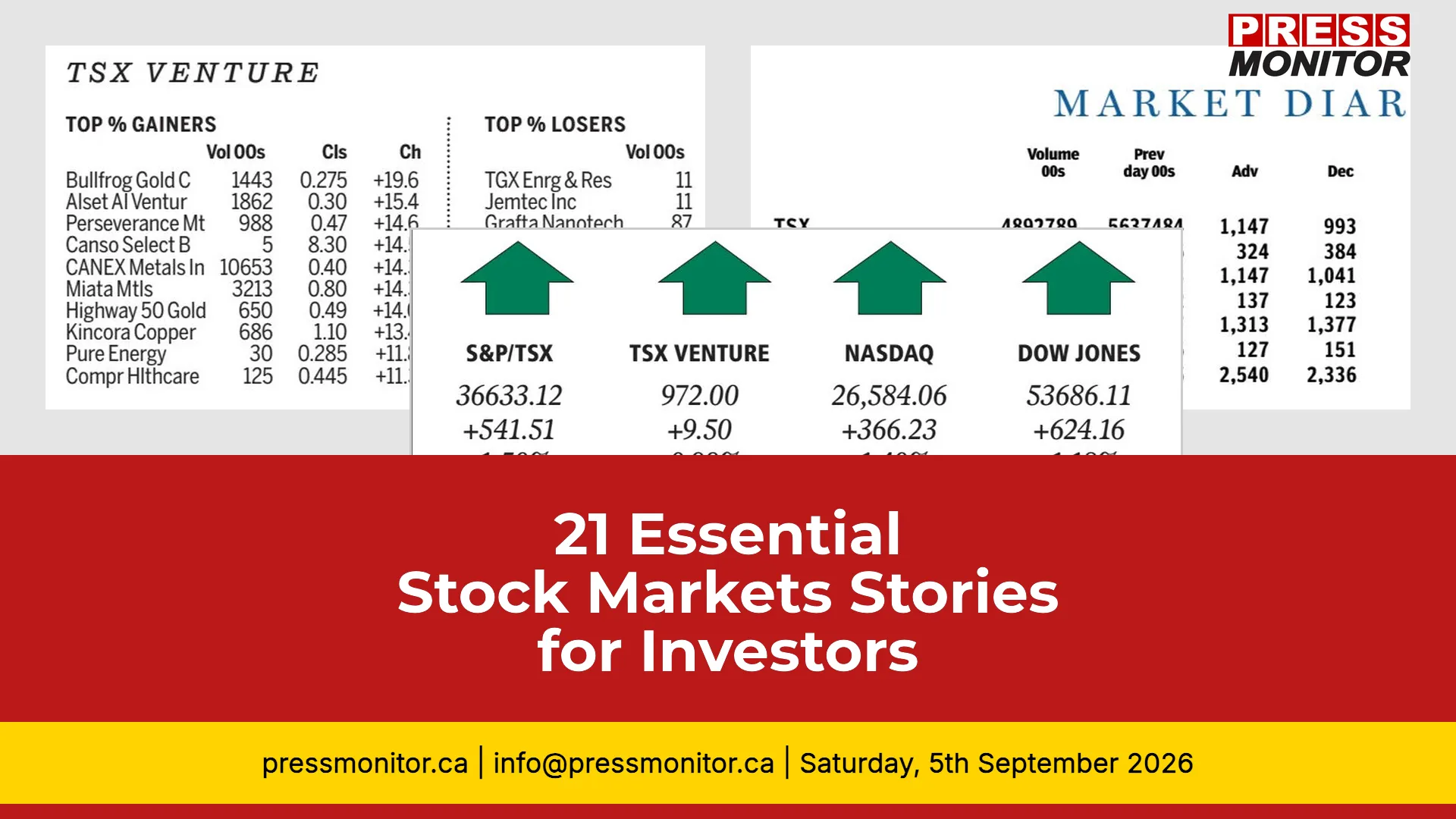
Print media monitoring from Press Monitor delivers 21 essential stock markets stories for investors and professionals. This press review brings together print media intelligence on today's equity trading, index movements, and market sentiment across Canadian exchanges. According to Press Monitor's tracking of Canadian publications, these news on stock markets stories cover TSX surges, small-cap rallies, venture stock volatility, and currency movements — providing the actionable context you need. From the Toronto Stock Exchange closing at 36,633 to small-cap dividend shifts and TSX Venture volatility, this curated review distills the day's most significant developments from Calgary to Vancouver.
1. TSX Venture Stocks See Sharp Gains
Vancouver Sun reports that TSX Venture listed equities showed significant volatility, with mining and healthcare stocks leading gains above fifteen percent while energy and technology firms posted notable losses. Several junior resource companies experienced heavy trading volumes as share prices fluctuated across Canadian capital markets.
Why it matters: TSX Venture volatility signals shifting capital flows into junior resources and healthcare, critical for investors tracking early-stage opportunities. Key detail: Mining and healthcare stocks led gains above fifteen percent while energy and technology firms posted notable losses. Source: Vancouver Sun, September 5, 2026. Next step: Monitor which sectors sustain momentum beyond the initial surge.
2. TSX Market Diary Volume 4892789
Financial Post Magazine reports that the TSX market diary for July 18, 2026, shows daily trading volume of 4,892,789 shares, with previous day volume at 5,637,484 and advancing issues at 1,147,324. The data includes highs, lows, and most active stocks, with rights, warrants, units, and debentures excluded and a minimum trading threshold of 500 shares.
Why it matters: Daily trading volume data reveals market depth and investor participation trends essential for timing entries and exits. Key detail: Daily trading volume of 4,892,789 shares, previous day volume at 5,637,484, and advancing issues at 1,147,324. Source: Financial Post Magazine, July 18, 2026. Next step: Compare volume trends across multiple sessions to identify accumulation patterns.
3. TSX Index Surges Over 540 Points
Times Colonist reports that the Toronto Stock Exchange closed at 36,633.12, gaining 541.51 points or 1.50 percent on heavy trading volume exceeding 247 million shares. Major stocks saw mixed movements, with significant gains reported across energy, financial, and technology sectors. Market participants noted strong upward momentum driven by broad-based buying across the index.
Why it matters: A 541-point gain on the TSX signals broad-based bullish sentiment across energy, financial, and technology sectors. Key detail: Toronto Stock Exchange closed at 36,633.12, gaining 541.51 points or 1.50 percent on heavy trading volume exceeding 247 million shares. Source: Times Colonist, September 5, 2026. Next step: Watch for follow-through buying in the sectors that led the rally.
4. Top Gainers Lead Market Rally
{source_name} reports that market data shows significant price jumps for companies like Marriot VacaWo and CostamareBlkrs, while Active Ticker Class roared 12.2% higher, marking a strong day for equity trading volumes.
Why it matters: Individual stock momentum in names like Marriot VacaWo and CostamareBlkrs highlights sector rotation opportunities. Key detail: Active Ticker Class roared 12.2% higher, marking a strong day for equity trading volumes. Source: Calgary Herald, September 5, 2026. Next step: Check whether top gainers are sustainable moves or short-covering rallies.
5. Small Caps Surge 18 Per Cent
{source_name} reports that small-cap stocks are gaining attention after years of underperformance, with the Russell 2000 index up 18 per cent this year versus the S&P 500's 11 per cent gain. Peter Hodson notes that many small-cap companies are now paying higher dividends to attract investors, offering both higher yield and growth potential despite the sector's inherent risks and volatility.
Why it matters: Small-cap outperformance signals a potential shift in investor appetite toward higher-risk, higher-reward opportunities. Key detail: Russell 2000 index up 18 percent this year versus the S&P 500's 11 percent gain, with many small-cap companies now paying higher dividends. Source: Financial Post Magazine, Peter Hodson. Next step: Evaluate small-cap dividend sustainability against earnings growth.
6. TSX Composite Stocks Close
Montreal Gazette reports that the September 5, 2026 financial page listed S&P/TSX Composite stock closes and changes for major Canadian companies on the Toronto Stock Exchange. The page highlighted most active stocks, top gainers and top losers across energy, banking, mining, telecommunications and retail sectors.
Why it matters: Sector-level breakdown of gainers and losers across energy, banking, mining, telecommunications, and retail reveals where capital is flowing. Key detail: Most active stocks, top gainers, and top losers highlighted across major Canadian companies on the Toronto Stock Exchange. Source: Montreal Gazette, September 5, 2026. Next step: Cross-reference sector performance with macroeconomic indicators.
7. Toronto Stock Exchange Top 100 Rankings
Financial Post Magazine reports that the Toronto Stock Exchange Top 100 stocks ranked by trading value for April 9, 2026, are led by ARC Resources, Dollarama, and Nutrien Ltd. The rankings include major Canadian and international companies across mining, energy, banking, and technology sectors. Thomson Reuters supplied the trading figures for the list published on page 43.
Why it matters: Trading value rankings identify the most liquid and actively watched stocks, useful for liquidity-focused strategies. Key detail: ARC Resources, Dollarama, and Nutrien Ltd led the rankings, with Thomson Reuters supplying trading figures. Source: Financial Post Magazine, April 9, 2026. Next step: Track whether top-ranked stocks maintain their positions through the next reporting period.
8. C$10 Billion Canadian Markets
National Post reports that Toronto Stock Exchange saw significant trading activity on October 4, 2026, with top companies including Barrick Mining, Shopify, and TD Bank. Mining stocks showed mixed results while technology and financial sectors experienced key movements across the board.
Why it matters: Significant trading activity in Barrick Mining, Shopify, and TD Bank reflects sector-specific investor interest. Key detail: Mining stocks showed mixed results while technology and financial sectors experienced key movements across the board. Source: National Post, October 4, 2026. Next step: Assess whether the C$10 billion volume threshold signals a regime shift in market participation.
9. Mixed Stock Performance Reported for July 18
The Welland Tribune reports that the S&P/TSX index closed at 36,513.80, while the S&P 500 reached 53,414.25 on July 18, 2026. The NASDAQ rose to 26,506.99, and the DJIA stood at 53,786, alongside commodity and currency valuations for the day.
Why it matters: Comparing Canadian and US index closes provides a cross-border perspective on relative market strength. Key detail: S&P/TSX index closed at 36,513.80, S&P 500 reached 53,414.25, NASDAQ rose to 26,506.99, and DJIA stood at 53,786. Source: The Welland Tribune. Next step: Use the US-Canada spread to gauge currency and interest rate impacts on equity valuations.
10. Canada US Markets Slide After Labour Data
Times Colonist reports that stock markets in Canada and the United States fell on Friday after the release of labour data from both economies. Statistics Canada reported a loss of 42,000 jobs in August with the unemployment rate holding steady at 6.4 percent, while the U.S. government reported employers added 162,000 jobs far exceeding expectations.
Why it matters: Labour data releases move markets — the divergence between Canadian job losses and US job gains has direct implications for cross-border investment. Key detail: Statistics Canada reported a loss of 42,000 jobs in August with unemployment at 6.4 percent, while the US added 162,000 jobs. Source: Times Colonist, Daniel Johnson, Toronto. Next step: Watch for Bank of Canada and Fed policy responses to the divergent labour pictures.
11. S&P/TSX Composite Stocks Snapshot
The Edmonton Journal reports that S&P/TSX composite stocks closed with mixed movements among major Canadian companies. Gains were led by Enbridge, BCE, and Air Canada, while CPL Composites and Crombie REIT declined. The overview covers dozens of equities from mining, financials, energy, and technology sectors.
Why it matters: Individual stock snapshots across Enbridge, BCE, Air Canada, CPL Composites, and Crombie REIT show where institutional money is flowing. Key detail: Gains led by Enbridge, BCE, and Air Canada, while CPL Composites and Crombie REIT declined. Source: Edmonton Journal, September 5, 2026. Next step: Track whether the gainers-losers split reflects sector rotation or company-specific news.
12. Top Stock Market Gainers Losers
Vancouver Sun reports that the stock market showed significant movement with several companies posting top gains and losses. Quanex Building, Yatsen, and LiveWire Group led the gainers, while Guidewire Soft and Viking Acq Corp were among the biggest losers. The performance reflects the day's trading activity across multiple sectors.
Why it matters: Identifying the day's biggest winners and losers helps investors spot momentum and reversal opportunities. Key detail: Quanex Building, Yatsen, and LiveWire Group led the gainers, while Guidewire Soft and Viking Acq Corp were among the biggest losers. Source: Vancouver Sun, September 5, 2026. Next step: Investigate whether gainers have catalysts or are purely sentiment-driven.
13. National Post Reports Stock Rankings
National Post reports that a list of stocks ranked by trading value, including Dollarama, Enbridge, and Imperial Oil, was published with figures supplied by Thomson Reuters. The data includes close prices, yields, and price-to-earnings ratios for various Canadian companies.
Why it matters: Thomson Reuters-sourced rankings of Dollarama, Enbridge, and Imperial Oil provide a data-backed view of market leadership. Key detail: Close prices, yields, and price-to-earnings ratios for various Canadian companies were included. Source: National Post. Next step: Use P/E ratios to identify whether market leaders are fairly valued or stretched.
14. TSX Composite Index Newsletter
The Globe And Mail (ottawa/quebec Edition) reports that additional market indexes are available online at tgam.ca/markets. The Globe And Mail (ottawa/quebec Edition) invites readers to subscribe to a weekly newsletter offering sector-by-sector analysis of the TSX Composite Index, and asks suggestions for the investing editor to be sent to jcowan@globeandmail.com.
Why it matters: Sector-by-sector analysis tools help investors dig deeper beyond headline index moves. Key detail: The Globe and Mail invites readers to subscribe to a weekly newsletter offering sector-by-sector analysis of the TSX Composite Index. Source: The Globe and Mail (ottawa/quebec Edition). Next step: Subscribe to the newsletter for ongoing sector intelligence.
15. Calgary Herald Reports Market Index Closes
Calgary Herald reports that financial market indices showed mixed movements in North American trading, with the FPX Growth index closing slightly lower. Stock market volume data was recorded across multiple exchanges including the TSX, NYSE, and NASDAQ.
Why it matters: Multi-exchange data including TSX, NYSE, and NASDAQ provides a global context for Canadian market moves. Key detail: FPX Growth index closed slightly lower while stock market volume data was recorded across multiple exchanges. Source: Calgary Herald, September 5, 2026. Next step: Compare Canadian index performance against global benchmarks for relative strength insights.
16. Small Cap Dividend Yields Climb
National Post - (latest Edition) reports that small-cap stocks are raising dividend payouts to around one point three nine percent as companies seek investor attention following years of poor performance. While the Russell two thousand index recently outpaced the Standard and Poor's five hundred, long-term annualized returns have historically trailed large-cap benchmarks despite higher volatility. Financial experts attribute this yield shift to changing capital strategies and altered sector compositions within the small-cap space.
Why it matters: Rising dividend yields in small-caps signal changing capital allocation strategies and potential income opportunities. Key detail: Small-cap stocks are raising dividend payouts to around 1.39 percent as companies seek investor attention. Source: National Post, Peter Hodson. Next step: Compare small-cap dividend yields against bond yields to assess relative value.
17. TSX Materials Index Rises 3 O7 Percent
Times Colonist reports that the S&P/TSX Capped Materials Index gained 3 O7 percent while the Information Technology Index surged 43.67 percent. Consumer Staples and Utilities showed modest increases, and the Health Care Index remained unchanged.
Why it matters: Materials sector strength often signals commodity demand expectations, relevant for resource-sector investors. Key detail: S&P/TSX Capped Materials Index gained 3.07 percent while the Information Technology Index surged 43.67 percent. Source: Times Colonist, September 5, 2026. Next step: Monitor commodity price trends to confirm whether materials gains are sustainable.
18. Russell 2000 Small-Cap Investment Analysis
Financial Post Magazine reports that small-cap investments face higher volatility and financial risks but offer growth potential through companies represented by the Russell 2000 index. The publication reviews historical performance data from nineteen eighty four through twenty oh eight, highlighting strong pre-financial crisis gains alongside severe post-crisis declines. Additional backtesting since nineteen seventy nine indicates the asset class historically avoids consecutive losing years, presenting both challenges and long-term resilience for investors.
Why it matters: Historical performance data helps investors understand the risk-return profile of small-cap allocations. Key detail: Backtesting from 1984 through 2008 shows strong pre-financial crisis gains alongside severe post-crisis declines, with the asset class historically avoiding consecutive losing years. Source: Financial Post Magazine. Next step: Use historical drawdown data to size small-cap positions appropriately.
19. National Post: Small-Cap Volatility Risks
National Post - (latest Edition) reports that small-cap investing offers potential higher returns but comes with significant volatility and financial risk. The article examines the Russell 2000 index and exchange-traded funds, noting strong performance after the dot-com crash followed by severe losses during the Great Financial Crisis.
Why it matters: Understanding volatility and risk in small-cap investing is essential for managing portfolio drawdowns. Key detail: The Russell 2000 index and ETFs showed strong performance after the dot-com crash followed by severe losses during the Great Financial Crisis. Source: National Post. Next step: Stress-test small-cap allocations against historical crisis scenarios.
20. Canadian Dollar at 1.3840 US
Times Colonist reports that the Canadian dollar averaged 1.3840 against the US dollar on Friday, September 4, slightly below the previous day's 1.3789. Sector indexes showed gains across materials, industrials, and financials, while the S&P/TSX Capped Information Technology Index surged 3.67 percent. Currency data listed the US dollar at 1.3840, the euro at 1.6038, and the British pound at 1.8665 in Canadian funds.
Why it matters: Currency movements directly impact the returns of Canadian equity investments for both domestic and international investors. Key detail: The Canadian dollar averaged 1.3840 against the US dollar, with the S&P/TSX Capped Information Technology Index surging 3.67 percent. Source: Times Colonist, September 5, 2026. Next step: Monitor whether the loonie's weakness supports or undermines export-oriented Canadian equities.
21. TSX Composite Stocks Close April 9
Vancouver Sun reports that S&P/TSX composite stock closing prices and daily changes were published on April 9, 2026, covering dozens of companies traded on the Toronto Stock Exchange.
Why it matters: Historical closing price data provides a baseline for comparing current market levels and identifying trends. Key detail: S&P/TSX composite stock closing prices and daily changes were published on April 9, 2026, covering dozens of companies traded on the Toronto Stock Exchange. Source: Vancouver Sun. Next step: Track whether current levels represent a continuation or reversal of the April trend.
Closing: Which of these 21 stories will prove most consequential for your portfolio this week? Stay tuned to Press Monitor for daily updates as Canadian print media continues to deliver the editorial-vetted data you need.