3 Essential Logistics Stories for Supply Chain Leaders


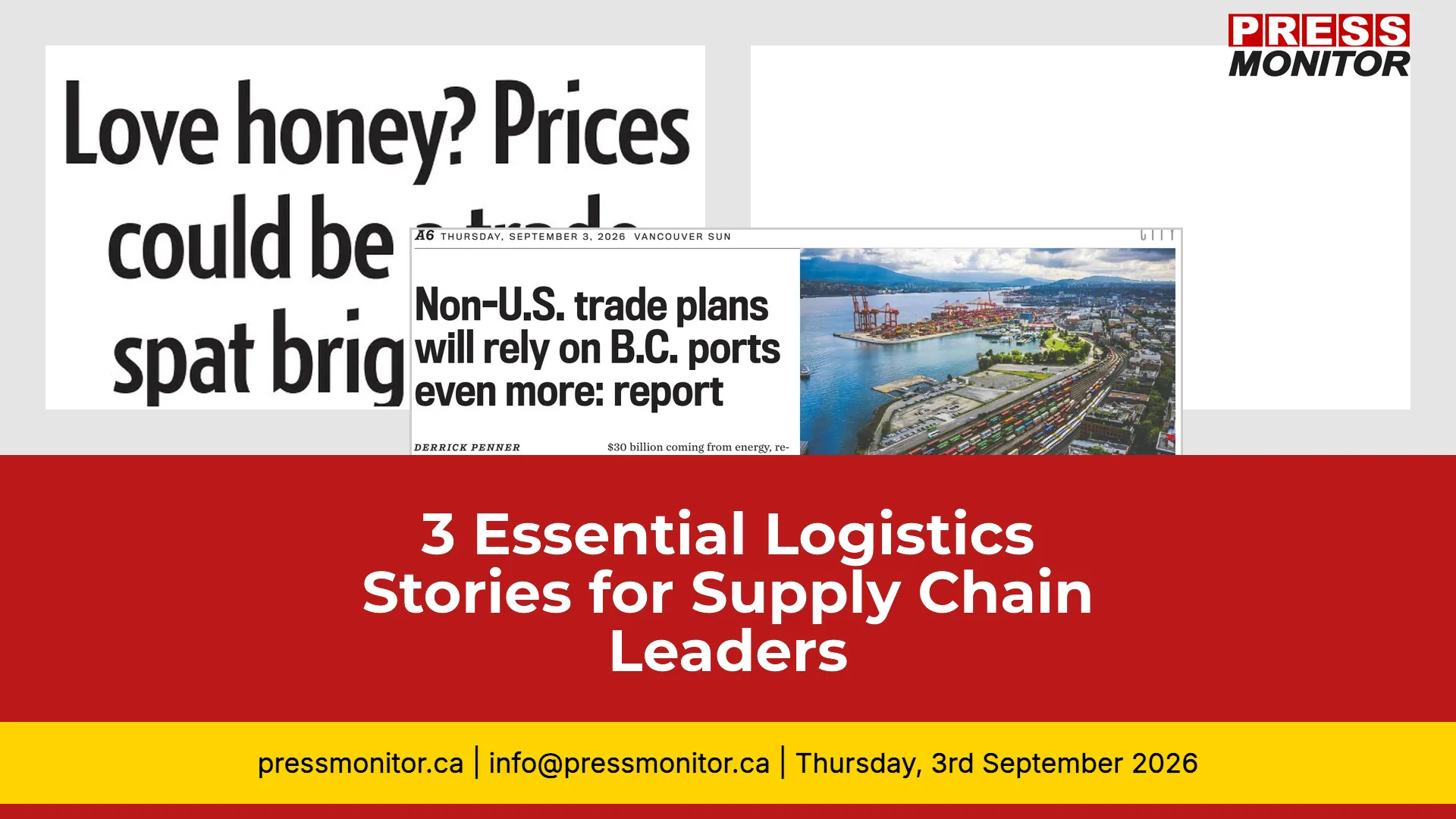
According to Press Monitor's tracking of Canadian publications, this media monitoring report highlights three essential developments shaping Canada's logistics and supply chain landscape today. From trade retaliation risks at the Welland Canal to honey tariffs reshaping agricultural exports, these stories offer actionable media intelligence for supply chain professionals navigating an increasingly complex trade environment. This news on logistics reflects the growing intersection of trade policy and freight operations across the country.
1. US Tariff on Canadian Honey Keeps Exports North
Vancouver Sun reports that a 50 per cent US tariff is keeping more Canadian honey north of the border, which could mean lower prices for consumers in the short term. Between January and April, 80.2 per cent of Canadian honey exports by quantity went to the United States, and producers such as Podolski Honey Farms in Ethelbert, Man. have lost as much as 90 per cent of their customers. Experts from the University of Guelph, the Manitoba Beekeepers' Association and Dalhousie University warn that a short crop this year may keep prices stable, but the loss of Canada's largest honey export market could hurt producers and the pollination sector over time.
Why it matters: The 50% US tariff on Canadian honey is fundamentally altering export patterns, with 80.2% of Canadian honey exports previously destined for the United States. Producers like Podolski Honey Farms in Ethelbert, Manitoba have lost up to 90% of their US customers, and experts warn the pollination sector could face long-term damage.
Key detail: Between January and April, 80.2% of Canadian honey exports by quantity went to the US, and 69.1% of the value did as well. Short-term consumer price drops may give way to longer-term agricultural disruption.
Source: Vancouver Sun, tracked by Press Monitor
Next step: Monitor whether the Canadian Honey Council's warnings about pollination impacts materialize in coming quarters.
2. Welland Canal Blockade Would Backfire, Experts Warn
The Standard (St. Catharines) reports that trade and supply chain experts are warning against blocking American ships from the Welland Canal in retaliation for tariffs imposed by United States President Donald Trump. Trade lawyer John Boscariol of McCarthy Tétrault says the move would be cutting off Canada's nose to spite its face, since the canal is overseen by both Canadian and American organizations and retaliation would likely follow. Supply chain expert Fraser Johnson of Western University's Ivey School of Business notes the canal handles roughly 3,000 ships a year carrying 40 million to 50 million tonnes of freight, and disruption would raise costs on both sides of the border.
Why it matters: Social media calls to block American ships from the Welland Canal as retaliation for US tariffs have been dismissed by trade and supply chain experts. The canal's eight locks in Ontario handle roughly 3,000 ships a year carrying 40 to 50 million tonnes of freight, and disruption would raise costs on both sides of the border.
Key detail: Trade lawyer John Boscariol of McCarthy Tétrault says the move would be cutting off Canada's nose to spite its face, since the canal is overseen by both Canadian and American organizations including the Great Lakes St. Lawrence Seaway Development Corp.
Source: The Standard (St. Catharines), tracked by Press Monitor
Next step: Watch for any policy proposals that could threaten this critical trade corridor.
3. PwC Study: Canada Could Boost Non-US Trade by C$146 Billion
The Vancouver Sun reports that a new PwC study says Canada could boost non-U.S. exports by C$146 billion by 2035 by focusing on energy, metals and minerals, and agriculture. Michael English, leader of PwC's transportation and logistics advisory practice, said strategic investments in ports, pipelines, rail and road infrastructure will be key, particularly through British Columbia ports such as Vancouver, Prince Rupert and Nanaimo. The report's release coincided with escalating trade tensions and new rounds of tariffs and counter-tariffs between Canada and the United States.
Why it matters: A new PwC study says Canada could increase non-US exports by C$146 billion by 2035 by focusing on energy, metals and minerals, and agriculture. Strategic investments in ports, pipelines, rail and road infrastructure will be key, particularly through British Columbia ports such as Vancouver, Prince Rupert and Nanaimo.
Key detail: The report's release coincided with escalating trade tensions and new rounds of tariffs and counter-tariffs between Canada and the United States, making diversification more urgent than ever.
Source: Vancouver Sun, tracked by Press Monitor
Next step: Track which infrastructure projects get prioritized as Canada pursues trade diversification.
Closing: As Canadian supply chains face tariff pressures from multiple directions, how will logistics operators adapt their freight strategies for the next quarter? Share your perspective in the comments.