3 Essential Mortgage and Property Finance Stories for Canadians


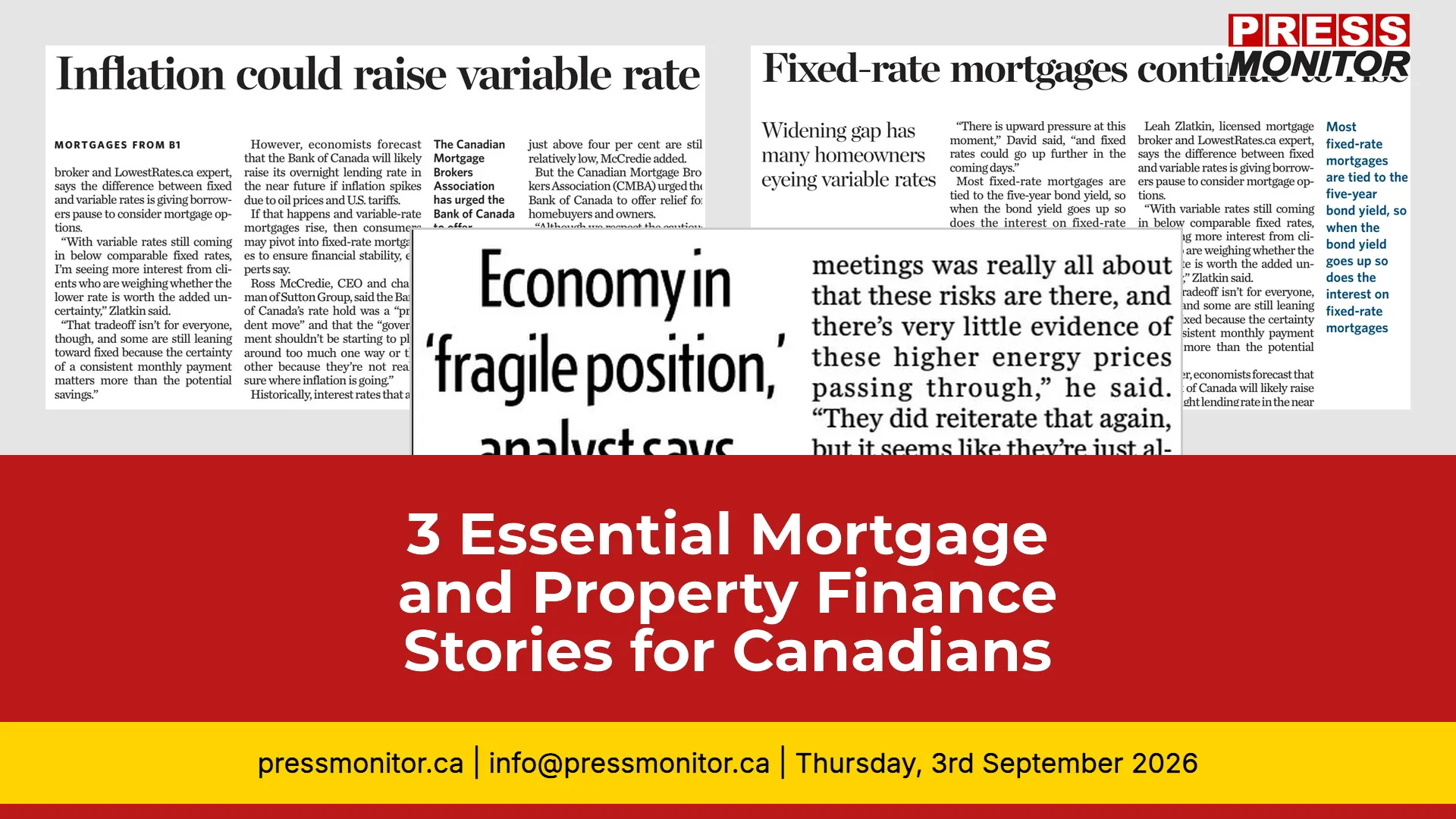
According to Press Monitor's tracking of Canadian publications, today's mortgage and property finance landscape is shaped by the Bank of Canada's steady hold on interest rates and the growing gap between fixed and variable mortgage options. This media monitoring report delivers the news on mortgages that matters most to Canadian homeowners, investors, and industry professionals.
1. Bank of Canada Holds Rate at 2.25% for Seventh Consecutive Time
Toronto Star reports that borrowers are weighing fixed versus variable mortgages after the Bank of Canada held its overnight lending rate, with economists forecasting a rate hike if inflation spikes due to oil prices and US tariffs. Sutton Group CEO Ross McCredie called the hold a prudent move, noting rates just above four per cent remain relatively low. The Canadian Mortgage Brokers Association, however, urged the central bank to offer interest-rate relief, saying the decision fails to ease financial pressures on homebuyers and owners. The Bank of Canada kept its key interest rate unchanged at 2.25 per cent, marking its seventh consecutive pause. While this provides predictability for borrowers, it does not offer immediate relief for households carrying near-record debt. Sutton Group CEO Ross McCredie called the hold a prudent move, while the Canadian Mortgage Brokers Association urged the central bank to offer interest-rate relief. According to Press Monitor's tracking of Canadian publications, this decision reflects deep uncertainty from trade tensions and the conflict in the Middle East.
2. Fixed and Variable Mortgage Rates Diverge Widely
The Welland Tribune reports that the gap between fixed-rate and variable-rate mortgages in Canada is widening, with the lowest five-year fixed rate around 4.09 per cent compared with about 3.3 per cent for a five-year variable. The Bank of Canada held its key overnight lending rate at 2.25 per cent on Wednesday, but rising bond yields amid elevated oil prices and the United States trade war are pushing fixed rates higher. Mortgage experts say many homeowners are weighing the savings of a variable rate against the certainty of fixed monthly payments. The gap between five-year fixed-rate and five-year variable-rate mortgages continues to widen, with the lowest fixed rate around 4.09 per cent compared with about 3.3 per cent for a variable. Rising bond yields amid elevated oil prices and the United States trade war are pushing fixed rates higher. Mortgage experts say many homeowners are weighing the savings of a variable rate against the certainty of fixed monthly payments. This media intelligence highlights a critical decision point for Canadian borrowers.
3. Strategist Surprised by Bank of Canada's Decision
Financial Post Magazine reports that Taylor Schleich, a strategist at National Bank of Canada, was surprised by the Bank of Canada’s decision. Oxford Economics expects the central bank to hold rates for the rest of 2O26 and most of 2O27, possibly going into 2O28 as well. Taylor Schleich, a strategist at National Bank of Canada, expressed surprise at the details in Governor Tiff Macklem's speech and the Bank of Canada's decision. Oxford Economics expects the central bank to hold rates for the rest of 2026 and most of 2027, possibly extending into 2028. print media monitoring from Press Monitor captures this market reaction as a signal of evolving expectations among Canadian financial professionals.
What will borrowers do as the fixed-variable gap grows? The latest news on mortgages suggests the answer depends on how long trade tensions and inflation risks persist.