3 Essential Shipping Stories for Industry Leaders


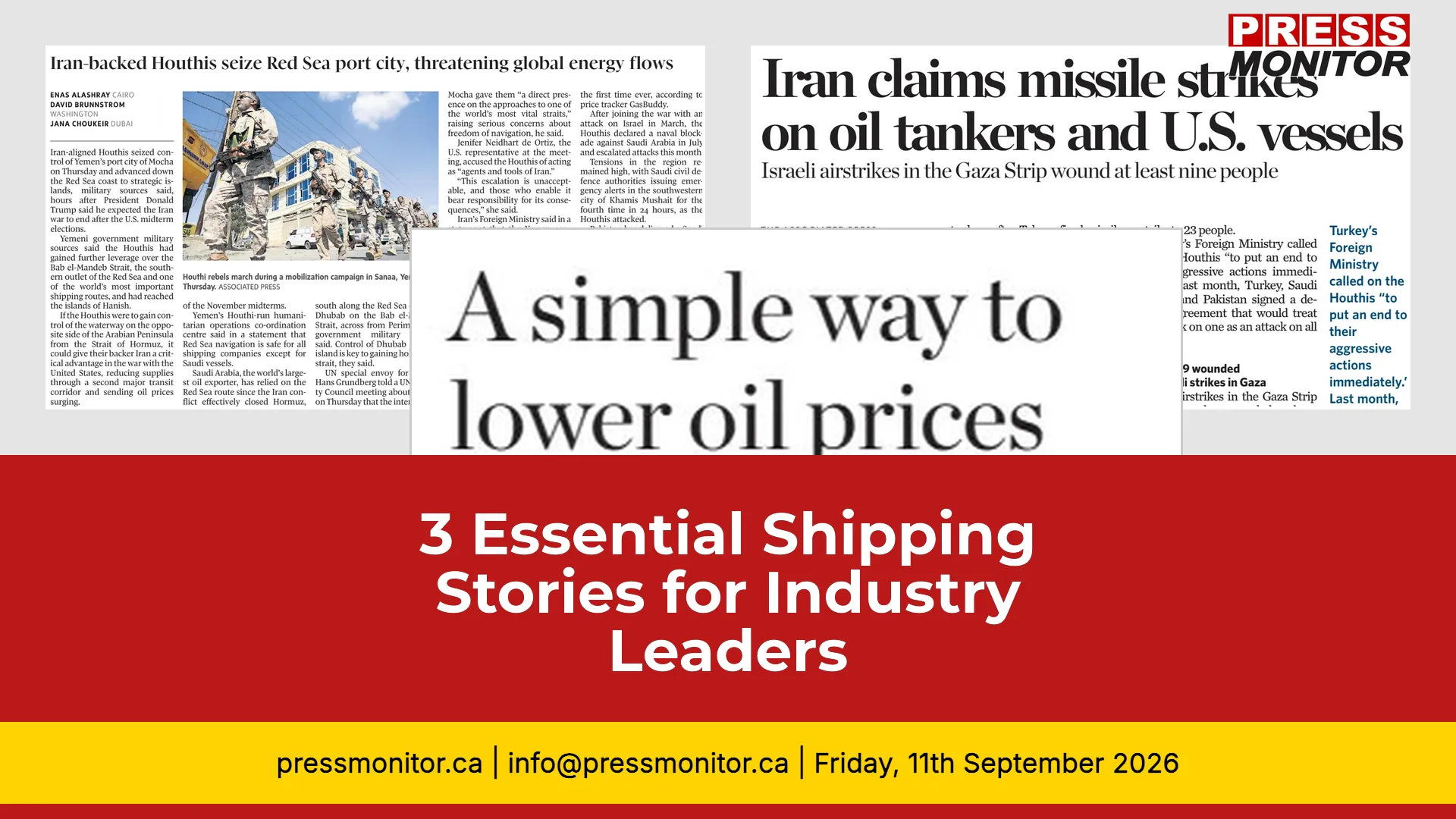
Media monitoring of Canadian print publications reveals escalating tensions across the Red Sea and global energy markets — the latest news on commercial shipping, according to Press Monitor's tracking. This press review draws on print media monitoring and media intelligence to highlight three stories reshaping maritime trade and energy security.
1. Houthis Seize Yemen's Mocha Port
The Globe And Mail (ottawa/quebec Edition) reports that Iran-aligned Houthis seized control of Yemen's port city of Mocha and advanced down the Red Sea coast to strategic islands, raising concerns about global energy flows and freedom of navigation. The advance came hours after President Donald Trump said he expected the Iran war to end after the US midterm elections, with Brent crude jumping 4 percent above US$105 a barrel. The Houthi takeover of Mocha represents a direct threat to Red Sea shipping lanes and global energy flows. The advance came hours after President Trump indicated the Iran war might end after US midterm elections, with Brent crude jumping 4 percent above US$105 a barrel. According to The Globe and Mail (ottawa/quebec Edition), reported by Enas Alashray, David Brunstrom, and Jana Choukeir, the seizure was cross-referenced with Toronto Star coverage. Monitor how the Houthi presence near the Bab el-Mandeb Strait affects commercial shipping routes and insurance costs.
2. Iran Strikes Oil Tankers, US Vessels
The Welland Tribune reports that Iran claimed to have struck eight oil tankers and two US vessels in retaliation for US strikes on Iranian tankers. US Central Command denied the claims, stating all attempted attacks failed. Meanwhile, Brent crude oil rose above 100 dollars per barrel amid the ongoing conflict. Iran's claimed strikes on oil tankers and US vessels escalate maritime conflict in a critical global chokepoint. Iran claimed to have struck eight oil tankers and two US vessels in retaliation for US strikes on Iranian tankers, though US Central Command denied all attempted attacks. Brent crude rose above $100 per barrel amid the ongoing conflict, as reported by The Welland Tribune via THE ASSOCIATED PRESS. Track whether US Central Command's denial holds as tensions persist in the Strait of Hormuz region.
3. Oil Surges Above $100 Per Barrel
Toronto Star reports that oil prices surged above 100 dollars a barrel as the United States and Iran launched new attacks on September 9. Gasoline prices also jumped, and prices will not start to come down until the Strait of Hormuz once again allows the free flow of shipping. The letter writer Jim Lang from Thornbury, Ontario suggests a simple bargain where the United States drops all Trump tariffs globally in return for cooperation on freeing up the strait. The oil price surge directly impacts shipping costs, freight rates, and global supply chain economics. Gasoline prices jumped as the United States and Iran launched new attacks on September 9. Prices will not ease until the Strait of Hormuz allows free flow of shipping again, reported by the Toronto Star. A letter from Jim Lang of Thornbury, Ontario suggests the United States drop all Trump tariffs globally in return for cooperation on freeing up the strait. Watch for policy responses that could stabilize energy markets and restore maritime trade flows.
As this media intelligence review shows, the convergence of geopolitical conflict and energy market disruption is reshaping commercial shipping in real time. Which development will have the most lasting impact on global trade?