5 Essential Financial Services Stories for Industry Leaders


According to Press Monitor's tracking of Canadian publications, this media monitoring press review delivers five essential stories shaping the financial services landscape today. From major bank divestitures to central bank policy shifts, these developments offer critical media intelligence for professionals tracking news on financial services across Canada and beyond.
1. BMO Financial Group Sells 138 U.S. Branches
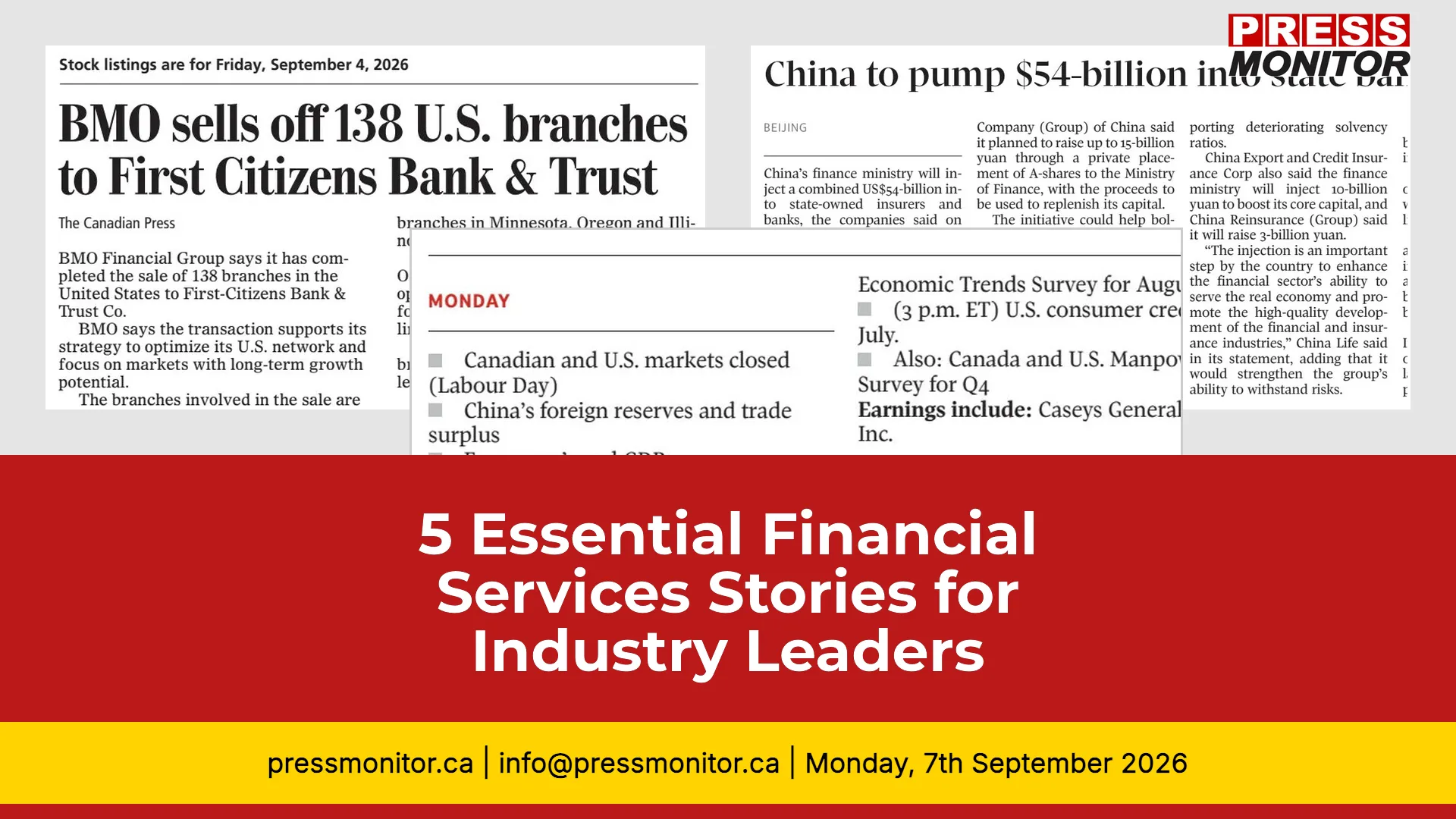
Times Colonist reports that BMO Financial Group has completed the sale of 138 branches in the United States to First Citizens Bank & Trust Co. The transaction supports BMO's strategy to optimize its U.S. network and focus on markets with long-term growth potential, with branches involved located across eight states plus select locations in Minnesota, Oregon, and Illinois. Under the deal terms, First Citizens Bank assumes about US$5.7 billion in deposits and purchases about US$1.1 billion in loans.
Why it matters: BMO Financial Group has completed the sale of 138 branches in the United States to First Citizens Bank & Trust Co., signaling a strategic reshaping of its cross-border retail footprint. This transaction affects banking competition and market positioning across eight states.
Key detail/stat: First Citizens Bank assumes approximately US$5.7 billion in deposits and purchases about US$1.1 billion in loans under the deal terms.
Source: Times Colonist, reported by The Canadian Press.
Next step: Monitor how BMO redeploys the proceeds and which markets it prioritizes for long-term growth.
2. China Injects $54 Billion into State Banks and Insurers
The Globe And Mail reports that China’s finance ministry will inject a combined US$54-billion into state-owned insurers and banks in a coordinated push to shore up capital across its financial system. China Life Insurance and China Taiping Insurance Group will receive large yuan allocations, while three state lenders announced combined injections of 290-billion yuan to replenish core Tier 1 capital and sustain credit expansion amid weak loan demand.
Why it matters: China's finance ministry is deploying a combined US$54 billion into state-owned insurers and banks in a coordinated push to shore up capital across its financial system. This intervention has global implications for capital flows and lending conditions.
Key detail/stat: Three state lenders announced combined injections of 290 billion yuan to replenish core Tier 1 capital, while China Life Insurance and China Taiping Insurance Group receive large yuan allocations.
Source: The Globe and Mail.
Next step: Track how this capital injection affects Chinese credit expansion and its ripple effects on Canadian financial institutions with Asian exposure.
3. Economic Calendar: China Trade Data and Earnings Season Ahead
The Globe And Mail reports that Canadian and United States markets closed for Labour Day, with a full economic calendar ahead. Tuesday features China's foreign reserves and trade surplus data, Euro zone real gross domestic product, and Germany's industrial production, alongside the National Federation of Independent Business survey and consumer credit releases. Wednesday includes Japan's machine tool orders, the United States ADP employment data, and a quarterly services survey for the second quarter, plus earnings from Caseys General Stores, D two L, Haivision Systems, North West Company, and Transcontinental.
Why it matters: With Canadian and U.S. markets closed for Labour Day, a packed economic calendar presents both risks and opportunities for financial services professionals who rely on timely data.
Key detail/stat: Tuesday features China's foreign reserves and trade surplus data, Euro zone real GDP, and Germany's industrial production, plus the NFIB survey and consumer credit releases. Wednesday includes Japan's machine tool orders, U.S. ADP employment data, a Q2 services survey, and earnings from Casey's General Stores, D two L, Haivision Systems, North West Company, and Transcontinental.
Source: The Globe and Mail.
Next step: Mark these dates on your calendar and prepare analytical responses to the data releases.
4. Canadian Dollar Trades at 1.3840 Against U.S. Dollar
Times Colonist reports that in Canada on Friday, Sept. 4, the Canadian dollar traded at 1.3840 Canadian dollars per U.S. dollar, up from 1.3789 the previous day. Bank of Canada data showed the U.S. dollar at 0.7225 Canadian dollars and listed closing levels for S&P/TSX sector indexes, including gains in consumer discretionary and staples and declines in energy and materials.
Why it matters: The Canadian dollar's movement against the U.S. dollar has direct implications for cross-border trade, investment returns, and the cost of servicing U.S.-denominated debt for Canadian financial institutions.
Key detail/stat: The loonie closed at 1.3840 Canadian dollars per U.S. dollar on September 4, up from 1.3789 the previous day. S&P/TSX sector indexes recorded gains in consumer discretionary and staples alongside declines in energy and materials.
Source: Times Colonist, Bank of Canada data.
Next step: Assess how the currency shift affects BMO's remaining U.S. operations and other Canadian banks' international portfolios.
5. $8,269 Monthly Budget Breakdown Highlights Canadian Financial Priorities
The Globe And Mail reports that Benjamin allocates approximately eight thousand two hundred seventy Canadian dollars per month toward personal and household expenses. His budget emphasizes maximizing Registered Retirement Savings Plan and First Home Savings Account contributions while paying down a four point three five percent line of credit. Key spending areas include thirteen hundred Canadian dollars for urban rent, nearly two thousand Canadian dollars covering vehicle and transit costs, and over three thousand Canadian dollars dedicated to lifestyle, wellness, and subscription services.
Why it matters: A detailed household budget snapshot reveals how Canadian consumers allocate their spending, providing valuable context for wealth management advisors and retail banking strategists.
Key detail/stat: Benjamin allocates approximately $8,269 per month, emphasizing RRSP and FHSA contributions while paying down a 4.35% line of credit. Spending includes $1,300 for urban rent, nearly $2,000 for vehicle and transit, and over $3,000 for lifestyle, wellness, and subscriptions.
Source: The Globe and Mail.
Next step: Use this data to inform product development and advisory services targeting Canadian consumers.
This print media monitoring roundup, drawn from Press Monitor's curated tracking of Canadian publications, delivers the media intelligence professionals need to stay ahead of news on financial services. Which of these five stories will have the biggest impact on your sector in the coming week?
