5 Essential Trade Stories for Business Leaders


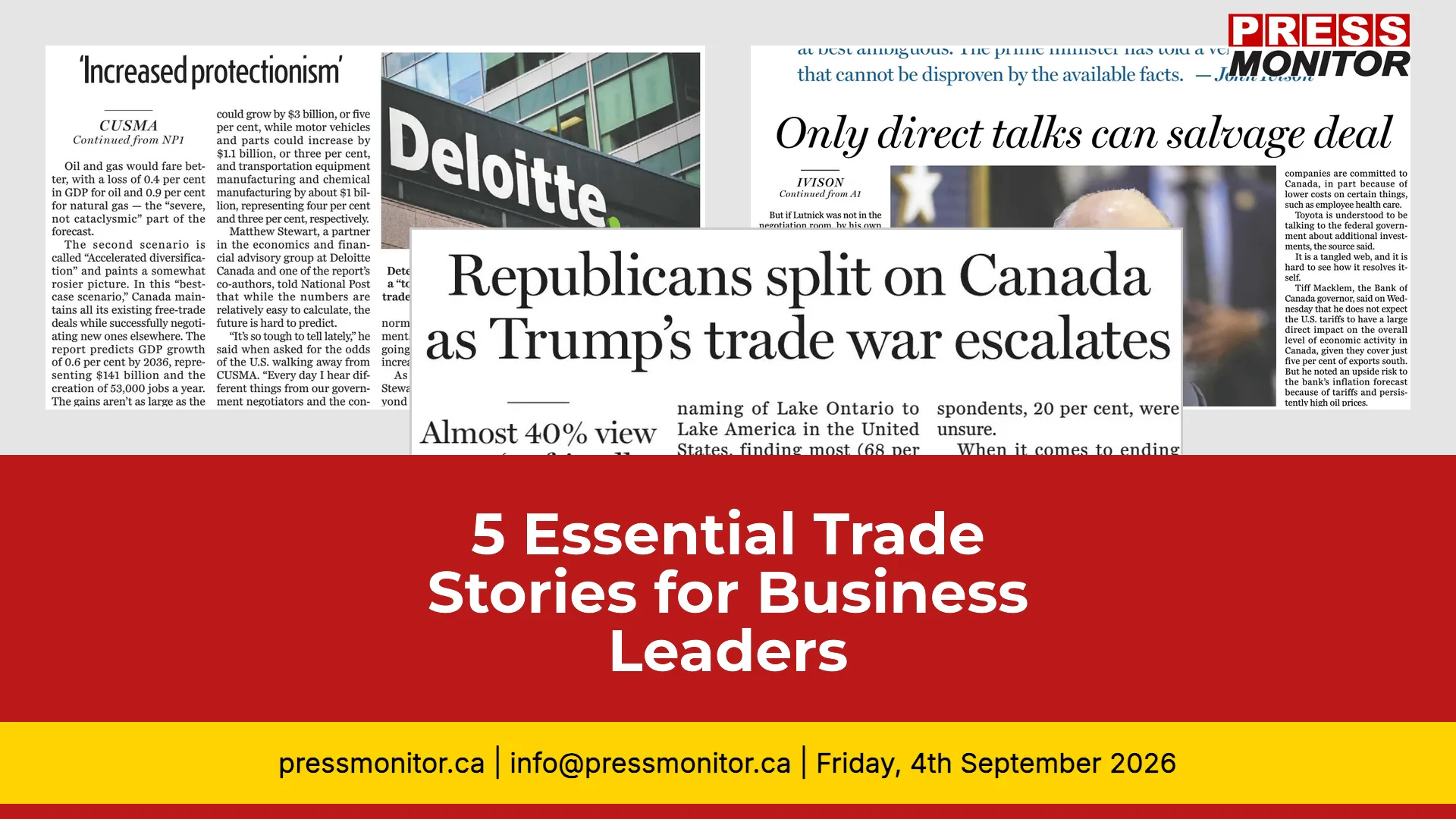
According to Press Monitor's tracking of Canadian publications, this media monitoring roundup covers today's most important news on trade: a fractured U.S. political stance on Canada, the collapse of bilateral negotiations, and a Deloitte Canada report mapping two stark economic futures.
1. CUSMA Withdrawal & GDP Scenarios
Edmonton Journal reports that a Deloitte Canada study finds Canada could lose O.4 per cent of GDP from oil and O.9 per cent from natural gas under a severe trade scenario, while an accelerated diversification scenario could yield O.6 per cent GDP growth by 2O36, representing C$141 billion and 53,000 new jobs annually. The report highlights agriculture, electronics manufacturing, and motor vehicles as key growth sectors, while noting that interprovincial trade barriers remain a substantial obstacle despite efforts to reduce them. Matthew Stewart, a Deloitte Canada partner and co-author, said the odds of a U.S. withdrawal from CUSMA are tough to predict, but increased tariffs and protectionism seem likely regardless of the administration.
Why it matters: The Deloitte Canada report Tariffs: A Rough Road Leads to New Destinations maps two scenarios for Canada's economy under potential U.S. withdrawal from CUSMA, offering critical media intelligence for trade-dependent businesses.
Key detail: GDP could fall 1.6% by 2036 ($402 billion lost) in the worst case, or grow 0.6% ($141 billion) under accelerated diversification. Manufacturing faces a 28% GDP drop; agriculture could see $4 billion in increased crop exports to non-US markets.
Source: Edmonton Journal, Calgary Herald, Montreal Gazette, National Post
Next step: Monitor which sectors your organization depends on for exposure to CUSMA disruption.
2. Trade Talks Collapse
The National Post reports that Canadian Prime Minister Mark Carney's government walked away from a proposed trade deal with the United States due to Ontario Premier Doug Ford's refusal to accept a 15 per cent auto tariff and reintroduce American alcohol. U.S. Commerce Secretary Howard Lutnick alleges the Canadians abandoned negotiations for political reasons tied to provincial elections in Quebec and an independence referendum in Alberta, though Carney's version of events emphasizes culture and sovereignty. Bank of Canada Governor Tiff Macklem expects limited direct economic impact from U.S. tariffs covering five per cent of exports, while Treasury Secretary Scott Bessent suggests direct talks between the leaders should wait until after the Alberta referendum in October.
Why it matters: Canada's chief negotiator Howard Lutnick revealed the U.S. Commerce Secretary was absent when talks broke down, and Prime Minister Mark Carney rejected Lutnick's political motivations claim — a breakdown with direct implications for cross-border supply chains.
Key detail: Canada imposed 15-50% retaliatory tariffs on $28 billion of U.S. goods; Doug Ford's refusal of a 15% auto tariff derailed the deal. Bank of Canada Governor Tiff Macklem expects limited direct economic impact from tariffs covering 5% of exports.
Source: National Post, Edmonton Journal, Montreal Gazette, Calgary Herald
Next step: Assess your supply chain exposure to U.S.-Canada tariff escalation.
3. Republicans Split on Canada
Edmonton Journal reports that Americans are becoming increasingly divided on their feelings about Canada and the freshly stoked trade war, according to polls released this week. YouGov polling for The Economist found 38 per cent of Republican voters now view Canada as unfriendly or an enemy, by far the highest level in the past decade and up from 22 per cent in February. Overall, a majority of Americans describe Canada as either an ally or friendly, but there are sharp partisan divides on trade treatment and Trump's renaming of Lake Ontario.
Why it matters: YouGov polling for The Economist shows 38% of Republican voters now view Canada as unfriendly or an enemy, up from 22% in February — a shift that could reshape U.S. trade policy.
Key detail: Sharp partisan divides on trade treatment and Trump's renaming of Lake Ontario signal deepening diplomatic friction. Overall, a majority of Americans describe Canada as either an ally or friendly.
Source: Edmonton Journal
Next step: Track U.S. political sentiment shifts that could affect trade policy and market access.
4. Retaliatory Tariffs Hit Alberta Firms
National Post reports that Alberta companies are preparing for Canadian counter-tariffs on U.S. goods set to begin Tuesday after trade talks collapsed. Satco Oil and Gas and RAM Elevators and Lifts face higher costs, with the ATB Financial economist warning of disproportionate impacts on small businesses and lower-income households. The Mark Carney government announced a $7.5-billion assistance package as exports worth $4.9 billion face exposure.
Why it matters: Alberta companies like Satco Oil and Gas and RAM Elevators and Lifts face higher costs as Canadian counter-tariffs on U.S. goods take effect, with small businesses bearing the heaviest burden.
Key detail: ATB Financial warns of disproportionate impacts on small businesses and lower-income households. The Mark Carney government announced a $7.5-billion assistance package as exports worth $4.9 billion face exposure.
Source: National Post
Next step: Evaluate your Alberta operations for tariff exposure and eligibility for government relief.
5. 50% Tariff Threat to Ontario Auto Industry
National Post - (latest Edition) reports that Ontario Premier Doug Ford's push to preserve auto assembly faces growing doubts as vehicle production has declined from over three million in 1999 to 1.2 million in 2025. The article argues that Canadian-owned auto parts companies, which employ 71,400 workers and contribute $11.3 billion to GDP, represent a more sustainable foundation than foreign-owned assembly plants. It suggests Canada should accept high auto tariffs in exchange for duty-free access for Canadian parts, rather than continuing to subsidize assembly operations that remain vulnerable to corporate decisions.
Why it matters: Ontario Premier Doug Ford's push to preserve auto assembly faces growing doubts as production has declined from 3 million vehicles in 1999 to 1.2 million in 2025, raising questions about the sustainability of assembly operations.
Key detail: Canadian-owned auto parts companies employ 71,400 workers and contribute $11.3 billion to GDP. The article argues Canada should accept high auto tariffs in exchange for duty-free access for Canadian parts.
Source: National Post
Next step: Consider whether your auto supply chain strategy should pivot toward parts manufacturing over assembly.
Closing: Which of these trade developments will most affect your organization's bottom line? This press review is powered by Press Monitor's print media monitoring of Canadian publications.