5 Essential Transportation & Logistics Stories for Industry Leaders


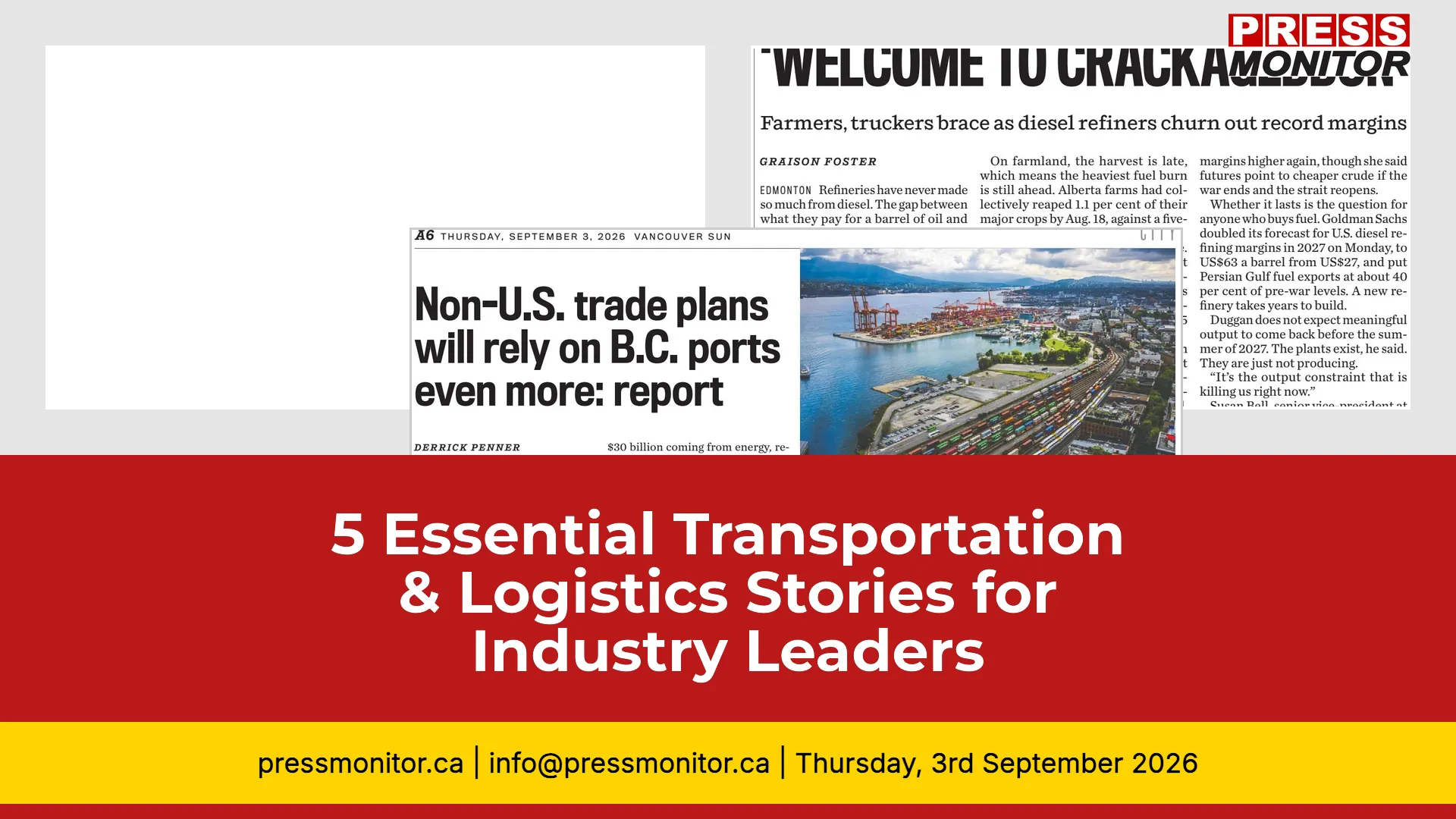
According to Press Monitor's tracking of Canadian publications, the transportation and logistics sector is shaping up as one of the most consequential stories of the week. From trade war flashpoints at the Welland Canal to record diesel margins and major infrastructure investments, here are the 5 essential news on transportation & logistics stories every industry leader needs to know — powered by our media monitoring and print media monitoring across Canada's full newspaper landscape.
1. Welland Canal Blockade Would Backfire
The Standard (St. Catharines) reports that trade and supply chain experts are warning against blocking American ships from the Welland Canal in retaliation for tariffs imposed by United States President Donald Trump. Trade lawyer John Boscariol of McCarthy Tétrault says the move would be cutting off Canada's nose to spite its face, since the canal is overseen by both Canadian and American organizations and retaliation would likely follow. Supply chain expert Fraser Johnson of Western University's Ivey School of Business notes the canal handles roughly 3,000 ships a year carrying 40 million to 50 million tonnes of freight, and disruption would raise costs on both sides of the border.
Why it matters: Experts warn that blocking American ships from the Welland Canal in retaliation for U.S. tariffs would disrupt tightly integrated supply chains and hurt Canadian businesses as much as American ones.
Key detail: The canal handles roughly 3,000 ships a year carrying 40 to 50 million tonnes of freight, and is overseen by both Canadian and American organizations including the Great Lakes St. Lawrence Seaway Development Corp.
Source: The Standard (St. Catharines), Toronto Star
Next step: Monitor government statements on retaliatory trade measures and assess your supply chain exposure to canal disruption.
What would you do if the canal were blocked — and who bears the real cost?
2. Canadian Diesel Margins Hit Record
Saskatoon Starphoenix reports that Canadian refineries are earning record margins on diesel, with the average refining margin topping 110 cents a litre and hitting an all-time high of 119.4 cents on Aug. 19, according to Kalibrate Canada. Economist Charles St-Arnaud of Servus Credit Union attributes the spike to knocked-out Russian refining capacity and refined fuel being unable to cross the Strait of Hormuz. With Canadian diesel averaging about C$2.30 a litre, roughly 55 per cent higher than a year ago, farmers and truckers are bracing for higher costs.
Why it matters: Record refining margins are translating directly into higher freight costs for farmers and truckers across every sector of the economy.
Key detail: The average refining margin topped 110 cents a litre and hit an all-time high of 119.4 cents on Aug. 19, with Canadian diesel averaging about C$2.30 a litre — roughly 55 per cent higher than a year ago.
Source: Saskatoon Starphoenix
Next step: Track whether provincial governments intervene on fuel costs and model the impact on your logistics budget.
How will your supply chain absorb another 55% year-over-year increase?
3. C$146 Billion Non-U.S. Trade Boost
The Vancouver Sun reports that a new PwC study says Canada could boost non-U.S. exports by C$146 billion by 2035 by focusing on energy, metals and minerals, and agriculture. Michael English, leader of PwC's transportation and logistics advisory practice, said strategic investments in ports, pipelines, rail and road infrastructure will be key, particularly through British Columbia ports such as Vancouver, Prince Rupert and Nanaimo. The report's release coincided with escalating trade tensions and new rounds of tariffs and counter-tariffs between Canada and the United States.
Why it matters: Diversification away from U.S. dependency is no longer theoretical — it is a C$146 billion opportunity backed by concrete infrastructure planning from PwC.
Key detail: The study says Canada could boost non-U.S. exports by C$146 billion by 2035 by focusing on energy, metals and minerals, and agriculture, with strategic investments in ports, pipelines, rail and road infrastructure.
Source: Vancouver Sun
Next step: Watch for federal budget allocations tied to trade corridor development and assess whether your organization is positioned to capture a share of this growth.
Is your business ready to pivot toward non-U.S. markets?
4. Province Tenders Major Contracts for Hwy. 413
The Ontario government is moving ahead with its Highway 413 project, announcing two major developments along the Brampton, Caledon and Vaughan corridor. Transportation Minister Prabmeet Sarkaria said the province is seeking proposals to design and build the eastern stretch of Highway 413, from west of The Gore Road to Highway 400, as well as an extension of Highway 427, from Major Mackenzie Drive north to Highway 413.
Why it matters: Major highway tenders signal long-term freight corridor investment in the Greater Toronto Area — the logistics backbone of Canadian commerce.
Key detail: Transportation Minister Prabmeet Sarkaria announced the province is seeking proposals to design and build the eastern stretch of Highway 413 and an extension of Highway 427 along the Brampton, Caledon, and Vaughan corridor.
Source: The Hamilton Spectator
Next step: Follow the RFP timeline and identify contractor and supplier opportunities tied to this infrastructure project.
How will this infrastructure reshape regional freight flows in the GTA?
5. Metrolinx Names Two SmartTrack Stations
Toronto Star reports that Metrolinx has unveiled the names of two future SmartTrack stations in Toronto's west end: Stockyards Station at St. Clair Avenue West and Old Weston Road, and Junction Triangle Station at Bloor Street West and Lansdowne Avenue. Stockyards Station, which will be served by UP Express, is slated to open by the end of 2031, while Junction Triangle Station on the Barrie Line is expected to be in service by 2027. They are among only three remaining stations of former mayor John Tory's SmartTrack plan, whose cost has climbed past the approved C$17 billion budget cap.
Why it matters: Transit infrastructure directly affects logistics workforce mobility and urban freight planning in Canada's largest metropolitan area.
Key detail: Metrolinx unveiled Stockyards Station (opening by end of 2031, served by UP Express) and Junction Triangle Station (by 2027, on the Barrie Line), among only three remaining stations of former mayor John Tory's SmartTrack plan, whose cost has climbed past the approved C$17 billion budget cap.
Source: Toronto Star
Next step: Monitor construction timelines and their impact on last-mile delivery routes and workforce commuting patterns.
Will these stations deliver on their promise, or will costs continue to climb?
Closing: These five stories illustrate the interconnected forces shaping Canadian transportation and logistics — from trade policy to fuel costs to infrastructure investment. Stay informed with Press Monitor's print media monitoring, delivering curated news on transportation & logistics from coast to coast. What story is most urgent for your organization right now?