5 Pivotal Currency & Trade Stories for CFOs


In today’s volatile global markets, staying ahead requires precise media monitoring. This press review distills the latest news on foreign exchange & currencies into five actionable insights. Here is what corporate leaders and treasury teams need to know right now.
1. Bombardier Faces US Market Ban Threats
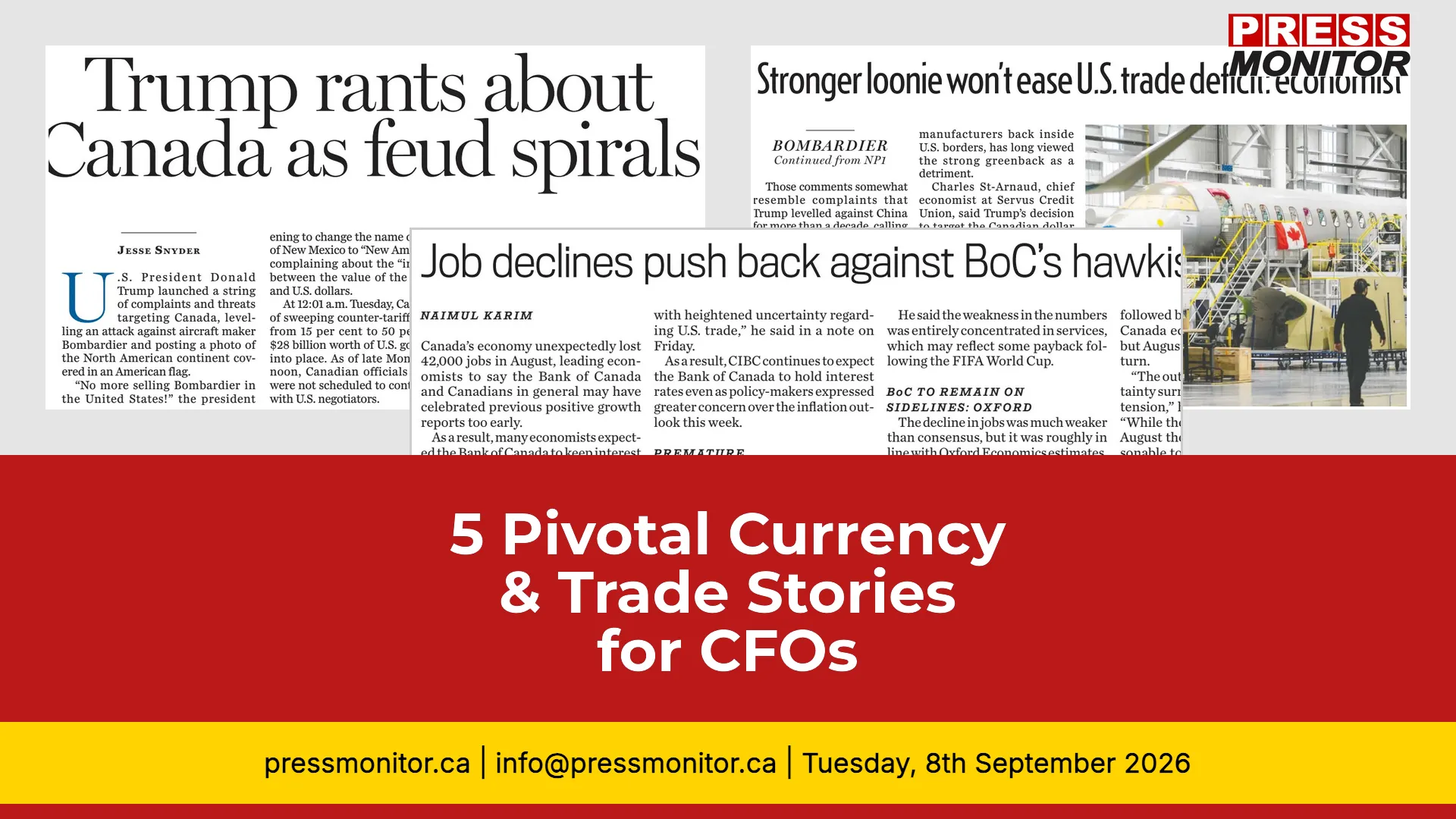
Montreal Gazette reports that United States President Donald Trump launched a series of social media attacks targeting Canada and aircraft manufacturer Bombardier ahead of a midnight trade deadline. Canadian officials implemented sweeping counter-tariffs ranging from fifteen percent to fifty percent on twenty-eight billion Canadian dollars worth of American goods just before Tuesday morning. Experts question whether the White House has the authority to ban Bombardier jet sales directly, noting that aviation certification falls under the Federal Aviation Administration.
Why it matters: Direct threats to aerospace exports signal escalating trade friction that could disrupt supply chains and revenue forecasts.
Key detail: President Trump threatened to block Bombardier jet sales while counter-tariffs ranging from 15% to 50% on $28 billion in U.S. goods took effect. Experts note aviation certification falls under the FAA, complicating direct bans.
Source: Montreal Gazette
Next step: Review export compliance protocols and stress-test Q4 revenue models against potential tariff escalations.
2. Trump Targets Loonie Over U.S. Trade Deficit
Montreal Gazette reports that U.S. President Trump has targeted the Canadian dollar, or loonie, as part of efforts to address the U.S. trade deficit with Canada. Trump's bellicose trade policy has sought to expand export capacity by attracting manufacturers back inside U.S. borders, and he views the strong U.S. dollar as a detriment to American exporters. The Canadian dollar was valued at seventy-two cents per American dollar on Monday, and was last valued higher than the U.S. dollar in two thousand eleven, when high oil prices had rapidly inflated the value of the Canadian dollar.
Why it matters: Political targeting of the Canadian dollar introduces currency volatility risk for importers and exporters alike.
Key detail: The loonie traded at roughly 0.72 USD. Economists argue a stronger Canadian dollar won’t significantly shrink the U.S. trade deficit, which is heavily driven by American oil imports.
Source: Montreal Gazette
Next step: Hedge foreign exchange exposure and monitor Federal Reserve commentary for policy shifts.
3. Canada Loses 42,000 Jobs in August
Regina Leader-post reports that Canada's economy unexpectedly lost 42,000 jobs in August, leading economists to say the Bank of Canada and Canadians in general may have celebrated previous positive growth reports too early. As a result, many economists expected the Bank of Canada to keep interest rates at 2.25 per cent, which it did this week for the seventh time in a row. The decline pushes back against the idea that the economy has decisively turned a corner amid heightened uncertainty regarding US trade and the Iran conflict.
Why it matters: Labor market cooling directly impacts consumer spending power and domestic demand forecasting.
Key detail: Unexpected job losses push back against earlier growth narratives. The Bank of Canada is expected to hold interest rates steady at 2.25%, marking its seventh consecutive pause.
Source: Regina Leader-post
Next step: Adjust workforce planning and liquidity reserves to account for slower domestic consumption.
4. Canada Retaliatory Tariffs Take Effect
Winnipeg Sun reports that Prime Minister Mark Carney's retaliatory tariffs on U.S. goods take effect Tuesday at 12:01 a.m., responding to Washington's 50 percent tariff on C$27.6 billion worth of Canadian exports. The countermeasures target steel, aluminum, dairy, appliances, agricultural equipment, pulp and paper, plastics, and electronics, raising costs for Canadian consumers. The article also covers President Donald Trump's posts on Truth Social about the Canadian dollar and his order renaming Lake Ontario to Lake America.
Why it matters: New levies on steel, dairy, appliances, and electronics raise operational costs for Canadian businesses reliant on U.S. inputs.
Key detail: Prime Minister Mark Carney’s countermeasures target $27.6 billion in U.S. imports, effective Tuesday at 12:01 a.m., amid broader geopolitical tensions.
Source: Winnipeg Sun
Next step: Audit procurement contracts and explore alternative sourcing strategies for affected categories.
5. Yen Hits Seven-Month High Against Dollar
The Globe And Mail reports that the Japanese yen strengthened to approximately one hundred fifty-four yen against the United States dollar, marking a seven-month high fueled by anticipated Bank of Japan rate hikes and surging capital repatriation. Traders observe that unwinding carry trades, shifting pension fund investments, and speculative buying around key technical levels have accelerated the rally. Analysts warn that long-term strength remains unconfirmed as investors weigh official intervention risks and the central bank's future policy path.
Why it matters: Global currency realignments affect multinational hedging strategies and cross-border investment flows.
Key detail: The yen strengthened to approximately 154 JPY/USD, driven by anticipated Bank of Japan rate hikes and capital repatriation. Traders are unwinding carry trades while watching for official intervention.
Source: The Globe And Mail
Next step: Rebalance international portfolio allocations and monitor BOJ policy statements closely.
These developments underscore why proactive print media monitoring remains essential for navigating currency and trade headwinds. Which of these shifts will impact your sector first? Share your analysis below.