5 Pivotal Stock Market Stories for Investors


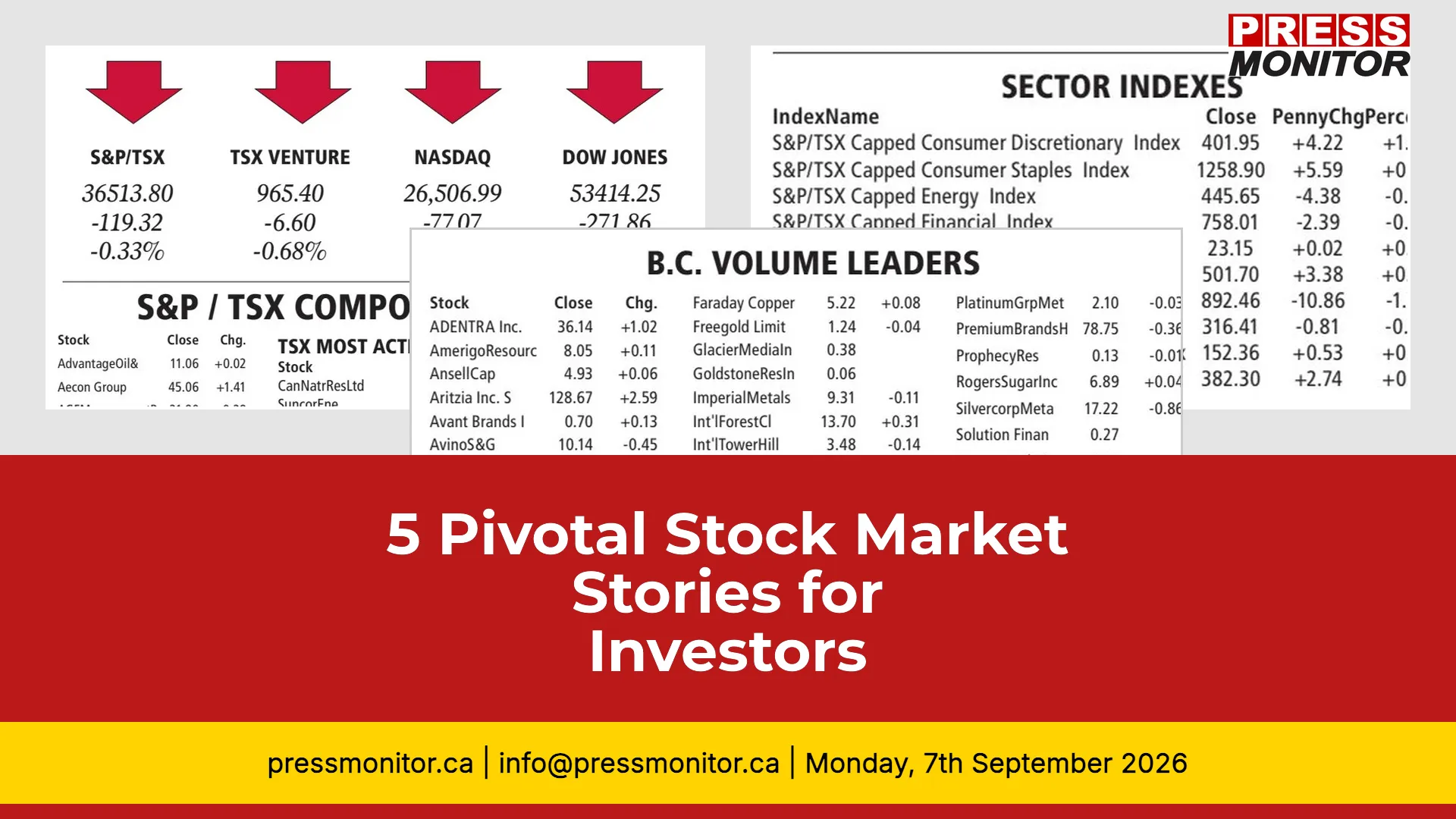
Stock Market News demands sharp eyes and reliable data today. According to Press Monitor's tracking of Canadian publications, this press review distills the most critical movements shaping equity markets right now. By leveraging advanced media intelligence, investors can separate signal from noise when scanning news on stock markets. Whether you are rebalancing a portfolio or watching macroeconomic shifts, these five developments demand immediate attention.
1. TSX Closes Down 0.33 Percent Daily
Times Colonist reports that the S&P TSX Composite Index closed at 36,513.80, down 119.32 points or 0.33 percent. The S&P TSX Venture Exchange declined 6.60 points to 965.40, while the NASDAQ dropped 77.07 points to 26,506.99.
Why it matters: Broad index weakness signals shifting sentiment ahead of key central bank decisions.
Key detail/stat: The S&P TSX Composite Index settled at 36,513.80, dropping 119.32 points, while the NASDAQ also retreated by 77.07 points.
Source: Times Colonist
Next step: Monitor sector rotation patterns to identify defensive plays before the week ends.
2. S&P TSX Sector Indexes Close Mixed
Times Colonist reports that Canada's S&P/TSX sector indexes closed mixed on July 18, 2026. The S&P/TSX Capped Energy Index fell 0.97%, while the S&P/TSX Capped Materials Index rose 1.20% and the S&P/TSX Capped Utilities Index gained 0.72%; other major sectors moved only slightly.
Why it matters: Divergent sector performance highlights where capital is flowing amid economic uncertainty.
Key detail/stat: Materials gained 1.20% and Utilities rose 0.72%, contrasting sharply with Energy's 0.97% decline.
Source: Times Colonist
Next step: Reallocate exposure toward outperforming sectors while hedging against commodity price swings.
3. Canadian Stocks Surge Across Sectors, With Mining and Energy Gaining Momentum
The Times Colonist reports that Canadian volume leaders across multiple sectors posted mixed price changes on July 18, 2026, reflecting broad market activity and shifting investor sentiment. Mining stocks like Faraday Copper and Ivanhoe Mines, alongside energy firms such as Meren Energy and Methanex Corporation, showed notable volatility, while regional developers and consumer brands also registered gains or losses.
Why it matters: Volatility in resource stocks reflects global supply chain adjustments and shifting investor appetite.
Key detail/stat: Faraday Copper, Ivanhoe Mines, Meren Energy, and Methanex Corporation posted notable price action alongside broader regional developers.
Source: Times Colonist
Next step: Track quarterly production reports from mining leaders to gauge long-term commodity trends.
4. Federal Reserve Meeting Impacts NYSE Stocks
The Globe And Mail reports that traders on the New York Stock Exchange floor are closely watching market movements this week. Investors are focused on the upcoming United States Federal Reserve meetings scheduled from September 15 to 16, where interest rate hikes are expected. These anticipated policy changes have kept market speculation active over recent weeks.
Why it matters: Anticipated U.S. monetary policy shifts directly influence cross-border capital flows and Canadian export valuations.
Key detail/stat: Traders are positioning ahead of the September 15–16 Federal Reserve meetings, where interest rate hikes are widely expected.
Source: The Globe And Mail
Next step: Prepare portfolio hedges against potential yield curve steepening over the next fortnight.
5. Hot Potato Portfolio Hits 13.6 Percent Annual Growth
The Globe And Mail reports that the Canadian stock market surged 29.9 per cent over the twelve months to the end of August, benefiting the momentum-based Hot Potato portfolio which gained a long-term average annual growth rate of 13.6 per cent. The aggressive strategy invests all money in the single best-performing asset class over the prior twelve months, while the conservative Passive Potato portfolio averaged 8.1 per cent annually over the same period.
Why it matters: Momentum-based strategies continue to outpace conservative allocations during extended bull runs.
Key detail/stat: The aggressive Hot Potato portfolio averaged 13.6% annual growth over twelve months, compared to 8.1% for the Passive Potato approach.
Source: The Globe And Mail
Next step: Evaluate risk tolerance thresholds before deploying concentrated asset-class bets.
These developments underscore why systematic media monitoring remains essential for institutional-grade decision-making. How are you adjusting your allocation strategy this quarter? Share your thesis below.