6 Pivotal Foreign Exchange & Currency Stories for Investors


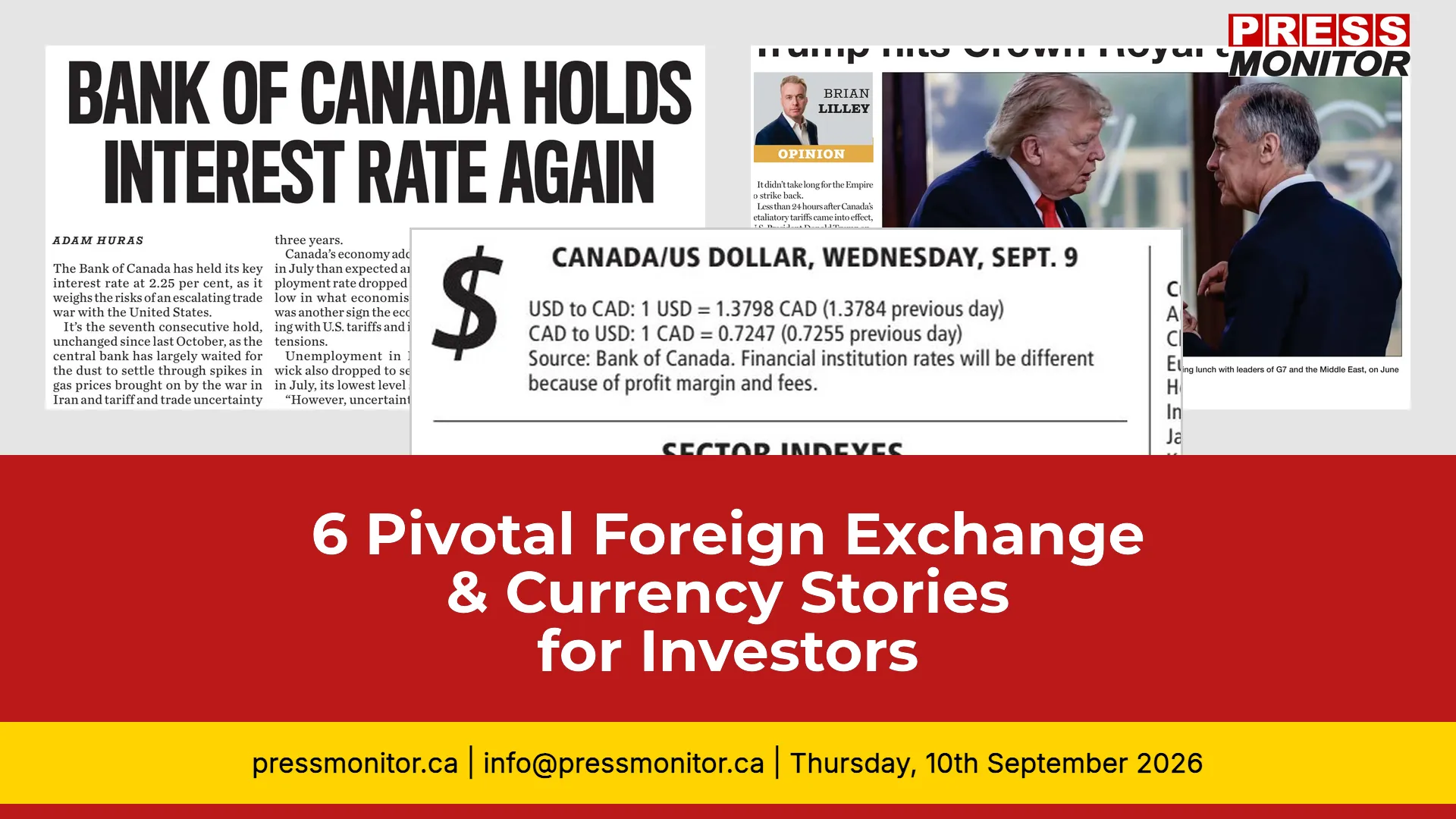
Navigating today's financial landscape requires sharp media monitoring to separate signal from noise. This press review highlights six critical developments shaping foreign exchange markets, central bank policy, and cross-border trade dynamics. According to Press Monitor's tracking of Canadian publications, here is what executives and traders need to know right now.
1. Bank of Canada Holds Interest Rate
The Tribune (New Brunswick) reports that the Bank of Canada has maintained its key interest rate at 2.25 per cent for a seventh consecutive meeting amid rising trade tensions with the United States and ongoing geopolitical uncertainties. Domestic economic data shows unexpected resilience with gross domestic product expanding at an annualized 3.3 per cent while unemployment drops to a two year low despite inflation risks. Governor Tiff Macklem notes monetary policy will stay flexible to navigate shifting global scenarios.
Why it matters: Monetary policy shifts directly influence currency valuation and capital flows across North America.
Key detail: Governor Tiff Macklem maintains the key rate at 2.25 percent for a seventh straight meeting, citing unexpected GDP growth of 3.3 percent and a two-year low unemployment rate despite rising U.S. trade tensions.
Source: The Tribune (New Brunswick)
Next step: Watch for Q3 inflation prints to gauge whether the BoC pivots toward easing before year-end.
2. Trump Slaps 50% Tariffs On Canadian Goods
Winnipeg Sun reports that less than 24 hours after Canada's retaliatory tariffs came into effect, U.S. President Donald Trump announced a new round of tariffs, contract exclusions, and a booze ban in response. Executive orders signed on Tuesday target Canadian products, including a ban on spirits like Canadian whisky that accounts for roughly one billion Canadian dollars of the 1.5 billion CAD in alcohol sold to the United States annually. Thousands of direct jobs in distilling are now under threat, with Crown Royal, Black Velvet, and Canadian Club among the hardest hit brands.
Why it matters: Escalating trade barriers trigger immediate hedging strategies and supply chain recalibrations for exporters.
Key detail: President Donald Trump announced new tariffs and a spirits ban targeting roughly one billion CAD in annual alcohol sales, directly threatening jobs at Crown Royal, Black Velvet, and Canadian Club.
Source: Winnipeg Sun
Next step: Monitor customs clearance delays and evaluate duty-free exemption requests for affected distilleries.
3. CAD Gains 0.1% on Sept 9
Times Colonist reports that the Canadian dollar strengthened against the U.S. dollar, rising to 1.3798 Canadian dollars per U.S. dollar on September 9, 2026. The TSX sector indexes also moved, with the Energy Index up 0.89% and the Financial Index up 0.49%.
Why it matters: Daily currency fluctuations signal investor sentiment ahead of major macroeconomic releases.
Key detail: The loonie strengthened to 1.3798 against the greenback, while TSX Energy and Financial indexes posted gains of 0.89 percent and 0.49 percent respectively.
Source: Times Colonist
Next step: Track intraday volume spikes to identify institutional positioning ahead of Friday's employment data.
4. Canadian Dollar Foreign Currency Rates Published
Times Colonist reports that a comprehensive list of foreign exchange rates against the Canadian dollar has been published in Canada, featuring conversion data for major global currencies including the United States dollar, British pound, Japanese yen, and Chinese yuan. The financial update provides essential reference figures for international trade and personal investment on July 18, 2026.
Why it matters: Transparent FX benchmarks are essential for corporate treasury management and international invoicing.
Key detail: Updated conversion figures now cover major global pairs including USD, GBP, JPY, and CNY, providing precise reference points for cross-border settlements.
Source: Times Colonist
Next step: Integrate these published rates into automated AP/AR systems to reduce manual reconciliation errors.
5. US Tariffs Stunt Quebec Brewer
Le Journal de Quebec reports that US tariff measures under President Trump have forced Quebec distiller Esprits Créatifs, led by Nicolas Duvernois, to postpone its expansion into the United States for a third time over the next six years. The company has invested over C$20 million in market research and distributor meetings, and faces losses of about 25 percent in revenue from its Sober Carpenter brand in North America.
Why it matters: Sector-specific tariff exposure forces small manufacturers to delay capital expenditure and reassess export pipelines.
Key detail: Esprits Créatifs CEO Nicolas Duvernois postponed U.S. market expansion for a third time, absorbing over 20 million CAD in research costs while facing a projected 25 percent revenue dip on the Sober Carpenter brand.
Source: Le Journal de Quebec
Next step: Engage trade compliance advisors to explore alternative distribution channels outside traditional border crossings.
6. TSX Falls on Tech Losses
Times Colonist reports that Canada's main stock index fell 216.49 points on Wednesday, weighed down by losses in the technology sector. In New York, the Dow Jones industrial average dropped 405.41 points, the S&P 500 fell 37.16 points, and the Nasdaq composite declined 168.07 points. The Canadian dollar traded at 72.47 cents US, crude oil rose US$3.02 to US$96.05 per barrel, and gold gained US$21.70 to US$4,460.70 an ounce.
Why it matters: Equity volatility often precedes currency corrections as risk appetite shifts across asset classes.
Key detail: The benchmark index dropped 216.49 points alongside Wall Street declines, while crude oil climbed to 96.05 USD per barrel and gold reached 4,460.70 USD per ounce.
Source: Times Colonist
Next step: Rebalance portfolio hedges using commodity-linked currency forwards to offset tech sector drawdowns.
Stay ahead of market-moving headlines with consistent print media monitoring and advanced media intelligence. For daily news on foreign exchange & currencies, trust editorial-vetted sources over algorithmic feeds. Which of these developments will have the strongest impact on your treasury strategy this quarter? Share your analysis below and tag your finance team.