7 Critical Logistics and Supply Chain Stories for Executives


Navigating today's volatile freight landscape requires precise print media monitoring to separate signal from noise. This press review distills seven pivotal developments shaping global logistics, freight routing, and supply chain resilience. According to Press Monitor's tracking of Canadian publications, here is your essential briefing on news on Logistics, Freight & Supply Chain.
1. Alberta Separation Would Add Supply Chain Friction
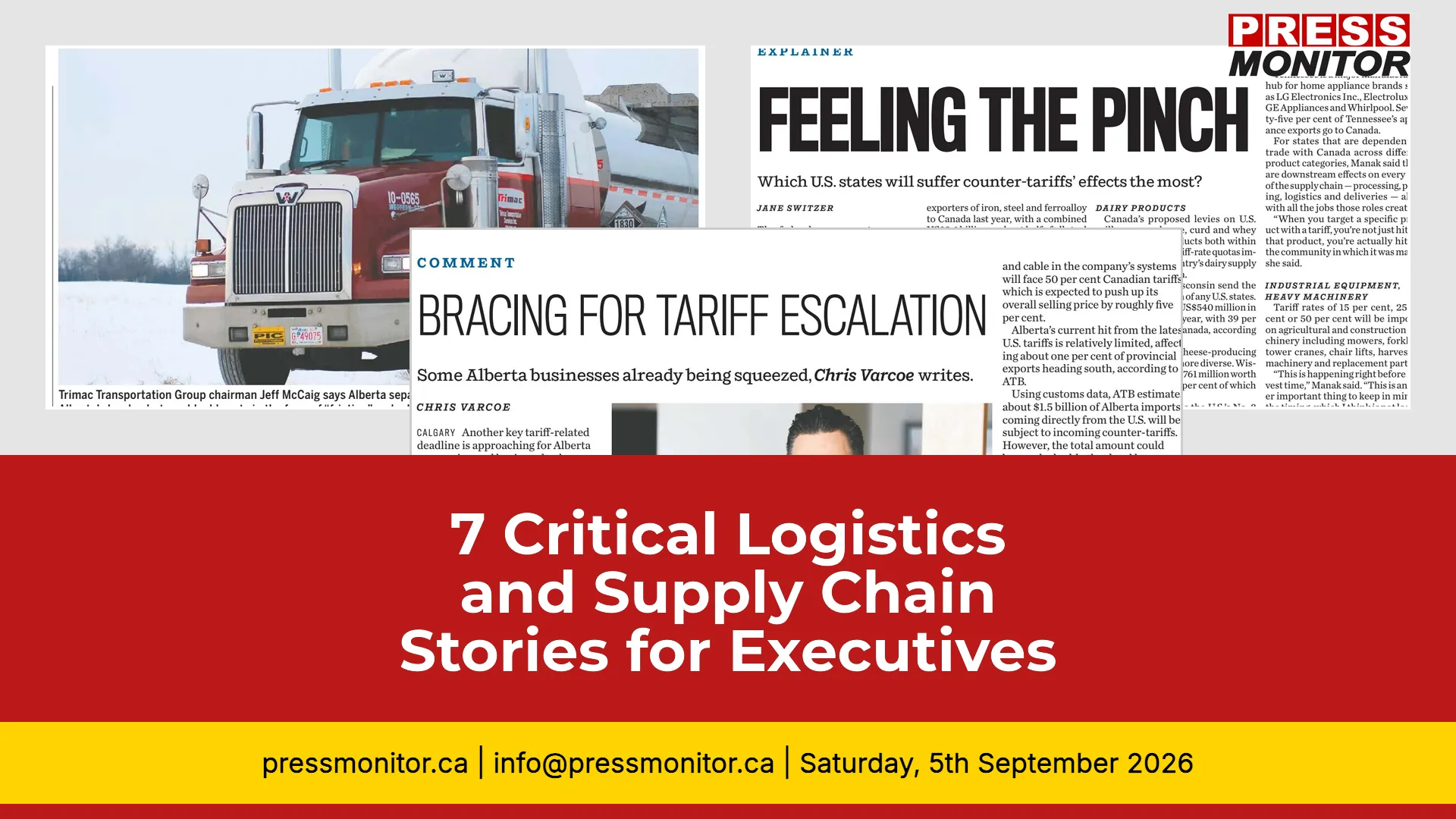
Edmonton Journal reports that Trimac Transportation Group chairman Jeff McCaig says Alberta's separation from Canada would create costly supply chain friction through duplicated regulations and added transaction costs, similar to Brexit. The Canada West Foundation report released Aug. 27 examines the economic implications of separation for industries like trucking and aviation. McCaig warned that while freight would continue crossing borders, businesses would face new layers of documentation and regulatory requirements.
Why it matters: Political fragmentation directly impacts cross-border trucking routes and aviation logistics.
Key detail: Trimac Transportation Group chairman Jeff McCaig warns that Alberta's potential separation would duplicate regulations and spike transaction costs, mirroring post-Brexit friction.
Source: Edmonton Journal
Next step: Audit route dependencies and stress-test contingency plans for western corridor disruptions.
2. Canada's Counter-Tariffs Hit US States
Saskatoon Starphoenix reports that Canada's new counter-tariffs on U.S. goods are primarily designed to protect Canadian companies' domestic market share, but with November's U.S. midterm elections looming, the levies will have economic and political effects south of the border, particularly in battleground states such as Michigan, Ohio and Iowa. The federal government says the C$27.6 billion in counter-tariffs set to take effect in less than a week will target industries including steel, aluminum, motor vehicles, dairy products, appliances and industrial equipment.
Why it matters: Retaliatory trade measures reshape North American manufacturing and freight flows.
Key detail: The federal government's C$27.6 billion counter-tariff package targets steel, aluminum, motor vehicles, dairy, and industrial equipment, heavily impacting Michigan, Ohio, and Iowa ahead of midterm elections.
Source: Saskatoon Starphoenix
Next step: Review customs classifications and adjust inventory positioning to mitigate border delays.
3. C$1.5 Billion Alberta Imports Face Counter-Tariffs
Saskatoon Starphoenix reports that Canadian counter-tariffs are expected to kick in on Tuesday unless a Canada-United States trade deal is reached soon. The Mark Carney government announced retaliatory tariffs on more than 600 items, including steel, agriculture, and electronics, in response to US tariffs on over $27 billion of Canadian products. Alberta businesses, including Saturn Oil & Gas and RAM Elevators and Lifts, are bracing for increased costs, with ATB Financial estimating C$1.5 billion in Alberta imports subject to the new tariffs.
Why it matters: Provincial import exposure highlights localized economic vulnerability in retaliatory trade wars.
Key detail: ATB Financial estimates C$1.5 billion in Alberta imports subject to new levies, with companies like Saturn Oil & Gas and RAM Elevators bracing for increased operational costs.
Source: Saskatoon Starphoenix
Next step: Conduct supplier risk assessments and negotiate tariff-sharing clauses with key vendors.
4. Food Prices Hit 3-Year High
{source_name} reports that global food prices reached their highest level since late 2022 in August, driven by extreme weather, drought, and disruptions in the Black Sea region. The United Nations Food and Agriculture Organization said its Food Price Index averaged 133.3 points, with rising costs across cereals, vegetable oils, sugar, meat, and dairy as supply risks grow. The agency also cut its 2026 global cereal production forecast by 3.4 million tonnes to 2.98 billion tonnes, marking the largest annual decline since 2018.
Why it matters: Agricultural commodity volatility drives cold chain demand and warehouse utilization spikes.
Key detail: The UN FAO reports its Food Price Index averaged 133.3 points in August, driven by Black Sea disruptions and extreme weather, while cutting the 2026 global cereal forecast by 3.4 million tonnes.
Source: The Globe And Mail
Next step: Lock in forward contracts for perishable freight and secure additional refrigerated storage capacity.
5. Free Trade Economics Lost in Tariff Fog
The Chronicle Herald reports that economic analyses have been lost in a dense fog of incoherent tariff war theories following US President Donald Trump's nationalist trade actions. Terence Corcoran argues that the automobile industry exemplifies the collapse of free trade theory, as government intervention attempts to shore up a declining sector that contributes less than one per cent of Canada's gross domestic product.
Why it matters: Policy uncertainty complicates long-term capital allocation for logistics real estate and fleet expansion.
Key detail: Economist Terence Corcoran argues that nationalist trade actions have fractured free trade theory, particularly within the automotive sector, which now contributes less than one percent of Canada's GDP amid heavy intervention.
Source: The Chronicle Herald
Next step: Diversify sourcing strategies and reduce reliance on single-market dependency models.
6. Canadian brands lack supply chain transparency
Financial Post Magazine reports that Canadian brands lack supply chain transparency despite worker protections woven into Dindigul-style agreements. Of the 25 Canadian clothing brands reviewed by the IJB, only 10 publicly disclose the factories from which they source garments as no laws in Canada require them to do so. Worker-led initiatives in Dindigul have made significant improvements in gender-based violence and harassment but protections for factory workers are missing engagement from brands.
Why it matters: Opaque procurement networks increase compliance risks and reputational exposure for retailers.
Key detail: An IJB review found only 10 of 25 major Canadian clothing brands publicly disclose their garment factories, leaving worker protections and ethical sourcing standards unverified.
Source: Financial Post Magazine
Next step: Implement third-party audit requirements and publish tier-one supplier disclosures.
7. Dindigul Agreement Brands Backing Out
National Post reports that a historic labour contract signed in Dindigul, India, in 2O22 improved working conditions for garment workers producing clothing for Canadian brands. However, major clothing brands like Lululemon and Aritzia are pulling out of the agreement or refusing to sign similar ones now that the initial term expired in October 2O25. Researchers at Simon Fraser University found over 8O per cent of workers reported more respect and 87 per cent reported increased wages, but factory executives say brands avoid factories with binding agreements.
Why it matters: Withdrawal from landmark labor contracts threatens downstream manufacturing stability and quality control.
Key detail: Major retailers including Lululemon and Aritzia are exiting the Dindigul labor pact despite SFU research showing over 80 percent of workers reported improved wages and respect, prompting factory executives to reconsider binding agreements.
Source: National Post
Next step: Evaluate alternative certification frameworks and strengthen direct-to-factory engagement protocols.
Tracking these shifts requires disciplined media intelligence. Which of these supply chain headwinds demands immediate action in your operations?