7 Essential Legal and Regulatory Stories for Canadian Professionals


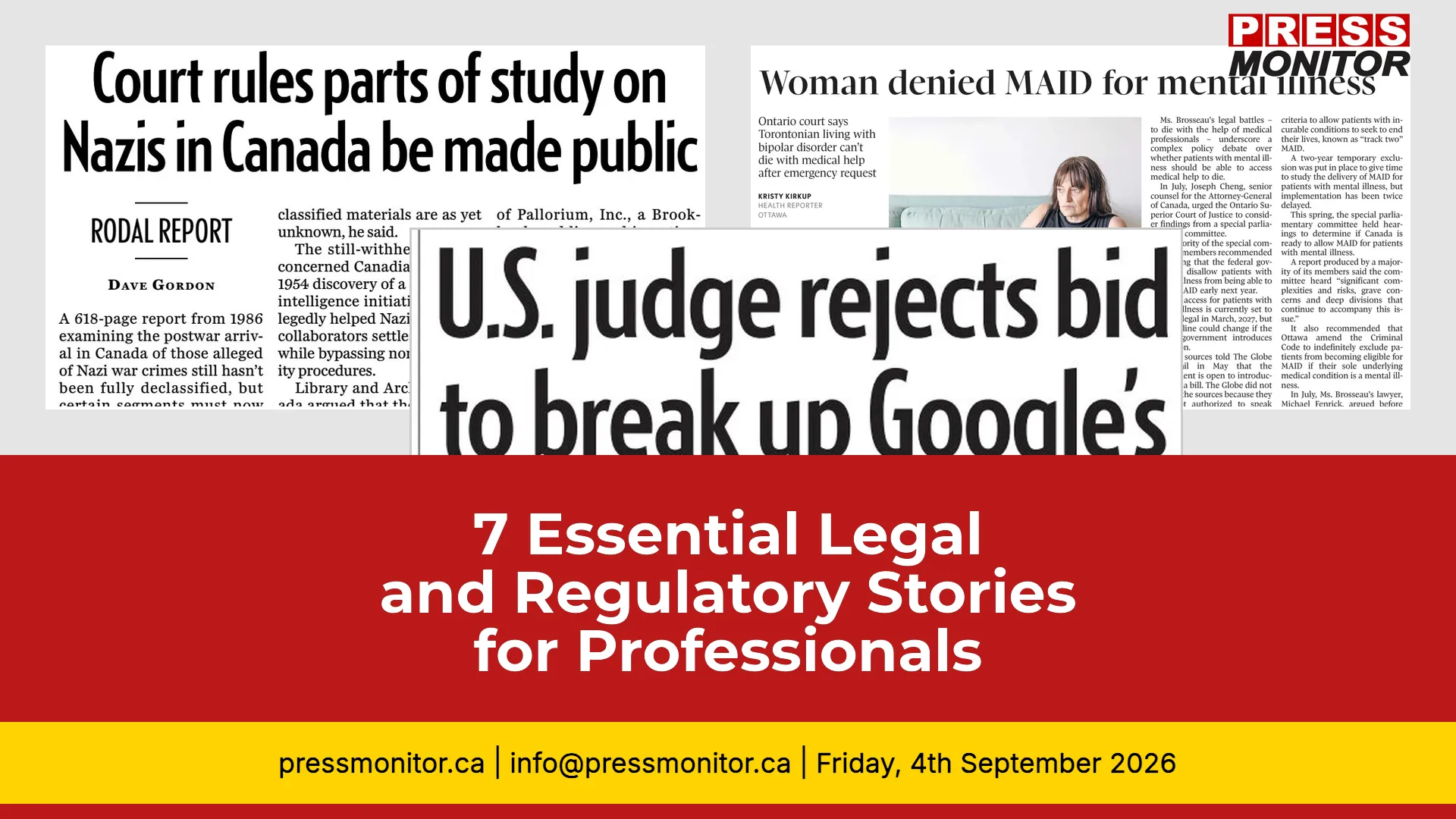
According to Press Monitor's tracking of Canadian publications, this media monitoring review covers seven legal and regulatory stories that demand attention from compliance officers, corporate secretaries, and government relations professionals. From the DOJ's Google ad tech breakup bid to the declassification of the Rodal Report on Nazi war criminals and a landmark MAID ruling affecting Canadians with mental illness — news on legal and regulatory developments that shape business and policy.
1. Rodal Report Partially Declassified
National Post reports that a Federal Court ruling requires certain segments of a 1986 study on Nazi war criminals in Canada to be made public, despite the full 618-page Rodal Report remaining partially classified. Justice Simon Fothergill determined that the public interest in preserving the historical record and the weakness of the government's reasons for secrecy outweighed the arguments for continued concealment, though one section containing a U.S. official's assessment remains withheld. B'nai Brith Canada, which advocated for the release, welcomed the decision, while some critics argue the government's long resistance to disclosure is the more significant issue.
A Federal Court ruling has ordered the partial release of the 1986 Rodal Report on alleged Nazi war criminals in Canada, ending decades of government secrecy. Justice Simon Fothergill determined that public interest and the passage of time outweighed the government's reasons for continued concealment, though one section containing a U.S. official's confidential assessment remains withheld. B'nai Brith Canada, which championed the access-to-information campaign, welcomed the decision.
Why it matters: The ruling sets a precedent for government transparency in historical records and validates years of advocacy by human rights organizations. For compliance and legal professionals, it underscores the judiciary's role in balancing national security against the public's right to know.
Key detail: The full 618-page report remains partially classified, but significant portions will now be accessible to researchers and the public.
Source: National Post
2. Claire Brosseau Denied MAID Access
The Globe and Mail reports that an Ontario court denied emergency access to medical assistance in dying for a Toronto woman living with bipolar disorder, after she sought an emergency stay from the Ontario Superior Court of Justice to immediately end her life with medical help and is also suing the federal government over its decision to bar MAID in cases of mental illness. Justice Carissima Mathen described how Ms. Brosseau presented compelling evidence of harm while noting considerable interests on the other side including Parliament's role to make policy decisions on sensitive social issues and the proper interpretation of the Charter rights in play.
An Ontario court denied emergency access to medical assistance in dying for Claire Brosseau, a 49-year-old Toronto resident living with bipolar disorder and post-traumatic stress disorder. Justice Carissima Mathen dismissed the emergency motion but ordered the Attorney General to formally respond to Brosseau's broader constitutional challenge launched in August 2024.
Why it matters: This ruling deepens the legal and ethical debate around MAID eligibility for mental illness alone, with implications for healthcare policy and Charter rights across Canada.
Key detail: Brosseau is also suing the federal government over its decision to bar MAID in cases of mental illness, arguing the current law violates bodily autonomy.
Source: The Globe and Mail
3. Google Ad Business Survives DOJ Breakup Bid
Saskatoon Starphoenix reports that in a federal court on Wednesday, Judge Brinkema rejected the Department of Justice's proposal to break apart Google's advertising tools used by small businesses to reach customers. Google's vice-president of regulatory affairs Lee-Anne Mulholland said the company was pleased with the decision, and Brinkema left the reasoning under seal for fourteen days while both sides have thirty days to submit a joint proposed final judgment. The decision follows another recent federal ruling refusing to force the sale of Google's Chrome browser and forms part of the Department of Justice's broader effort to limit the dominance of big tech companies including Apple, Amazon and Meta.
A federal judge rejected the U.S. Department of Justice's proposal to break apart Google's advertising technology tools used by small businesses to reach customers. The ruling marks the second time in recent years a court has declined to dismantle a piece of Google's business, following a prior decision that protected the Chrome browser. Google's vice-president of regulatory affairs Lee-Anne Mulholland expressed satisfaction with the outcome.
Why it matters: The decision reinforces the judiciary's skepticism toward aggressive antitrust remedies against major technology platforms and signals continuity in the DOJ's broader effort to limit big tech dominance including Apple, Amazon, and Meta.
Key detail: Judge Brinkema left the reasoning under seal for fourteen days while both parties have thirty days to submit a joint proposed final judgment.
Source: Saskatoon Starphoenix
4. Supreme Court Mail Ballot Rule Under Review
Toronto Star reports that the Trump administration asked the Supreme Court on Thursday to reject a federal judge's order halting a new rule regulating mail ballots. The appeal came as the administration could not confirm if the computer system required to govern the project was operational, with North Carolina scheduled to send ballots out on Friday ahead of the November midterm elections. Judge Indira Talwani in Boston questioned Department of Justice attorney Michael Velchik about whether the Postal Service could implement President Donald Trump's executive order, noting the online portal to track tens of millions of mail ballots appeared inactive.
The Trump administration asked the Supreme Court to reject a federal judge's order halting a new rule regulating mail ballots ahead of the November midterm elections. Judge Indira Talwani in Boston questioned whether the Postal Service's computer system for tracking tens of millions of mail ballots was operational, raising concerns about the administration's ability to implement the executive order.
Why it matters: The case highlights tensions between executive authority and judicial oversight in election administration, with implications for voting rights and election integrity nationwide.
Key detail: North Carolina was scheduled to send ballots out on Friday, making the timing of the Supreme Court's decision critical.
Source: Toronto Star
5. Supreme Court Rules on Language in Quebec Elections
The Montreal Gazette reports that Elections Alberta is confident it can meet the two-day deadline to count expected millions of ballots for the historic fall referendum, proceeding with question 1 after question 10 is counted. Alberta NDP house leader Christina Gray is calling on Premier Danielle Smith to cancel the referendum and re-send corrected special ballots, while urging Albertans to vote for option one to keep Alberta in Canada.
Elections Québec sent voting notices in French only, citing Bill 96 as the cause, but the Chief Electoral Officer's failure to provide bilingual documents as mandated by the Quebec Election Act and the Constitution has drawn scrutiny. The ruling raises questions about linguistic rights in the electoral process.
Why it matters: For corporate secretaries and compliance professionals operating in Quebec, this decision reinforces the importance of bilingual compliance in government communications and electoral processes.
Key detail: The case underscores ongoing tensions between provincial language laws and constitutional bilingualism requirements.
Source: Montreal Gazette
6. Darren Reid Licence Suspended
Le Journal de Montreal reports that the Quebec Court ordered the suspension of real estate broker Darren Reid's licence from 3 September 2026 to 1 November 2026. The suspension follows infractions including failure to properly advise a seller and executing contracts with erroneous information on properties in Westmount. The disciplinary committee cited misconduct between 2018 and 2023.
The Quebec Court ordered the suspension of real estate broker Darren Reid's licence from September 3, 2026 to November 1, 2026, following infractions including failure to properly advise a seller and executing contracts with erroneous information on properties in Westmount. The disciplinary committee cited misconduct spanning 2018 to 2023.
Why it matters: This ruling sends a clear signal to real estate professionals about the consequences of ethical breaches and contract irregularities, relevant for compliance and regulatory oversight in the province's property sector.
Key detail: The suspension period covers nearly two months, reflecting the severity of the documented infractions.
Source: Le Journal de Montreal
7. OpenAI Faces Lawsuits Over Tumbler Ridge Shooting
Times Colonist reports that British Columbia Premier David Eby blames OpenAI for new lawsuits filed by witnesses to the deadly Tumbler Ridge mass shooting, saying the firm walked away from mediation. The province intends to join the litigation, citing OpenAI's failure to report the shooter's troubling online behaviour before he killed eight victims.
British Columbia Premier David Eby blamed OpenAI for new lawsuits filed by witnesses to the deadly Tumbler Ridge mass shooting, stating the firm walked away from mediation. The province intends to join the litigation, citing OpenAI's failure to report the shooter's troubling online behaviour before he killed eight victims.
Why it matters: This case could establish important precedents for AI liability and the duty of care technology companies owe regarding harmful content, a developing area of legal and regulatory concern across Canada.
Key detail: The province's decision to join the litigation signals growing governmental willingness to hold AI companies accountable for downstream harms.
Source: Times Colonist
Closing: These seven stories reflect the evolving legal and regulatory landscape in Canada and beyond. Which ruling will have the most lasting impact on your industry? Follow Press Monitor for ongoing media intelligence and media monitoring of the cases that matter.