7 Essential Trade Stories for Business Leaders


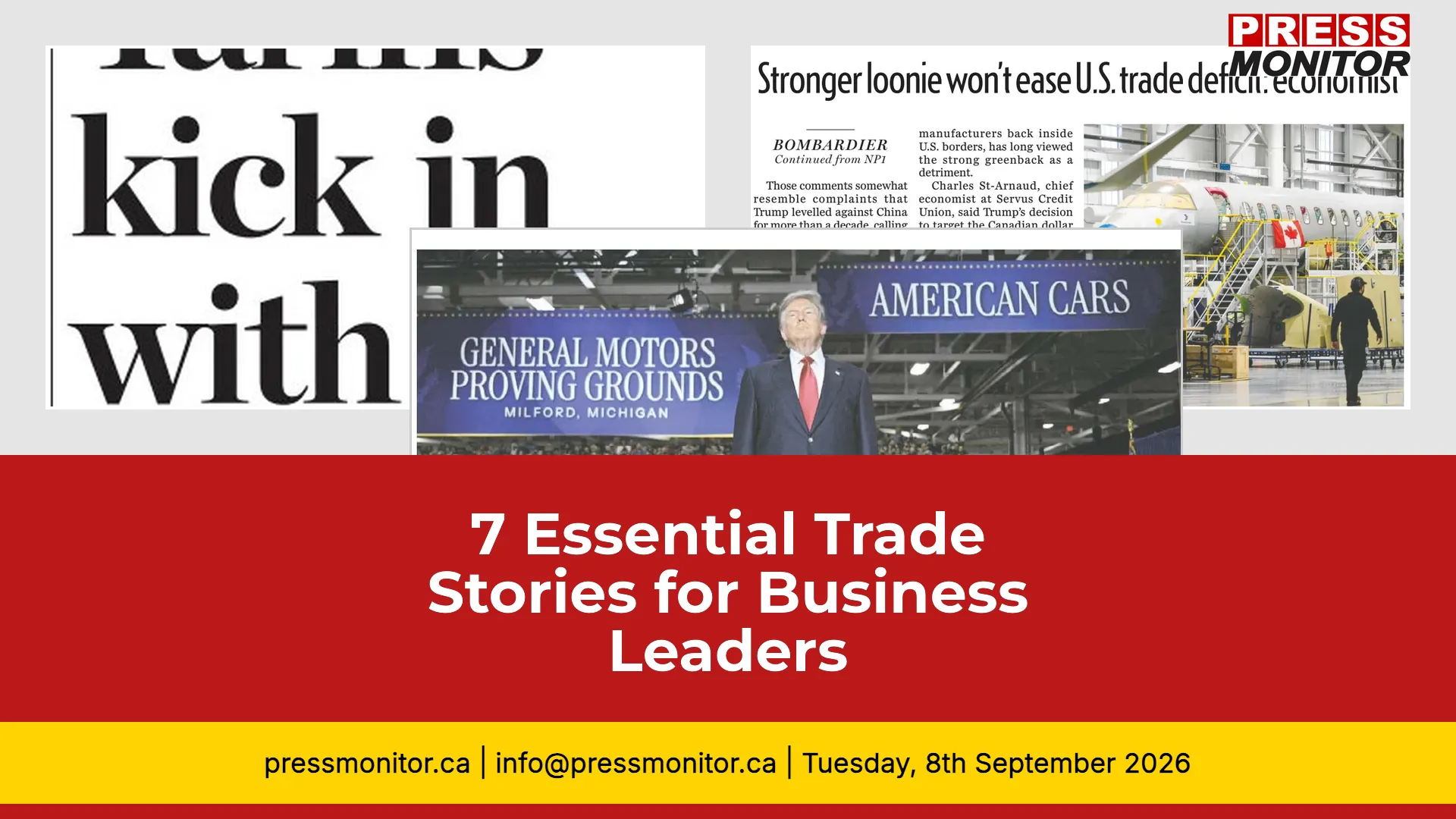
Media monitoring of Canadian print publications delivers this press review of seven essential trade stories for business leaders. According to Press Monitor's tracking of Canadian publications, the Canada-US trade war is reshaping supply chains, threatening aerospace exports, and forcing governments to respond with billions in support. This media intelligence report draws on print media monitoring to give you the full picture before your next meeting.
1. Canada's $28B Counter-Tariffs Take Effect
The Toronto Star reports that retaliatory tariffs on nearly $28 billion in American products kick in Tuesday, as trade tensions between Canada and the United States persist with no planned return to the negotiating table. Prime Minister Mark Carney's government is doubling tariffs on American steel and aluminum from 25 per cent to 50 per cent, while hitting other American products including cheese, household appliances, machinery and clothing with import taxes of 15, 25 and 50 per cent. More than 600 products are being tariffed starting Tuesday in the latest round of a tit-for-tat that Trump has vowed to escalate with even more import duties on Canadian autos and steel in the new year.
Why it matters: The largest retaliatory tariff package in Canadian history is now in effect, impacting over 600 US product lines and raising costs for Canadian consumers.
Key detail: Tariffs range from 15% to 50%, with steel and aluminum doubled to 50%. More than 700 US products are affected, covering dairy, appliances, machinery, and clothing.
Source: Toronto Star, tracked by Press Monitor
Next step: Monitor US response — Trump has vowed to escalate with additional duties on Canadian autos and steel in the new year.
2. Trump Threatens Bombardier Sales Ban
Calgary Herald reports that Donald Trump launched a series of social media attacks targeting Canada, threatening to block sales of Bombardier aircraft and complaining about the Canadian dollar imbalance. Canada's sweeping counter-tariffs on $28 billion worth of US goods came into effect just hours after Trump's posts. Jennifer Kavanagh of Defense Priorities questioned whether Trump had the authority to ban Bombardier sales.
Why it matters: A sales ban would disrupt one of Canada's flagship aerospace companies and cross-border aviation commerce.
Key detail: Jennifer Kavanagh of Defense Priorities questioned whether Trump has the authority to ban Bombardier sales, raising constitutional questions about executive power.
Source: Calgary Herald, tracked by Press Monitor
Next step: Watch for legal challenges and diplomatic responses from the Canadian government.
3. Michigan Hit Hardest by Canadian Tariffs
Edmonton Journal reports that Canada has launched retaliatory tariffs on U.S. goods, with Michigan facing the hardest hit due to $1.5 billion in annual tariff-listed exports to Canada. The new Canadian duties range from 15 to 50 percent and cover vehicle-related goods, auto parts, steel, aluminum, and industrial inputs. Analysts warn the tariffs could disrupt wholesale margins, retail pricing, and cross-border supply chains across multiple U.S. states.
Why it matters: Michigan sends $1.5 billion in tariff-listed exports to Canada annually, making it the most exposed US state to Canadian retaliation.
Key detail: Analysts warn tariffs could disrupt wholesale margins, retail pricing, and cross-border supply chains, potentially driving retailers to source from China and Vietnam.
Source: Edmonton Journal, tracked by Press Monitor
Next step: US manufacturers in Michigan should prepare for margin compression and potential sourcing shifts.
4. Frechette Pauses Campaign for Tariff Meeting
Le Journal de Montreal reports that the trade war with Donald Trump is again contaminating the election campaign, forcing Christine Fréchette's government to rescue Quebec businesses. The Parti Québécois leader announced new aid measures after a special Cabinet meeting, including suspending the lowest bidder rule for public contracts to favour Quebec and Canadian companies.
Why it matters: Quebec's election campaign is being shaped by the trade war, with emergency aid measures announced for businesses.
Key detail: The Parti Quebecois leader suspended the lowest bidder rule for public contracts to favour Quebec and Canadian companies.
Source: Le Journal de Montreal, tracked by Press Monitor
Next step: Quebec businesses should watch for new procurement rules that could favour local suppliers.
5. CUSMA Withdrawal Could Cost $402 Billion
The Daily Press reports that a new Deloitte Canada study finds a US withdrawal from the Canada-United-States-Mexico trade agreement would cause a severe but not cataclysmic impact on Canada's economy. The report predicts Canadian GDP would fall 1.6 percent by 2036, representing $402 billion in lost GDP and 163,000 jobs lost annually. A second scenario shows potential GDP growth of 0.6 percent if Canada diversifies trade partnerships.
Why it matters: A Deloitte study quantifies the economic damage of a potential US withdrawal from the trade agreement.
Key detail: Canadian GDP would fall 1.6% by 2036, representing $402 billion in lost GDP and 163,000 jobs lost annually.
Source: The Daily Press (Timmins), tracked by Press Monitor
Next step: Businesses should model CUSMA withdrawal scenarios in their trade risk assessments.
6. Wool Trade Disrupted by Trump Tariffs
Times Colonist reports that U.S. President Donald Trump's 50 per cent tariffs on greasy wool imports are disrupting Canadian wool producers, forcing some to cut ties with American customers. Canadian producers are increasingly shipping raw wool to China and the Czech Republic to evade U.S. tariffs, while an Ottawa yarn shop owner says she will no longer stock U.S. labels. The Canadian Wool Council chair describes the situation as an unfortunate rupture in a longstanding trading relationship.
Why it matters: US tariffs on greasy wool imports are severing a longstanding trading relationship and forcing Canadian producers to find new markets.
Key detail: Canadian producers are shipping raw wool to China and the Czech Republic to evade US tariffs, while an Ottawa yarn shop owner will no longer stock US labels.
Source: Times Colonist, tracked by Press Monitor
Next step: Wool industry stakeholders should explore diversification into Asian and European markets.
7. C$7.5B Trade War Support Package
Cape Breton Post reports that Canada's Minister of Justice Sean Fraser rallied support for the country's trade war stance against the United States in Dartmouth, Nova Scotia, on Wednesday. Fraser argued that Canada must resist American economic pressure to protect its sovereignty, while announcing billions of Canadian dollars in regional support for businesses affected by tariffs.
Why it matters: Canada is committing billions to support workers and businesses affected by the escalating trade dispute.
Key detail: Minister of Justice Sean Fraser announced regional support in Dartmouth, Nova Scotia, emphasizing sovereignty and resistance to American economic pressure.
Source: Cape Breton Post, tracked by Press Monitor
Next step: Affected businesses should apply for regional support programs and document tariff-related losses.
Which of these trade developments will have the greatest impact on your supply chain? Stay informed with Press Monitor's print media monitoring — delivering Canadian news on trade before it breaks elsewhere.