7 Pivotal Trade Stories for Executives


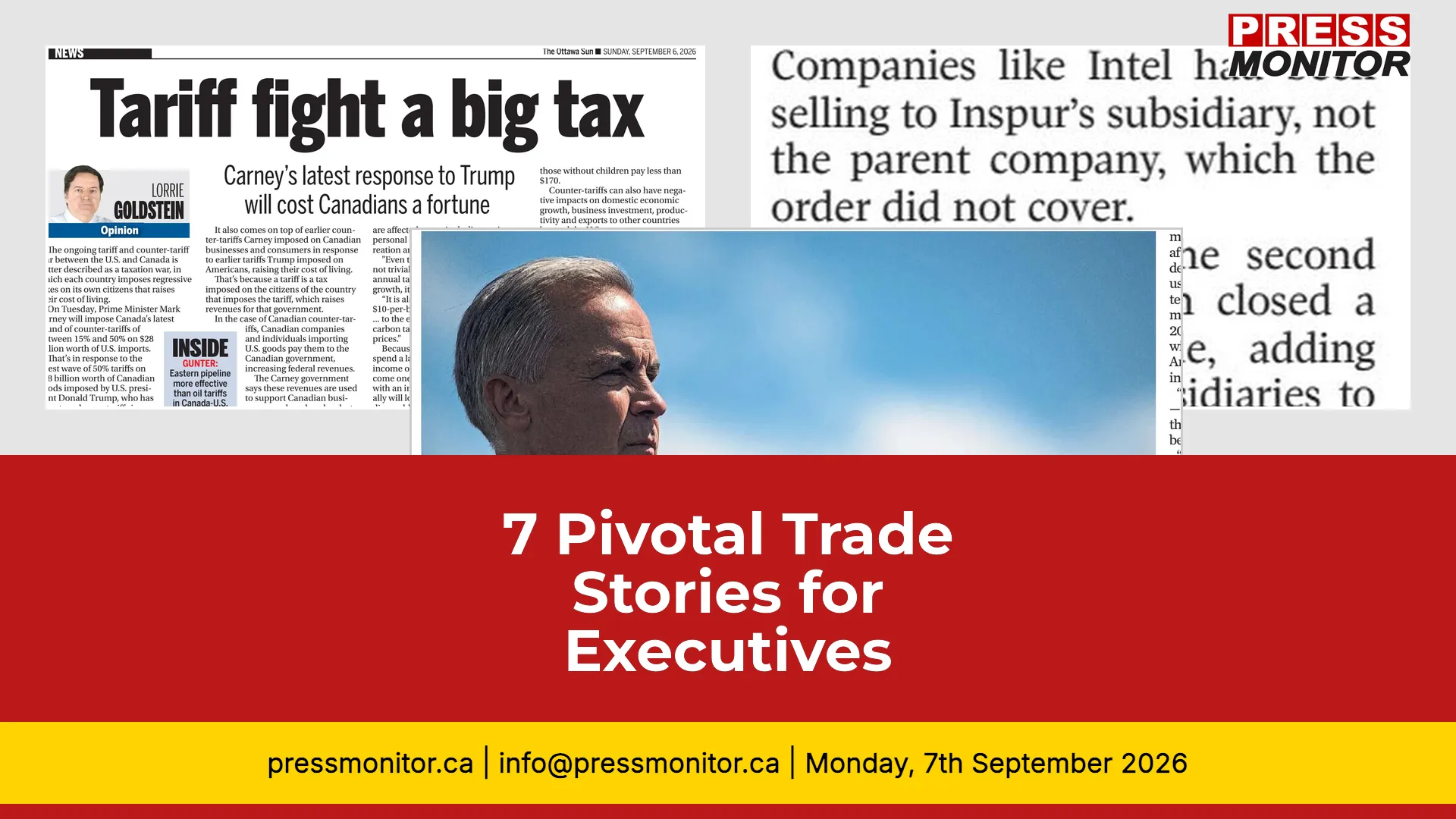
Tracking real-time shifts in North American commerce requires sharp eyes and reliable media monitoring. According to Press Monitor's tracking of Canadian publications, this week's print landscape reveals critical developments in tariffs, supply chains, and energy policy. This press review distills seven high-impact stories grounded in live editorial data.
1. Carney's New Counter-Tariffs Cost Canadians Billions
{source_name} reports that on Tuesday, Prime Minister Mark Carney will impose Canada's latest round of counter-tariffs of between 15% and 50% on 28 billion dollars worth of U.S. imports. University of Calgary economist Trevor Tombe estimates these counter-tariffs will cost Canadians at least 4 billion dollars in the coming months, with lower-income families taking the hardest hit because tariffs function as a regressive tax. The article notes that Carney has acknowledged Canada cannot win a long-term dollar-for-dollar tariff war with the U.S. given its economy is 13 times the size.
Why it matters: Direct economic impact on household budgets and corporate procurement margins.
Key detail: Prime Minister Mark Carney will impose counter-tariffs of 15% to 50% on $28 billion in U.S. imports. University of Calgary economist Trevor Tombe estimates a $4 billion hit to Canadians, functioning as a regressive tax that disproportionately affects lower-income families.
Source: Ottawa Sun
Next step: Review your Q4 procurement budgets and assess exposure to U.S.-origin inputs.
2. Shell Firms Channel Billions To China
The Globe And Mail (ottawa/quebec Edition) reports that Chinese entities, including government-owned Maginfra and Inspur subsidiary Aivres, are using shell companies across Southeast Asia to bypass United States export controls on advanced artificial intelligence chips. Records indicate that seven billion dollars in high-performance servers have flowed into mainland China over recent months, while regulators in the second Trump administration continue to approve licenses for restricted Nvidia components despite the workaround network. Analysts describe the operations as a coordinated, state-sponsored effort to circumvent Washington technology restrictions.
Why it matters: Highlights vulnerabilities in global semiconductor export controls and compliance frameworks.
Key detail: Records show $7 billion in high-performance servers flowed into mainland China via Southeast Asian shell companies. Analysts describe this as a coordinated, state-sponsored effort to circumvent Washington technology restrictions.
Source: The Globe And Mail
Next step: Audit third-party vendor networks and strengthen end-user verification protocols.
3. Trump Tariffs Threaten Canadian Economy
The Toronto Star reports that the US government has signalled it will respond to Canadian retaliation, as Trump threatens to increase tariffs on Canadian autos on Jan. 1 in what experts warn could be catastrophic for the Ontario-based sector. Ottawa and provincial governments have pledged support for workers and businesses impacted by the trade war, including through a 7.5 billion dollar aid package that bolsters employment insurance and provides favourable loans to affected businesses. The Canadian economy grew at an annualized rate of 3.3 percent in the second quarter of this year, while University of Calgary economist Trevor Tombe predicts the new American tariffs could shave 0.4 percent off the country's gross domestic product.
Why it matters: Escalating auto sector risks demand immediate contingency planning.
Key detail: The U.S. signals increased tariffs on Canadian autos effective January 1. Ottawa has pledged a $7.5 billion aid package, though economists warn new levies could shave 0.4% off national GDP.
Source: Toronto Star
Next step: Stress-test automotive and manufacturing supply chains against potential January escalations.
4. Sixty-One Percent Cut Spending Amid Tariff Pressures
Winnipeg Sun reports that a recent Merchant Growth survey indicates Canadian small businesses are facing increased financial pressure ahead of new United States counter-tariffs taking effect September eighth. Over two thirds of respondents rely heavily on American suppliers and partners, prompting sixty-one percent to reduce spending, delay hiring, or cancel expansion plans. While weaker consumer demand remains the top concern, widespread economic uncertainty is driving businesses to seek government loan access and permanent tax relief.
Why it matters: Small business sentiment indicates broader macroeconomic tightening ahead.
Key detail: A recent Merchant Growth survey shows over two-thirds of respondents rely heavily on American suppliers. Consequently, 61% are reducing spending, delaying hiring, or canceling expansions due to tariff uncertainty.
Source: Winnipeg Sun
Next step: Evaluate supplier diversification strategies and secure flexible credit lines now.
5. Canada USMCA Trade Dispute
The Globe and Mail (Ottawa and Quebec edition) reports that opinion columnist Fred Gallagher argues Canada risks legitimizing United States tariffs and sidelining the United States Mexico Canada Agreement in new trade deal talks. He questions whether Canada has been maneuvered into undermining its own free trade agreement by trade demands from United States President Donald Trump and comments by Trade Minister Jamieson Greer. He argues Canada must resist trade wars and protect its economic interests.
Why it matters: Strategic positioning within the trilateral agreement defines future market access.
Key detail: Opinion analysis warns Canada risks sidelining the USMCA in new talks. Experts urge resisting dollar-for-dollar tit-for-tat tactics and protecting free trade foundations against external pressure.
Source: The Globe And Mail
Next step: Align corporate lobbying efforts with policymakers advocating for USMCA preservation.
6. Canada Oil Pipeline More Effective Than Tariffs
Calgary Sun reports that Canada should prioritize building an all-Canadian pipeline rather than using oil exports as a bargaining chip in the trade war with the Trump White House. Venezuela's decrepit oil infrastructure cannot quickly displace Alberta and Saskatchewan heavy oil, as rebuilding would cost over one hundred billion Canadian dollars and take five years or more. Threatening oil exports could fuel Alberta separatist sentiment ahead of an independence referendum and drive investment capital away from the Canadian energy sector.
Why it matters: Energy infrastructure strategy offers a more resilient leverage point than export bans.
Key detail: Analysts argue an all-Canadian pipeline outweighs threatening oil exports. Rebuilding Venezuelan capacity would cost over $100 billion CAD and take years, making domestic infrastructure the superior strategic play.
Source: Calgary Sun
Next step: Monitor federal energy approvals and position capital toward northern grid projects.
7. CUSMA trade deal inked with US
Toronto Star reports that American Free Trade Agreement inked in the 1990s with CUSMA. Premier Doug Ford proclaimed that Trump should kiss his ass, and Canada must consider slapping export taxes on electricity. Jason Kenney says Canada should be ready to tax exports of potash, critical minerals, and oil.
Why it matters: Historical framework informs current negotiations on critical minerals and energy.
Key detail: Provincial leaders debate export taxes on electricity, potash, and oil. The conversation centers on modernizing the 1990s free trade architecture to reflect contemporary resource economics.
Source: Toronto Star
Next step: Track legislative proposals on critical mineral export controls and adjust commodity hedging accordingly.
Navigating these shifts demands reliable data streams. By integrating print media monitoring into your daily workflow, you gain media intelligence that cuts through digital noise. What internal policy adjustments will your team prioritize this quarter?