9 Critical Food & Beverage Stories for Retail Leaders


Effective media monitoring cuts through algorithmic noise to deliver verified supply chain and pricing signals. This press review distills the day’s most actionable developments for executives tracking market resilience. According to Press Monitor's tracking of Canadian publications, here are the nine pivotal stories shaping the sector right now.
1. Federal $3B Pledge Targets National Food Terminals
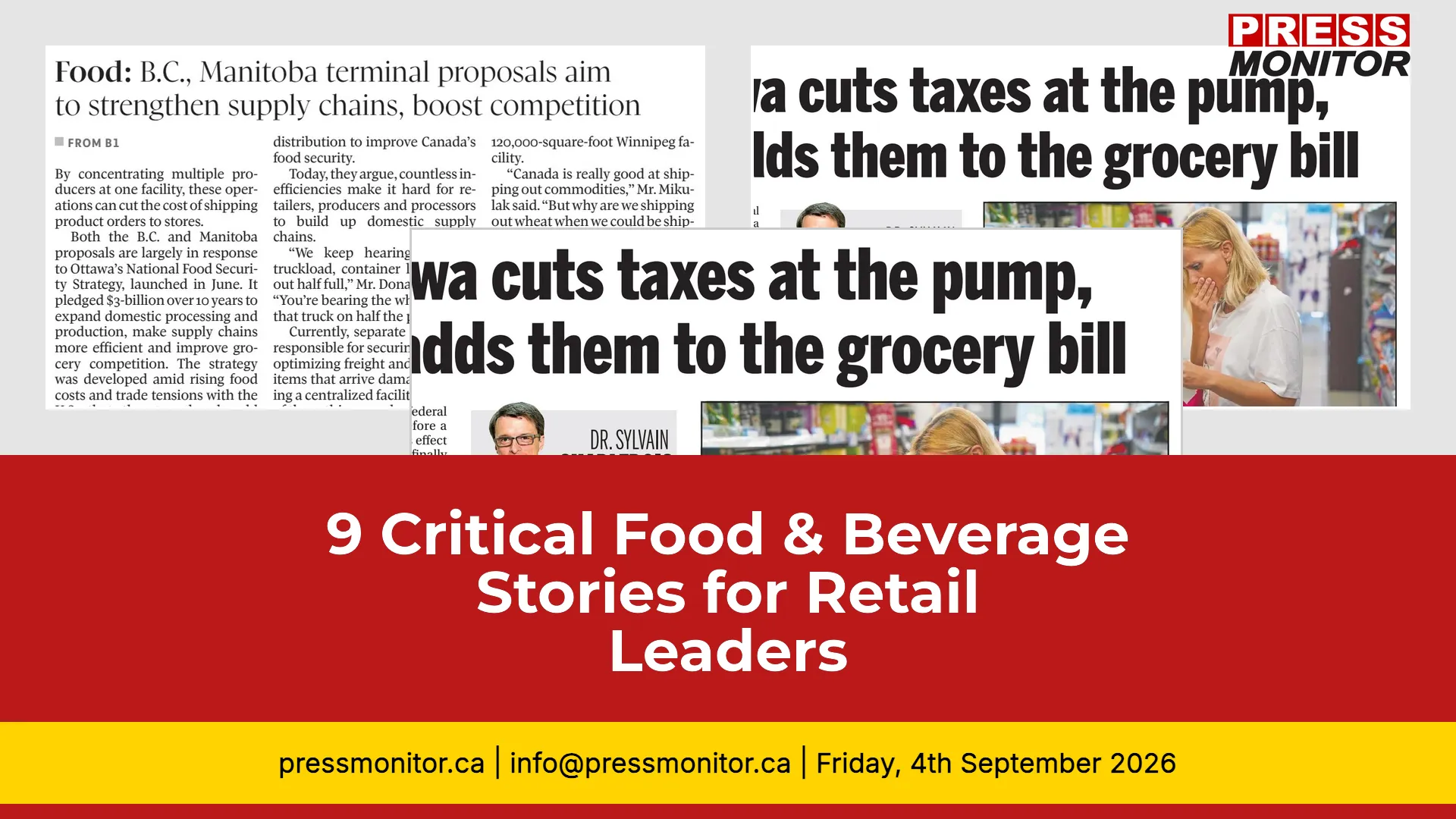
The Globe And Mail (ottawa/quebec Edition) reports that British Columbia and Manitoba terminal proposals aim to strengthen supply chains and boost competition in response to Ottawa's National Food Security Strategy launched in June. The strategy pledged 3 billion over 10 years to expand domestic processing and production, make supply chains more efficient and improve grocery competition amid rising food costs and trade tensions with the U.S. James Donaldson, chief executive officer at BC Food & Beverage, said the B.C. concept, dubbed the Pacific Gateway, could become a regional trade hub leveraging international trade.
Why it matters: Direct government investment aims to decentralize distribution and reduce reliance on vulnerable cross-border routes.
Key detail: Ottawa announced a decade-long $3 billion commitment under the National Food Security Strategy, while provincial groups in B.C. and Manitoba are fast-tracking $1 billion in matching infrastructure proposals.
Source: The Globe And Mail
Next step: Map your regional distribution dependencies against the new Pacific Gateway and Prairie hub timelines. Question: How will your procurement strategy adapt to decentralized terminals?
2. Food Insecurity Rate Climbs to 10.5%
Calgary Sun reports that Canada's food insecurity rate more than doubled from 5.1 per cent to 10.5 per cent between 2017 and 2025, reaching the sixth-highest level among comparable G20 nations. Bank of Canada research found retaliatory tariffs pushed tariffed products up by roughly six per cent, adding about 0.3 percentage points to consumer inflation, as Ottawa's trade retaliation significantly impacted household grocery affordability despite a more focused policy approach this year.
Why it matters: Household affordability pressures directly correlate with shifting basket sizes and premium product demand.
Key detail: Bank of Canada research confirms the rate more than doubled between 2017 and 2025, reaching sixth-highest among G20 peers.
Source: Calgary Sun
Next step: Audit private-label positioning and value-tier promotions for Q4 inventory planning. Question: Are your shelf layouts optimized for current trade-in behavior?
3. Counter-Tariffs Drive 6% Grocery Price Increase
Ottawa Sun reports that Canada’s 2025 counter‑tariffs raised grocery prices by about six percent and that food insecurity rates have more than doubled, rising from five point one percent to ten point five percent between 2017‑19 and 2023‑25.
Why it matters: Import levies are passing straight through to retail margins and consumer wallets.
Key detail: The 2025 retaliatory measures added roughly six percent to grocery prices, with inflation data showing sustained pressure on staple categories.
Source: Ottawa Sun
Next step: Stress-test supplier contracts for tariff-adjustment clauses before renewal cycles. Question: Which SKUs face the highest pass-through risk next quarter?
4. Fuel Tax Relief Extended Through January 2027
The Edmonton Sun reports that Ottawa is extending the federal fuel-tax suspension until January 31, 2027, saving motorists ten cents per litre on gasoline and four cents per litre on diesel. The decision comes just days before Canada imposes counter-tariffs on twenty-seven point six billion Canadian dollars worth of American goods. Dr. Sylvain Charlebois argues that evaluating who ultimately pays for retaliatory trade policy is critical given Canada's deteriorating food-security performance.
Why it matters: Logistics cost relief provides temporary breathing room for cold-chain and last-mile delivery networks.
Key detail: Ottawa extended the federal fuel-tax suspension, saving motorists ten cents per litre on gasoline and four cents on diesel.
Source: Edmonton Sun
Next step: Lock in freight rates where possible to capitalize on the temporary margin buffer. Question: How will you allocate saved logistics capital back into store operations?
5. Established Terminals Buffer Rising Shelf Costs
The Globe And Mail reports that a worker loads a truck at the Ontario Food Terminal in Toronto, highlighting how food terminals can help buffer rising grocery costs. The facility serves as a key distribution hub for food products in the region.
Why it matters: Legacy distribution hubs continue to stabilize local pricing amid macro volatility.
Key detail: Operations at facilities like the Ontario Food Terminal demonstrate how centralized wholesale markets absorb shock before retail checkout.
Source: The Globe And Mail
Next step: Strengthen relationships with regional terminal operators for priority allocation during shortages. Question: Is your warehouse network leveraging terminal economies of scale?
6. Canadian Tire & Tim Hortons Unify Loyalty Ecosystems
Regina Leader-post reports that Canadian Tire Corp. has launched a loyalty partnership with Tim Hortons, allowing customers to link their Triangle Rewards and Tims Rewards accounts to earn up to five per cent in Canadian Tire Money on eligible Tims purchases. The partnership, first announced a year ago, expands Canadian Tire's rewards program by including more brands and locations across Canada. Tim Hortons is the fourth Canadian brand to join the Triangle Rewards program alongside Petro-Canada, Royal Bank of Canada, and WestJet Airlines.
Why it matters: Cross-banner rewards are redefining customer retention in quick-service and retail environments.
Key detail: Customers can now link Triangle and Tims Rewards accounts to earn up to five percent in Canadian Tire Money on eligible coffee purchases.
Source: Regina Leader-post
Next step: Evaluate partnership opportunities that align with your brand’s demographic overlap. Question: Could a co-branded rewards layer boost your average transaction value?
7. Ugly Potato Day Shatters Produce Donation Record
Saskatoon Starphoenix reports that more than 500,000 pounds of food was scooped up at an event in Surrey, B.C. called Ugly Potato Day. The event attracted roughly 30,000 people and broke the Guinness World Record for the largest donation of fruits and vegetables in 24 hours.
Why it matters: Corporate sustainability initiatives are scaling rapidly, influencing brand perception and waste-reduction mandates.
Key detail: Roughly 30,000 participants collected over 543,501 pounds of produce in Surrey, B.C., setting a new Guinness World Record.
Source: Saskatoon Starphoenix
Next step: Benchmark your food-waste recovery programs against this community-driven model. Question: How can your CSR team replicate this grassroots engagement locally?
8. Labour Day Weekend Fuels Restaurant & Event Foot Traffic
The Hamilton Spectator reports that Hamilton has a full schedule of Labour Day long weekend activities for families, including outdoor events, sports, and cultural attractions running from Friday through Monday. Highlights include a corn maze at Hanes Farmland, ribfest at Spencer Smith Park, a Forge FC soccer match, baseball playoffs, and the Labour Day parade, among other family-friendly events and festivals across the region.
Why it matters: Holiday weekends remain critical revenue windows for casual dining and quick-service operators.
Key detail: Municipal calendars across Ontario highlight ribfests, corn mazes, and family festivals driving localized spend.
Source: The Hamilton Spectator
Next step: Align staffing schedules and promotional menus with peak weekend demand curves. Question: Are your weekend ops plans built around local event calendars?
9. Tariff Pass-Through Focus Shifts to Ingredients & Industrial Goods
Toronto Sun reports that Canada's food insecurity rate more than doubled between 2017-19 and 2023-25, rising from 5.1% to 10.5%. Bank of Canada research found approximately one-quarter of the 2025 counter-tariffs was passed through to retail prices. Ottawa's new retaliatory tariff list is more focused on industrial sectors and food ingredients rather than sweeping supermarket products.
Why it matters: Policy targeting is evolving, sparing some supermarket aisles while impacting manufacturing inputs.
Key detail: Research indicates roughly one-quarter of counter-tariffs hit retail prices, with Ottawa narrowing focus to food ingredients rather than broad grocery sweeps.
Source: Toronto Sun
Next step: Review formulation costs and alternative sourcing for tariff-exposed ingredients. Question: Which recipe formulations require immediate cost-neutral reformulation?
Tracking these shifts demands rigorous print media monitoring to separate signal from noise. By grounding your strategy in verified editorial reporting, you gain media intelligence that outpaces algorithmic feeds. What operational pivot will you prioritize this week?