9 Essential Automotive Stories for Industry Leaders


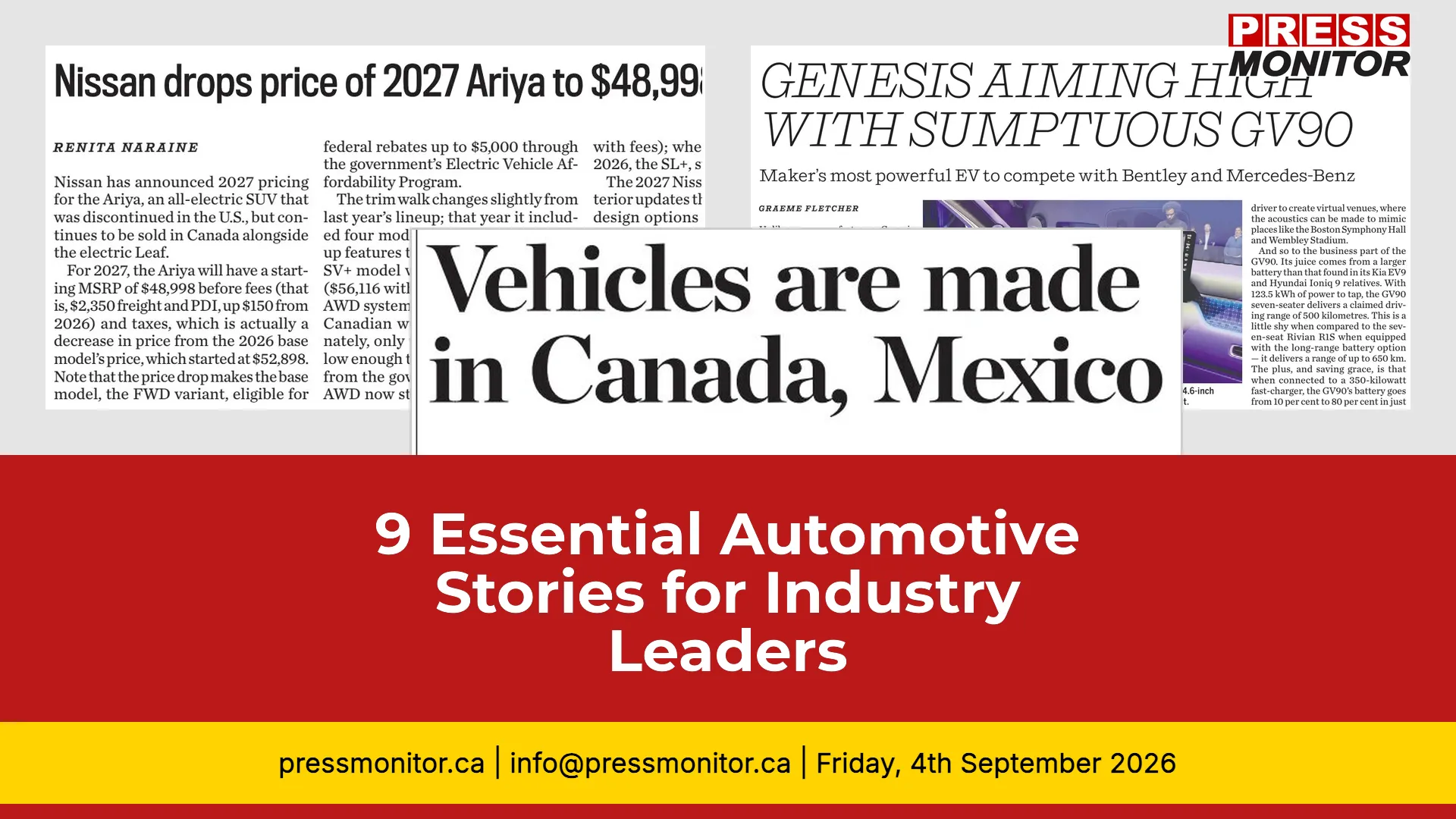
Media monitoring of Canadian print publications reveals nine essential automotive stories for industry leaders. This press review delivers media intelligence and print media monitoring insights on the sector's most impactful developments, from tariff battles to EV price wars.
1. Nissan Slashes 2027 Ariya Price to C$48,998
Montreal Gazette reports that Nissan has announced 2027 pricing for the Ariya, an all-electric sport utility vehicle that continues to be sold in Canada alongside the Leaf, with a starting manufacturer's suggested retail price of C$48,998 before freight, pre-delivery inspection fees and taxes. The base front-wheel drive model becomes eligible for up to C$5,000 in federal rebates through the government's Electric Vehicle Affordability Program, while the SV+ and Platinum AWD trims remain above the rebate threshold. The 2027 Ariya also adds new wheel designs, a new exterior colour, upgraded NissanConnect with Google built-in and a North American Charging Standard port supporting up to 130 kilowatts and Tesla Supercharger access.
Why it matters: Nissan's aggressive pricing move makes electric SUVs accessible to more Canadian buyers, reshaping the EV market landscape.
Key detail: The base FWD model qualifies for up to C$5,000 in federal rebates under the Electric Vehicle Affordability Program, while new NACS charging ports unlock Tesla Supercharger access across Canada.
Source: Montreal Gazette, Renita Naraine
Next step: Monitor whether other EV manufacturers follow with competitive pricing adjustments.
2. Genesis GV90 SUV Targets Luxury EV Market
Edmonton Journal reports that Genesis is introducing the GV90, its most powerful electric vehicle, designed to compete with high-end models from Mercedes-Benz and Bentley. The full-sized SUV features luxury options including suicide doors, a massive infotainment display, and a Cinematic Display that rises when parked. Production is scheduled to begin closer to the 2027 launch date, with Canadian specifications and pricing to be announced later.
Why it matters: Genesis enters the luxury EV SUV segment with 657 hp and Rolls-Royce-style suicide doors, challenging Bentley and Mercedes-Benz.
Key detail: The GV90 features a 123.5 kWh battery, 500 km range, and a Cinematic Display that rises when parked. Canadian pricing to be announced closer to the 2027 launch.
Source: Edmonton Journal, Graeme Fletcher
Next step: Track Genesis's Canadian launch strategy and dealer preparation.
3. BRP Faces 50-60% Earnings Drop on New Tariffs
The Toronto Star reports that a presidential proclamation introduced tweaked tariffs imposing a 25 per cent duty on the full value of products made substantially of steel, aluminum or copper heading stateside, directly impacting BRP snowmobiles and off-road vehicles. Normalized diluted earnings for the Quebec-based company are expected to fall between 50 and 60 per cent next quarter, mainly due to the incremental tariff impact, marking the first full quarter of exposure to the cranked-up metal levies ended July 31. BRP also announced that Martel will step down as chief financial officer on Oct. 1, to be replaced by Minh Thanh Tran, while Martel's three-wheeled Can-Am Spyder motorcycles face additional Section 338 tariffs authorized by US President Donald Trump on Aug. 22.
Why it matters: BRP's financial outlook is severely impacted by Section 232 steel and aluminum tariffs, with CFO Martel stepping down amid the turmoil.
Key detail: Normalized diluted earnings expected to fall 50-60% next quarter; Can-Am Spyder motorcycles face additional Section 338 tariffs authorized by the US President.
Source: Toronto Star
Next step: Watch for operational restructuring and leadership transition details.
4. GM Invests C$144 Million in Oshawa Pickup Production
Saskatoon Starphoenix reports that General Motors will spend C$144 million to expand its Oshawa assembly plant to build more pickup trucks, a vehicle type that has become a central issue in the Canada-US trade war. Under a recently rejected trade deal, US negotiators agreed to lower tariffs on most Canadian-made vehicles to 15 percent but maintained a 25 percent tariff on medium- and heavy-duty pickups. Prime Minister Mark Carney cited this exception as a key reason trade talks broke down, stating the deal would have made pickup production uneconomic and threatened both GM's Oshawa plant and Ford's C$5 billion Oakville investment.
Why it matters: GM's investment signals commitment to Canadian manufacturing despite trade tensions, with pickups as the most profitable vehicle segment.
Key detail: US negotiators maintained a 25% tariff on medium- and heavy-duty pickups; PM Carney cited this as a key reason trade talks broke down, threatening Ford's C$5 billion Oakville investment.
Source: Saskatoon Starphoenix, Gabriel Friedman
Next step: Monitor how the pickup tariff exception affects broader Canada-US trade negotiations.
5. 50% Tariff Could Crush Ontario Auto Industry
National Post - (latest Edition) reports that Ontario Premier Doug Ford's push to preserve auto assembly faces growing doubts as vehicle production has declined from over three million in 1999 to 1.2 million in 2025. The article argues that Canadian-owned auto parts companies, which employ 71,400 workers and contribute $11.3 billion to GDP, represent a more sustainable foundation than foreign-owned assembly plants. It suggests Canada should accept high auto tariffs in exchange for duty-free access for Canadian parts, rather than continuing to subsidize assembly operations that remain vulnerable to corporate decisions.
Why it matters: Ontario Premier Doug Ford's push to preserve auto assembly faces growing doubts as production has fallen from over three million in 1999 to 1.2 million in 2025.
Key detail: Canadian-owned auto parts companies employ 71,400 workers and contribute $11.3 billion to GDP, representing a more sustainable foundation than foreign-owned assembly plants.
Source: National Post, Randall Denley
Next step: Assess whether Canadian parts companies can serve as a more sustainable industry foundation.
6. Carney Trade Deal Stalled Over Autos
The National Post reports that Canadian Prime Minister Mark Carney's government walked away from a proposed trade deal with the United States due to Ontario Premier Doug Ford's refusal to accept a 15 per cent auto tariff and reintroduce American alcohol. U.S. Commerce Secretary Howard Lutnick alleges the Canadians abandoned negotiations for political reasons tied to provincial elections in Quebec and an independence referendum in Alberta, though Carney's version of events emphasizes culture and sovereignty. Bank of Canada Governor Tiff Macklem expects limited direct economic impact from U.S. tariffs covering five per cent of exports, while Treasury Secretary Scott Bessent suggests direct talks between the leaders should wait until after the Alberta referendum in October.
Why it matters: The collapse of Canada-US trade talks over auto tariffs has immediate implications for the entire automotive supply chain.
Key detail: PM Carney walked away from a deal with a 15% auto tariff and demands to reintroduce American alcohol; Bank of Canada Governor Macklem expects limited direct economic impact from U.S. tariffs.
Source: National Post, John Ivison
Next step: Watch for retaliatory tariff implementation and industry response.
7. Carney Rejects Lutnick's Trade War Claims
The Ottawa Citizen reports that Prime Minister Mark Carney rebuffed U.S. Commerce Secretary Howard Lutnick's recent comments that Canada pulled out of trade talks with the United States for political reasons. Carney stated that several last-minute conditions on the U.S. side, including auto industry tariffs and restrictions on language and cultural protections, made accepting a deal untenable. The breakdown in negotiations last month resulted in new fifty per cent U.S. tariffs on twenty-eight billion dollars worth of Canadian goods, with Canada promising retaliatory tariffs on twenty-seven point six billion dollars worth of U.S. products.
Why it matters: The diplomatic back-and-forth between Carney and Lutnick reveals the political dimensions of auto trade policy.
Key detail: New 50% U.S. tariffs on $28 billion of Canadian goods; Canada promises retaliatory tariffs on $27.6 billion of U.S. products.
Source: Ottawa Citizen, Jordan Gowling
Next step: Monitor how political narratives influence ongoing trade negotiations.
8. Canada Auto Industry Faces Global Competition
National Post reports that Canada will be challenged severely to compete in other markets for certain key industries. The auto industry, for example, is unable to compete with Mexico and China in European, Latin American and Asian markets due to high costs.
Why it matters: Canada's auto sector struggles to compete with Mexico and China in international markets due to high production costs.
Key detail: The industry cannot compete in European, Latin American, and Asian markets, limiting diversification options for Canadian manufacturers.
Source: National Post, Jack M. Mintz
Next step: Consider policy interventions to improve global competitiveness.
9. Uber and Wayve Launch Robotaxi Service in London
Toronto Star reports that Uber and Wayve launched London's first self-driving taxi service on Thursday, starting with a small rollout of Ford Mustang Mach-E vehicles. The service operates under the UK government's pilot framework with a human safety driver behind the wheel. The deployment will start with under 20 vehicles and expand from there.
Why it matters: Autonomous vehicle deployment marks a milestone in the evolution of urban mobility and ride-hailing.
Key detail: Uber and Wayve launched London's first self-driving taxi service using Ford Mustang Mach-E vehicles under a UK government pilot framework, starting with under 20 vehicles.
Source: Toronto Star, Kelvin Chan
Next step: Track regulatory developments for autonomous vehicles in Canada.
As these stories demonstrate, news on automotive continues to evolve rapidly across trade policy, EV pricing, and autonomous technology. Which development will have the most lasting impact on Canada's automotive future?
Tracked by Press Monitor — Canadian print media monitoring for the automotive sector.