9 Essential Automotive Stories for Industry Leaders


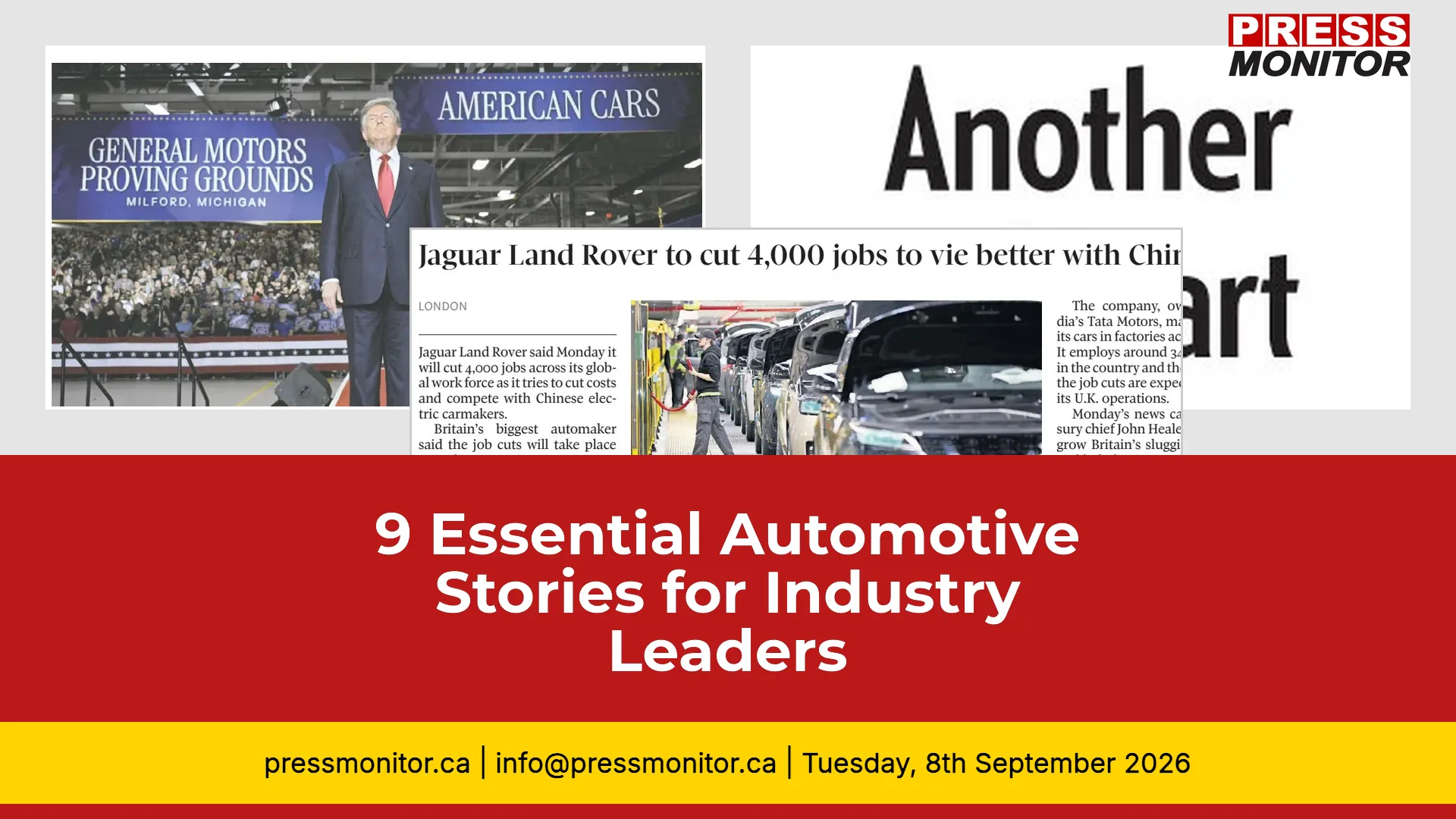
From media monitoring of Canadian print publications, this press review delivers nine essential Automotive & Vehicles stories for decision-makers. Tracked by Press Monitor, these stories span trade wars, corporate restructuring, and regulatory shifts shaping the industry. Whether you need media intelligence on tariff impacts or print media monitoring of labour developments, this roundup covers it all.
1. Canada Tariffs Hit Michigan Hardest
Ottawa Citizen reports that Canada's retaliatory tariffs will hit Michigan hardest, as the state ships about $1.5 billion in tariff-listed products to Canada each year. Canada was the destination for 36 per cent of Michigan's goods exports in 2025, with motor vehicles and auto parts making up a large share. Analysts say the Canadian duties range from 15 per cent to 50 per cent and cover vehicle-related goods, while businesses face uncertainty from shifting trade policy. Canada's retaliatory tariffs will hit Michigan the hardest, as the state ships about $1.5 billion in tariff-listed products to Canada each year. Ottawa's duties range from 15 to 50 percent on vehicle-related goods and industrial inputs, with analysts warning that wholesalers, retailers, and consumers will feel the impact within a quarter. Why it matters: Michigan's auto sector is deeply integrated with Canadian supply chains, making it the most exposed U.S. state to Canadian retaliation. Key detail: 36 percent of Michigan's goods exports went to Canada in 2025. Source: Ottawa Citizen, Tracy Moran. Next step: Monitor cross-border pricing adjustments and inventory decisions at Michigan wholesalers.
2. Golf Cart Makers Hit With $500K EV Tax Bills
Calgary Herald reports that Markham, Ont.-based Axglo Inc. has been hit with a back tax bill of approximately $500,000 from the Canada Border Services Agency for importing motorized push carts manufactured in China. The company's director of operations, Hanson Xie, says the six-person firm has been in the golf cart business since 2009 but lacks the funds to cover the unexpected charge, which mirrors a similar $178,000 bill levied against competitor JPSMGolf of Pickering, Ont. earlier this year. Both companies face hefty interest charges and must pay or post a bond before appealing, as the tax bills stem from a 17-month window in 2024-25 when Chinese-made EVs were taxed at 100 per cent by Ottawa to protect the Canadian auto industry, with the surtax ending after the Carney government reached a deal with Beijing on a 6.1 per cent tariff rate for 49,000 Chinese EVs. Axglo Inc. of Markham, Ontario, faces a $500,000 back tax bill from the Canada Border Services Agency for importing motorized push carts manufactured in China. Competitor JPSMGolf of Pickering was hit with a $178,000 bill during a seventeen-month window in 2024-25 when Chinese-made EVs were taxed at 100 percent. Why it matters: Small businesses face existential threats from retroactive customs classifications that reclassify non-EV products as electric vehicles. Key detail: The 100 percent surtax on Chinese EVs ended after the Carney government reached a deal with Beijing on a 6.1 per cent tariff rate for 49,000 Chinese EVs. Source: Calgary Herald. Next step: Watch for further CBSA enforcement actions on imported EV-adjacent goods and similar retroactive classifications.
3. Jaguar Land Rover Cuts 4,000 Jobs
{source_name} reports that Jaguar Land Rover announced Monday it will cut 4,000 jobs across its global workforce over the next two years as it targets 1.7 billion pounds in savings to compete with Chinese electric carmakers. The automaker, owned by India's Tata Motors, plans to invest between 15 billion and 18 billion pounds over five years in electrification and digital technologies while navigating U.S. tariffs and a recent cyberattack that halted production. Britain's government confirmed it will not bail out the company despite the challenging market conditions. Jaguar Land Rover announced it will cut 4,000 jobs across its global workforce over the next two years, targeting 1.7 billion pounds in savings to compete with Chinese electric carmakers. Owned by India's Tata Motors, JLR plans to invest between 15 billion and 18 billion pounds over five years in electrification while navigating U.S. tariffs and a recent cyberattack that halted production. Why it matters: The cuts signal a broader European automotive sector realignment as legacy automakers struggle against cheaper Chinese EV competitors. Key detail: Britain's government confirmed it will not bail out the company despite the challenging market conditions. Source: The Globe and Mail. Next step: Track JLR's electrification timeline and supplier restructuring announcements.
4. VW CEO Wins Backing for 50,000 Job Cuts
Regina Leader-post reports that Volkswagen AG's supervisory board backed a sweeping restructuring calling for 50,000 additional job cuts, fewer models, and a smaller industrial footprint, giving CEO Oliver Blume a clear mandate to overhaul Europe's biggest carmaker. The measures approved on Thursday in Wolfsburg double workforce reductions across Volkswagen Group brands since late 2024 and pave the way to slim the vehicle lineup by as much as half by 2035, with new staff cuts representing roughly eight per cent of VW's global workforce. Management is pursuing the reductions in response to declining sales in China, high costs in Germany, and underused factories, while the works council secured assurances that no factory would be immediately abandoned and compulsory layoffs remain ruled out through the end of 2030. Volkswagen AG's supervisory board backed a sweeping restructuring calling for 50,000 additional job cuts, fewer models, and a smaller industrial footprint, giving CEO Oliver Blume a clear mandate. The measures double workforce reductions across VW Group brands since late 2024 and pave the way to slim the vehicle lineup by as much as half by 2035. Why it matters: Europe's biggest carmaker is undergoing its deepest transformation, driven by declining sales in China, high costs in Germany, and underused factories. Key detail: New staff cuts represent roughly eight percent of VW's global workforce, with compulsory layoffs ruled out through the end of 2030. Source: Regina Leader-Post, William Wilkes. Next step: Monitor VW brand lineup reductions and factory utilization rates across Europe.
5. VW Repurposes German Plant for Defence Manufacturing
The Globe And Mail (ottawa/quebec Edition) reports that Volkswagen has struck a preliminary deal to sell its Osnabrueck plant in Germany to Aurelius Capital and the state of Lower Saxony, repurposing the site for defence manufacturing. The agreement aims to preserve approximately one thousand four hundred of the facility's eighteen hundred jobs through a collaboration with Israel's Rafael advanced defence systems, which will focus on producing air defence components and potentially converting pickup trucks for military use. This strategic shift positions the automotive giant to offset stagnant European car demand by leveraging rising continental defence spending. Volkswagen has struck a preliminary deal to sell its Osnabrueck plant in Germany to Aurelius Capital and the state of Lower Saxony, repurposing the site for defence manufacturing. The agreement aims to preserve approximately 1,400 of the facility's 1,800 jobs through collaboration with Israel's Rafael advanced defence systems, which will focus on producing air defence components. Why it matters: The pivot from civilian cars to defence production reflects shifting industrial priorities and rising continental defence spending. Key detail: The partnership may also convert pickup trucks for military use, creating a new revenue stream for VW. Source: The Globe and Mail, Christina Amann and Christoph Stetz. Next step: Watch for further automotive-to-defence conversions across Europe as defence budgets grow.
6. Canada Conservatives Push Tax Reform
The Globe And Mail (Ottawa/Quebec Edition) reports that, on July eighteenth, twenty twenty-six, Canadian conservatives led by Pierre Poilievre are seeking to regain their economic narrative by adopting tax reforms that would simplify the tax system and improve competitiveness. The paper notes that Poilievre’s proposals—such as eliminating the GST on Canadian-made vehicles and deferring tax on capital gains reinvested in Canada—aim to replace Mark Carney’s failure to deliver meaningful corporate tax reform. Canadian conservatives led by Pierre Poilievre are seeking to regain their economic narrative by adopting tax reforms that would simplify the tax system and improve competitiveness. Proposals include eliminating the GST on Canadian-made vehicles and deferring tax on capital gains reinvested in Canada. Why it matters: Tax policy directly affects automotive manufacturing competitiveness and investment decisions across Canada's auto sector. Key detail: The proposals aim to replace the current government's approach to corporate tax reform, positioning the Conservatives as the pro-business alternative. Source: The Globe and Mail, Geoffrey S. Turner. Next step: Follow parliamentary progress on proposed tax reforms and their impact on automotive manufacturing.
7. Chrysler Pacifica 2027 Refreshed Minivan
The Province reports that the 2027 Chrysler Pacifica minivan features minimal changes from the previous edition, with updated interior options and a new exterior grille but unchanged powertrain. Canadian pricing has been reduced, with the base front-wheel drive trim starting at 52,995 dollars, though reviewer Renita Naraine finds the vehicle lacks competitive fuel efficiency compared to hybrid rivals. The 2027 Chrysler Pacifica minivan features minimal changes from the previous edition, with updated interior options and a new exterior grille but unchanged powertrain. Canadian pricing has been reduced, with the base front-wheel drive trim starting at $52,995. Why it matters: The minivan segment faces intensifying competition from hybrid and electric alternatives, putting pressure on traditional powertrains. Key detail: Reviewer Renita Naraine finds the vehicle lacks competitive fuel efficiency compared to hybrid rivals despite the price reduction. Source: The Province, Renita Naraine. Next step: Compare fuel economy ratings against rival hybrid minivans in the Canadian market.
8. C$28 Billion Tariffs Escalate Canada-US Trade War
The Globe And Mail (ottawa/quebec Edition) reports that Canada is preparing to impose C$28 billion in retaliatory tariffs against the United States after diplomatic talks collapsed over unreasonable demands. Prime Minister Mark Carney confirmed there were no last-minute negotiations, as President Donald Trump escalated tensions through social-media threats targeting Bombardier and broader sovereignty claims. The new duties, covering nearly nine hundred American goods, take effect Tuesday morning, signaling a major escalation in the cross-border economic dispute. Canada is preparing to impose C$28 billion in retaliatory tariffs against the United States after diplomatic talks collapsed over unreasonable demands. Prime Minister Mark Carney confirmed there were no last-minute negotiations, as President Donald Trump escalated tensions through social-media threats targeting Bombardier and broader sovereignty claims. Why it matters: The escalation affects automotive supply chains across both countries, with nearly 900 American goods now facing Canadian duties. Key detail: The new duties take effect Tuesday morning, signaling a major escalation in the cross-border economic dispute. Source: The Globe and Mail, Marieke Walsh and Sophia Bertuzzi. Next step: Prepare for cross-border logistics disruptions and cost pass-through in the automotive supply chain.
9. Saskatchewan Auto Fund Rate Rise Effective June
Saskatoon Starphoenix reports that SGI announced a 3.75 percent rise in the Saskatchewan Auto Fund rate effective June one, 2027. The minister said the increase will help offset rising claim costs and inflation while avoiding further rate hikes. SGI announced a 3.75 percent rise in the Saskatchewan Auto Fund rate effective June one, 2027. The increase will help offset rising claim costs and inflation while avoiding further rate hikes. Why it matters: Auto insurance costs directly affect vehicle ownership and fleet operations in Saskatchewan, influencing consumer purchasing decisions. Key detail: The minister said the increase will help offset rising claim costs and inflation while avoiding further rate hikes. Source: Saskatoon StarPhoenix. Next step: Assess impact on personal and commercial auto policies in Saskatchewan and prepare for regional rate adjustments.
Closing: Which of these stories will reshape your business strategy first? Stay ahead with Press Monitor's print media intelligence and get the latest news on automotive from Canadian publications.
