9 Essential Government Policy Stories for Public Administrators


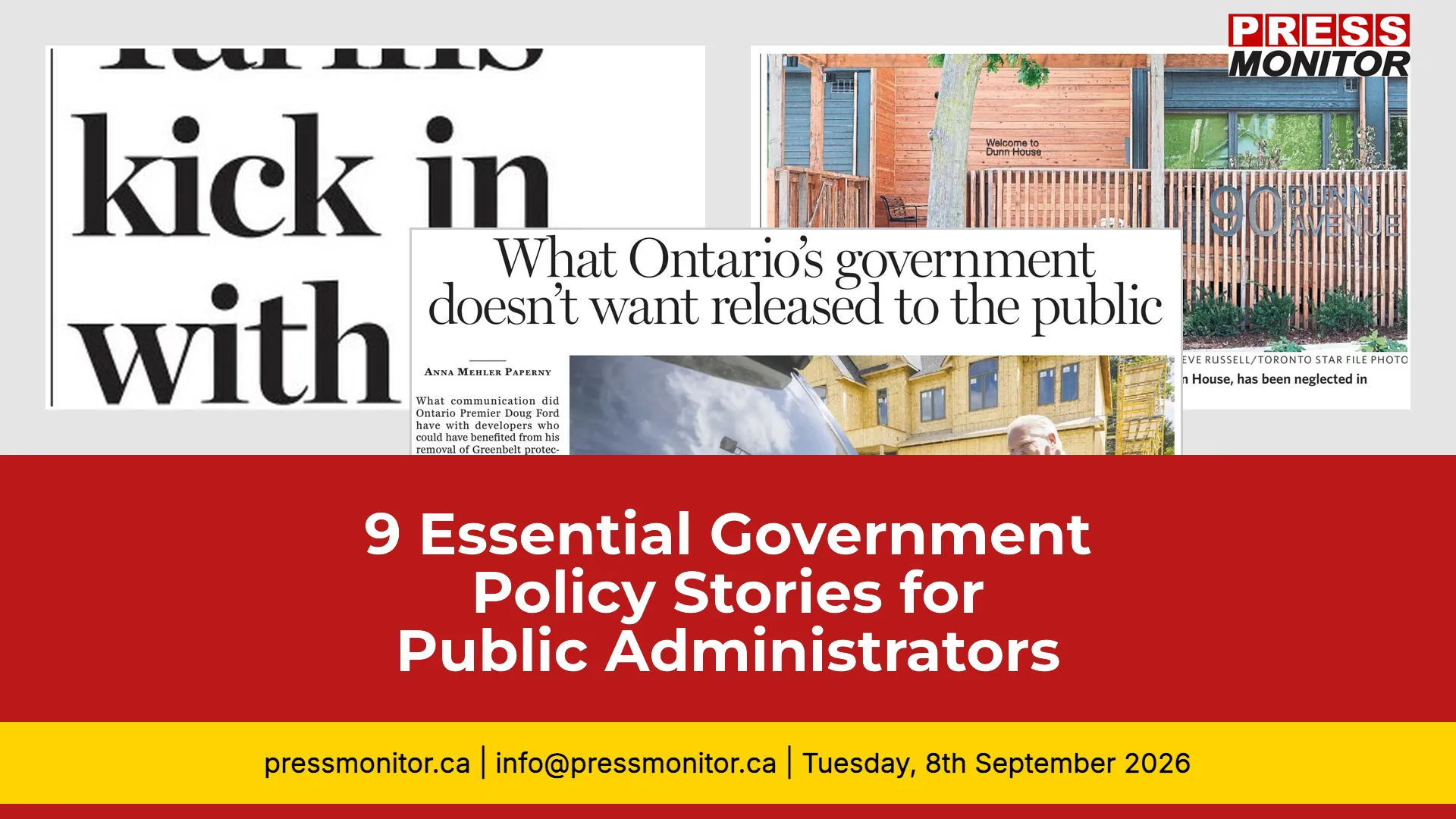
According to Press Monitor's tracking of Canadian publications, this media monitoring roundup covers the top news on government policy shaping Canada's public administration landscape today. From trade wars to fiscal errors to transparency battles, here are the 9 essential stories every public sector professional needs to know.
1. Canada Slaps 50 Percent Tariffs On US Steel And Aluminum
The Toronto Star reports that retaliatory tariffs on nearly $28 billion in American products kick in Tuesday, as trade tensions between Canada and the United States persist with no planned return to the negotiating table. Prime Minister Mark Carney's government is doubling tariffs on American steel and aluminum from 25 per cent to 50 per cent, while hitting other American products including cheese, household appliances, machinery and clothing with import taxes of 15, 25 and 50 per cent. More than 600 products are being tariffed starting Tuesday in the latest round of a tit-for-tat that Trump has vowed to escalate with even more import duties on Canadian autos and steel in the new year.
Why it matters: The retaliatory tariffs on nearly $28 billion in American products mark a major escalation in the Canada-US trade war, affecting supply chains across every province.
Key detail: Tariffs range from 15 to 50 percent on over 600 products, with steel and aluminum duties doubling from 25 to 50 percent starting Tuesday.
Source: Toronto Star, tracked by Press Monitor
Next step: Monitor how Canadian businesses adjust pricing and sourcing strategies in response to the new duties.
2. Canada Needs Tax Reform for Housing
Toronto Star reports that Canada's non-profit housing sector has been neglected for decades, with high construction costs blocking the building of social homes for low-income Canadians. Authors Mike Moffatt and Adam Mongrain argue that targeted tax reform, such as a capital gains tax exemption for sellers of real estate to accredited non-profit housing developers, could create a level playing field and incentivize affordable housing construction.
Why it matters: After four decades of building almost no social housing, targeted tax reform could unlock affordable housing construction for low-income Canadians.
Key detail: A capital gains tax exemption for sellers of real estate to accredited non-profit housing developers is among the proposed solutions.
Source: Toronto Star, Mike Moffatt and Adam Mongrain
Next step: Watch for federal budget announcements on housing tax incentives and advocate for reform in your organization.
3. Ontario FOI Denials Obscure Ford Government
The Ottawa Citizen reports that Ontario's cabinet office refused forty-eight freedom-of-information requests between April 27 and June 19, citing new provincial legislation that allows the premier and his cabinet to keep their office records secret. The legislation, passed as part of omnibus legislation in April, prompted the refusal of requests about Premier Doug Ford's communications with developers, briefing notes on Billy Bishop Airport expansion, his calendar, and meetings with U.S. Ambassador Pete Hoekstra. Journalist Dean Beeby and CCLA director Anais Bussières McNicoll warned the changes undermine government transparency and accountability.
Why it matters: The refusal of 48 freedom-of-information requests under new legislation raises serious concerns about government transparency and accountability.
Key detail: Requests covered Premier Doug Ford's communications with developers, Billy Bishop Airport expansion, and meetings with U.S. Ambassador Pete Hoekstra.
Source: Ottawa Citizen, by Anna Mehler Paperny
Next step: Follow the CCLA's response and any legal challenges to the new omnibus legislation.
4. $1.5 Billion Excel Spreadsheet Error
Business in Vancouver reports that a human error in an Excel spreadsheet caused a $1.5 billion overestimation of natural gas royalties in B.C.'s provincial budget. The error, which included double currency conversion and incorrect unit conversions, was acknowledged by Premier David Eby after persistent questioning by reporter Stefan Labbé. The mistake, which went unchecked through multiple ministry levels for five months, has raised serious concerns about fiscal competence and led to a referral to the auditor general.
Why it matters: A single spreadsheet mistake caused a $1.5 billion overestimation of natural gas royalties, exposing serious gaps in B.C.'s fiscal management.
Key detail: The error went unchecked through multiple ministry levels for five months before being identified, prompting a referral to the auditor general.
Source: Business in Vancouver, by Rob Shaw
Next step: Watch for the auditor general's findings and potential ministerial accountability measures.
5. B.C. Deficit Error Reaches $14.76 Billion
Times Colonist reports that a $1.46 billion error by B.C.'s financial department pushes the fiscal 2026 deficit to $14.76 billion. Premier David Eby claimed unfamiliarity with oil or gas errors while Adrian Dix faced calls for accountability.
Why it matters: A $1.46 billion accounting error pushes B.C.'s fiscal 2026 deficit to $14.76 billion, raising questions about fiscal competence at the provincial level.
Key detail: Premier David Eby claimed unfamiliarity with the oil and gas errors while Adrian Dix faced calls for accountability.
Source: Times Colonist
Next step: Track whether the opposition calls for a public inquiry into the budgeting process.
6. Canada Foreign Agents Registry
Business in Vancouver reports that Canadian businesses face a compliance deadline on August fourth for the new Foreign Influence Transparency and Accountability Act, which establishes a public registry for foreign principal activities. Legal professionals and civic advocates warn the legislations broad definitions could overwhelm registrars with routine filings, while also noting significant gaps regarding private sector political influence and proxy interference. Experts anticipate more interpretive guidance from the new federal commissioner as organizations navigate disclosure obligations and potential prosecution risks.
Why it matters: The new Foreign Influence Transparency and Accountability Act creates a public registry that will affect how Canadian businesses engage with foreign principals.
Key detail: The compliance deadline is August 4, and legal experts warn the broad definitions could overwhelm registrars with routine filings.
Source: Business in Vancouver, by Graeme Wood
Next step: Businesses should prepare their filings and monitor guidance from the new federal commissioner.
7. United States Pressures Canada On Culture Laws
National Post reports that American negotiators recently demanded Canada drop its digital streaming legislation during trade talks, specifically targeting Quebec’s Bill 109 which mandates French-language content on platforms. Former trade negotiator Barry Appleton argues this external pressure highlights years of regulatory surrender and warns that free trade does not require abandoning domestic policy sovereignty. The columnist contends that Ottawa must reclaim control over market rules rather than yielding to foreign tariff threats.
Why it matters: U.S. negotiators demanded Canada drop its digital streaming legislation, targeting Quebec's Bill 109, during trade talks — a sovereignty concern for Canadian cultural policy.
Key detail: Former trade negotiator Barry Appleton argues that free trade does not require abandoning domestic policy sovereignty.
Source: National Post, by Barry Appleton
Next step: Monitor how Ottawa responds to external pressure on cultural and digital legislation.
8. Canada Falls Behind Global Transparency
Ottawa Citizen reports that lawyer Matt Malone's new book Open Governments Secret Canada compares access-to-information regimes worldwide and finds Canada falling behind. The book arrives as Prime Minister Mark Carney's government considers reforms to the Access to Information Act that critics say will restrict transparency. Malone highlights examples from the Netherlands, Ireland, Iceland, and New Zealand where governments have adopted more open practices.
Why it matters: A new book comparing access-to-information regimes worldwide finds Canada falling behind, even as the government considers reforms that critics say will restrict transparency further.
Key detail: Examples from the Netherlands, Ireland, Iceland, and New Zealand highlight more open government practices that Canada could adopt.
Source: Ottawa Citizen, by Matteo Cimellaro
Next step: Watch for the Access to Information Act reform proposals and public consultation outcomes.
9. Canada Resumes Defence Talks With China
The Globe And Mail reports that Canada has restarted military talks with China after a break of more than eight years that began with Beijing's jailing of two Canadians in late 2018. The two countries held a defence co-ordination dialogue on September 4 in Ottawa, according to a statement issued by China's Ministry of National Defense, while Canada's Department of National Defence confirmed the meeting took place but did not publicize it.
Why it matters: After more than eight years of suspended military dialogue, Canada and China have restarted defence co-ordination talks, signaling a shift in bilateral relations.
Key detail: The meeting took place on September 4 in Ottawa, though Canada's Department of National Defence did not publicize it.
Source: The Globe and Mail, by Steven Chase
Next step: Monitor how this renewed dialogue affects Canada's Indo-Pacific strategy and relationships with allies.
Stay informed with Press Monitor's print media monitoring and media intelligence for the government and public administration sector. Which of these stories will have the biggest impact on Canadian public administration in the coming months?