9 Essential Government & Public Administration Stories for Policy Leaders


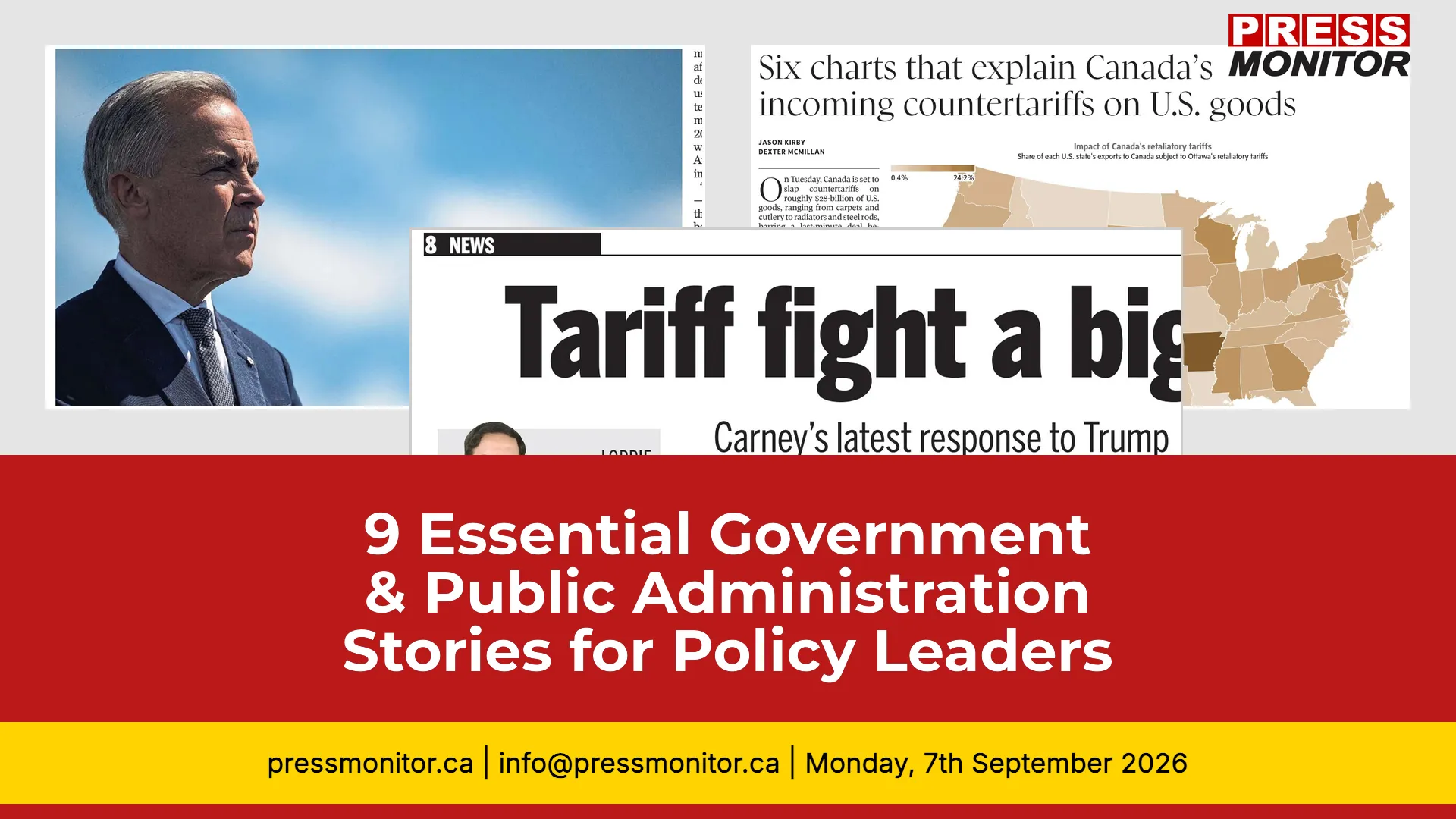
Press Monitor's tracking of Canadian publications reveals a day of pivotal government moves and public sector shifts across Canada. From retaliatory tariffs to digital transformation and labour actions, these stories define the current state of Canadian public administration. ## 1. Trump Tariffs Threaten Canadian Economy The Toronto Star reports that the US government has signalled it will respond to Canadian retaliation, as Trump threatens to increase tariffs on Canadian autos on Jan. 1 in what experts warn could be catastrophic for the Ontario-based sector. Ottawa and provincial governments have pledged support for workers and businesses impacted by the trade war, including through a 7.5 billion dollar aid package that bolsters employment insurance and provides favourable loans to affected businesses. The Canadian economy grew at an annualized rate of 3.3 percent in the second quarter of this year, while University of Calgary economist Trevor Tombe predicts the new American tariffs could shave 0.4 percent off the country's gross domestic product. Why it matters: Auto sector workers and supply chains face immediate disruption. Next step: Monitor Treasury Secretary Scott Bessent's next statement for escalation signals. ## 2. Canada Slaps Countertariffs on $28 Billion of U.S. Goods The Globe And Mail reports that Canada will impose countertariffs on approximately $28 billion worth of U.S. goods on Tuesday, barring a last-minute deal. The duties, which cover hundreds of items ranging from carpets to steel rods, are a tit-for-tat response to President Donald Trump's use of Section 338 of the Tariff Act of 1930 on roughly the same dollar figure worth of Canadian shipments to the U.S. The tariffs are designed to target swing states such as Ohio, Pennsylvania, Michigan, and Wisconsin, and could push Canada's effective tariff rate on U.S. imports to 3.8 per cent, the highest level since the 1980s. Why it matters: This is the largest retaliatory package in Canadian trade history. Key detail: $28 billion in targeted U.S. goods. Source: Globe And Mail. ## 3. $28B In U.S. Tariff Clash Toronto Sun reports that Prime Minister Mark Carney has announced counter‑tariffs ranging from fifteen percent to fifty percent on $28 billion worth of U.S. imports, responding to the U.S. imposition of fifty percent tariffs on $28 billion of Canadian goods. Economic analyst Trevor Tombe estimates that the tariffs will cost Canadians about four billion dollars in the coming months and raise consumer prices by roughly a quarter of a percent, with low‑income households taking the biggest hit. Why it matters: Consumer prices will rise, hitting vulnerable populations first. Next step: Watch for Ontario and Alberta industry responses. ## 4. Carney Tariff Dispute With Trump The Winnipeg Sun reports that Prime Minister Mark Carney ended trade negotiations with the United States government on September 1, 2026, and plans retaliatory sanctions on politically vulnerable Republican areas before the November midterm elections. Treasury Secretary Scott Bessent and Ontario Premier Doug Ford exchanged hostile comments, while commentators Mary Anastasia O'Grady and Laura Ingraham offered contrasting perspectives on the dispute. The article warns that if Carney's account of events proves false, his government could face a collapse similar to John Diefenbaker's in 1963. Why it matters: Political stakes are high for both governments. Source: Winnipeg Sun. ## 5. Trump Threatens Auto Tariffs On Canada Toronto Star reports that the US government has signalled it will respond to Canadian retaliation, as Trump threatens to increase tariffs on Canadian autos on Jan. 1. Experts warn this could be cataclysmic for the Ontario-based sector, and the trade war could be entering a more damaging phase with further escalation. Why it matters: Auto plants in Ontario face a potential shutdown scenario. Next step: Track OEM statements on supply chain contingency plans. ## 6. Carney's New Counter-Tariffs Cost Canadians Billions Ottawa Sun reports that on Tuesday, Prime Minister Mark Carney will impose Canada's latest round of counter-tariffs of between 15% and 50% on 28 billion dollars worth of U.S. imports. University of Calgary economist Trevor Tombe estimates these counter-tariffs will cost Canadians at least 4 billion dollars in the coming months, with lower-income families taking the hardest hit because tariffs function as a regressive tax. The article notes that Carney has acknowledged Canada cannot win a long-term dollar-for-dollar tariff war with the U.S. given its economy is 13 times the size. Why it matters: The fiscal impact is regressive and significant. Source: Ottawa Sun. ## 7. Carney Taps Pichette to Lead Digital Transformation Canada Ottawa Sun reports that Prime Minister Mark Carney has created Digital Transformation Canada, a new agency to scale technologies in the public service. The agency, led by former Google executive Patrick Pichette as CEO, will focus on equipping public servants with modern tools and using government purchasing power to support Canadian digital and AI companies. It will operate under Procurement Minister Joél Lightbound and include a fellowship model to bring private-sector expertise into government. Why it matters: A major public sector modernization push. Key detail: Patrick Pichette, former Google executive, named CEO. Source: Ottawa Sun. ## 8. C$Billions Owed To Ontario Workers The Globe And Mail reports that more than two years after Ontario repealed Bill 124, a law capping wages for public-service workers, around 23,000 members of the Ontario Public Service Employees Union still have not received back pay. Most are front-line social services workers in areas such as child protection, developmental services, and addictions and mental health. The compensation issue is at the heart of a labour stoppage of roughly 4,000 workers who have been locked out or on strike for more than two months. Why it matters: Front-line care services are disrupted. Next step: Watch for OPSEU negotiation updates. ## 9. Ontario Front-Line Workers Strike for Back Pay The Globe And Mail reports that front-line service workers in Ontario are striking to recover pay increases they say they are entitled to after the province repealed a wage-cap law. Community support services for children and adults with disabilities have been temporarily halted due to labour action, while workers argue they remain among the lowest-paid in the public sector despite performing skilled care work. Why it matters: Vulnerable populations lose critical support services. Source: Globe And Mail. Closing: Which of these government actions will have the most lasting impact on Canadian public administration? According to Press Monitor's tracking of Canadian publications, the interplay between trade policy and domestic labour relations defines this moment in Canadian governance.