9 Essential Retail Stories for Industry Leaders


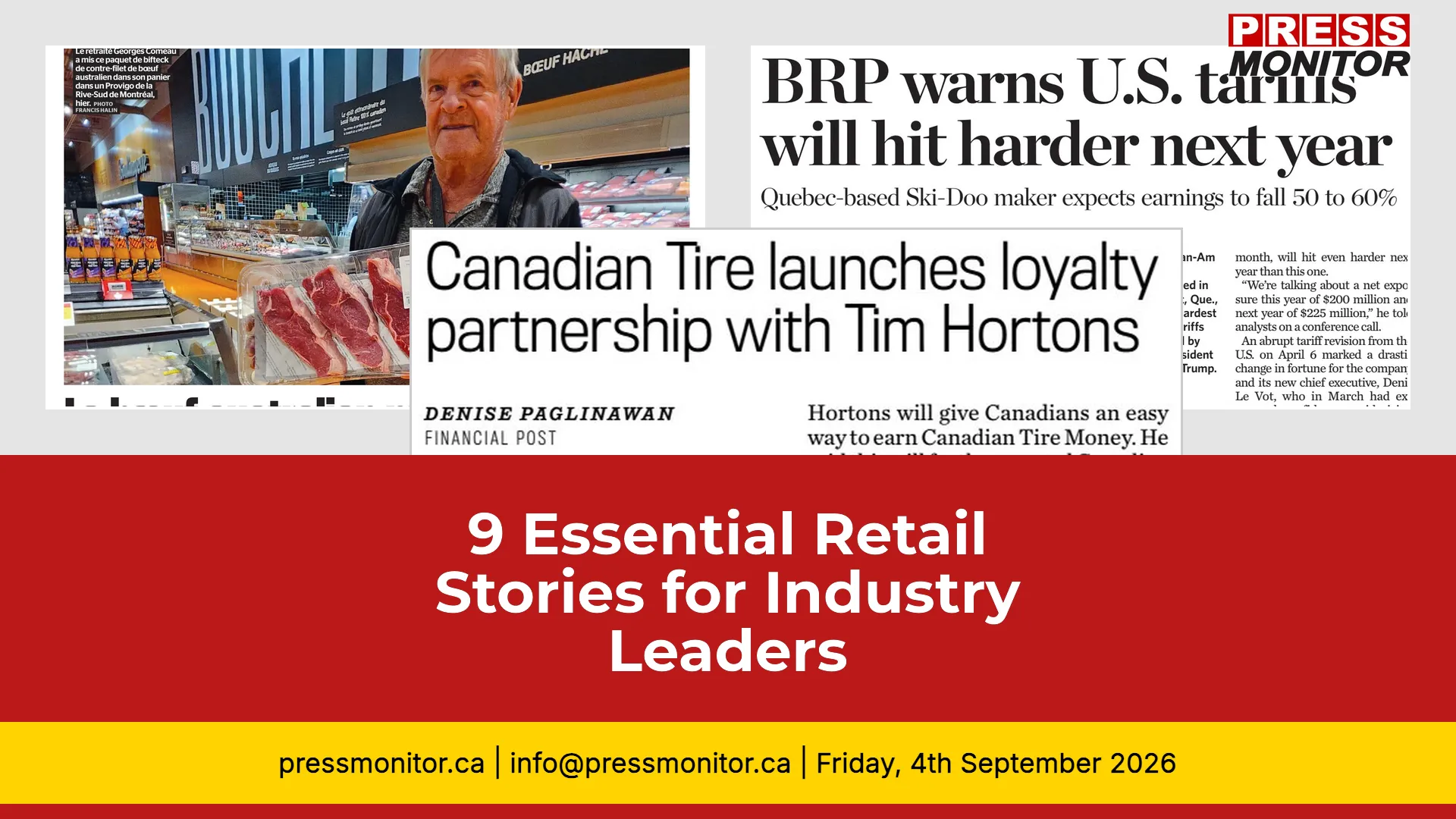
According to Press Monitor's tracking of Canadian publications, this media monitoring report covers nine essential retail stories shaping the consumer goods landscape. From tariff impacts to loyalty partnerships, these developments demand attention from every retail executive. This press review delivers news on retail and consumer goods compiled from Canada's print media ecosystem.
1. Australian Beef Cuts Into Quebec Grocery Market
Le Journal de Quebec reports that Quebec shoppers in Montreal are turning to cheaper Australian beef in grocery stores to reduce their food bills, attracted by prices such as C$10.88 per pound for sirloin tips. The shift is raising concerns among Quebec beef producers, including Giacomo Zoia of Ferme des patriotes and Kirk Jackson of the Canadian Cattlemen's Association, who say local producers need stronger support and face limited volume. Loblaw, parent of Provigo, says most beef in Quebec comes from Canada but also buys from Australia, New Zealand and Mexico to complement its Canadian supply. Quebec shoppers are increasingly turning to discounted Australian beef to reduce food bills, putting local producers under pressure. Prices as low as C$10.88 per pound for sirloin tips are driving the shift, raising concerns among Canadian cattle producers including Giacomo Zoia of Ferme des patriotes and Kirk Jackson of the Canadian Cattlemen's Association. Loblaw's Provigo stores stock both domestic and imported beef, reflecting the competitive dynamics at play.
Why it matters: This trend signals shifting consumer priorities in the grocery sector, with price sensitivity overriding local sourcing preferences. Retailers must balance cost efficiency with supporting domestic agriculture.
Key detail: Sales of beef have declined four percent over the past three months in Quebec.
Source: Le Journal de Quebec, Le Journal de Montreal
Next step: Monitor whether Canadian beef producers receive government support to compete with imports.
2. BRP Faces C$425 Million Tariff Toll
Toronto Star reports that Quebec-based BRP Inc., maker of Ski-Doo snowmobiles and Can-Am vehicles, expects earnings to fall 50 to 60 percent as United States tariffs are projected to cost the company C$425 million over two years. The company raised its fiscal-year revenue forecast to C$9.2 billion to C$9.5 billion while cutting its full-year profit outlook by another C$55 million to C$160 million to C$195 million. Chief Financial Officer Sébastien Martel said Thursday the impact will deepen next year, with Can-Am Spyder models assembled in Valcourt, Quebec, among the hardest hit by tariffs imposed by United States President Donald Trump. Quebec-based BRP Inc., maker of Ski-Doo snowmobiles and Can-Am vehicles, expects U.S. tariffs to cost C$425 million over two years. CFO Sébastien Martel said the impact will deepen next year, with Can-Am Spyder models assembled in Valcourt, Quebec, among the hardest hit by tariffs imposed by U.S. President Donald Trump. The company raised revenue guidance to C$9.2 billion to C$9.5 billion while cutting profit outlook to C$160 million to C$195 million.
Why it matters: Tariff uncertainty is reshaping corporate strategy across Canadian manufacturing. BRP's ability to navigate Section 232 tariffs will influence the broader powersports and manufacturing sector.
Key detail: Earnings expected to fall 50 to 60 percent under current tariff regime.
Source: Toronto Star
Next step: Watch for further guidance revisions as U.S.-Canada trade negotiations evolve.
3. Canadian Tire and Tim Hortons Link Rewards Programs
The Chronicle Herald (provincial) reports that Canadian Tire Corp. Ltd. has officially launched a linked loyalty partnership with Tim Hortons, now active in Canada and involving customers of both brands. The program lets customers connect Triangle Rewards and Tims Rewards accounts to earn Canadian Tire Money on eligible Tim Hortons purchases while continuing to earn points at the coffee chain. Darryl Jenkins of Canadian Tire and Hope Bagozzi of Tim Hortons said the linked accounts expand rewards across more Canadian banners, with Canadian Tire Triangle Mastercard holders receiving extra points at Tim Hortons. Canadian Tire Corp. has launched a linked loyalty partnership with Tim Hortons, allowing customers to connect Triangle Rewards and Tims Rewards accounts. Triangle Mastercard holders receive extra points at Tim Hortons, expanding rewards across more Canadian banners. The coffee chain becomes the fourth brand to join Triangle Rewards alongside Petro-Canada, Royal Bank of Canada, and WestJet Airlines.
Why it matters: This partnership deepens customer lock-in across the Canadian retail ecosystem and sets a benchmark for cross-brand loyalty programs in the retail sector.
Key detail: Customers can earn up to five percent in Canadian Tire Money on eligible Tim Hortons purchases.
Source: The Chronicle Herald
Next step: Track enrollment numbers and redemption rates in the first quarter.
4. Ottawa Extends Fuel Tax Relief Amid Tariff Tensions
The Edmonton Sun reports that Ottawa has decided to extend federal diesel excise tax relief just days before 25 per cent to 50 per cent counter-tariffs on 27.6 billion Canadian dollars of American goods take effect, saving motorists 1.5 cents per litre on gasoline and roughly 1 cent per litre on diesel until January 31, 2027. The federal excise tax will remain suspended until January 31, 2027, saving motorists 1.5 cents per litre on gasoline and roughly 1 cent per litre on diesel, though the relief halves its normal rate for February 1 before being fully restored by July 18, 2026. Dalhousie University's Dr. Sylvain Charlebois argues this targeted approach is more coherent than the 25 per cent counter-tariffs on American foods and other consumer goods imposed on February 4, 2025, which the Agri-Food Analytics Lab warned would function as a tax on Canadians. Ottawa has extended federal diesel excise tax relief until January 31, 2027, saving motorists 1.5 cents per litre on gasoline and roughly 1 cent per litre on diesel. The move comes days before counter-tariffs on 27.6 billion Canadian dollars of American goods take effect. Dr. Sylvain Charlebois of Dalhousie University argues this targeted approach is more coherent than the 2025 counter-tariffs that functioned as a tax on Canadians.
Why it matters: Fuel tax policy directly impacts retail logistics costs and consumer spending power, making this a critical story for supply chain and retail price forecasting.
Key detail: Federal excise tax suspension saves motorists ten cents per litre on gasoline and four cents per litre on diesel.
Source: Edmonton Sun
Next step: Monitor grocery price impacts as counter-tariffs take full effect in September.
5. Canadian Shoppers Outpace U.S. Retail Spending
The Globe And Mail reports that Canadian consumers are demonstrating stronger confidence and higher spending at major retailers like Walmart and Costco compared to their American counterparts, despite soaring gasoline prices and escalating trade war uncertainties. New vehicle sales in Canada rose five point four per cent in August, significantly outpacing the one point three per cent increase recorded in the United States. However, recent Statistics Canada data points to potential cooling, revealing a zero point eight per cent decline in retail sales for July after seven consecutive months of growth. Canadian consumers are demonstrating stronger confidence and higher spending at major retailers like Walmart and Costco compared to American counterparts, despite soaring gasoline prices and trade war uncertainties. New vehicle sales in Canada rose 5.4 percent in August, significantly outpacing the 1.3 percent increase in the United States.
Why it matters: Canadian retail resilience amid global trade tensions signals sustained consumer confidence that benefits retailers and consumer goods brands.
Key detail: Canadian retail sales declined 0.8 percent in July after seven consecutive months of growth, suggesting potential cooling.
Source: The Globe and Mail
Next step: Watch for August retail sales data to confirm whether the July decline was a temporary dip.
6. Lululemon Cuts Fiscal Forecast for Second Time
The Globe And Mail reports that Lululemon Athletica Inc. has lowered its fiscal 2026 revenue forecast for the second time in three months, expecting a five to seven percent decline. The Vancouver-based apparel maker cited ongoing pressure in North America and mainland China, with new CEO Heidi O'Neill set to lead turnaround efforts next week. Lululemon Athletica Inc. has lowered its fiscal 2026 revenue forecast for the second time in three months, expecting a five to seven percent decline. The Vancouver-based apparel maker cited ongoing pressure in North America and mainland China, with new CEO Heidi O'Neill set to lead turnaround efforts next week.
Why it matters: Lululemon's forecast cuts signal broader challenges in the athleisure retail segment and the impact of consumer spending shifts on premium brands.
Key detail: Revenue forecast lowered by five to seven percent for fiscal 2026.
Source: The Globe and Mail
Next step: Monitor Q2 earnings and Heidi O'Neill's first strategic moves as CEO.
7. Hamilton Labour Day Closures Affect Retail Operations
The Hamilton Spectator reports that many services in Hamilton, Ontario will be closed on Monday for Labour Day, the federal statutory holiday, affecting local residents and visitors planning shopping, transit, recreation, and city services. It also lists places remaining open, such as selected Shoppers Drug Mart stores, regional transit on a Saturday schedule, museums, Westfield Heritage Village, the Royal Botanical Gardens, Treetop Trekking, outdoor pools, splash pads, and delayed garbage collection. Many services in Hamilton, Ontario will be closed on Monday for Labour Day, the federal statutory holiday, affecting local residents and visitors planning shopping, transit, recreation, and city services. Selected Shoppers Drug Mart stores remain open, along with regional transit on a Saturday schedule and various recreational facilities.
Why it matters: Labour Day closures impact retail foot traffic and sales projections for the holiday weekend, a key period for consumer spending.
Key detail: Stores including Shoppers Drug Mart, museums, and botanical gardens remain open during the holiday.
Source: The Hamilton Spectator
Next step: Retailers should plan staffing and promotions around the Labour Day weekend closure patterns.
8. Ottawa Pledges 3 Billion for Food Terminals
The Globe And Mail (ottawa/quebec Edition) reports that British Columbia and Manitoba terminal proposals aim to strengthen supply chains and boost competition in response to Ottawa's National Food Security Strategy launched in June. The strategy pledged 3 billion over 10 years to expand domestic processing and production, make supply chains more efficient and improve grocery competition amid rising food costs and trade tensions with the U.S. James Donaldson, chief executive officer at BC Food & Beverage, said the B.C. concept, dubbed the Pacific Gateway, could become a regional trade hub leveraging international trade. British Columbia and Manitoba terminal proposals aim to strengthen supply chains and boost competition in response to Ottawa's National Food Security Strategy launched in June. The strategy pledged 3 billion over 10 years to expand domestic processing and production, improve grocery competition amid rising food costs and trade tensions with the U.S. James Donaldson, CEO at BC Food & Beverage, said the B.C. concept dubbed the Pacific Gateway could become a regional trade hub.
Why it matters: Food terminal investment directly affects retail supply chains and grocery pricing, making this a strategic story for consumer goods retailers.
Key detail: 3 billion Canadian dollars pledged over 10 years for domestic food processing and production.
Source: The Globe and Mail
Next step: Track which provinces and projects receive funding allocations in the coming fiscal year.
9. Calgary Herald Readers Vote for Best Businesses
Calgary Herald reports that readers can vote for the best restaurants, retailers, auto dealers, services and local attractions in Calgary. Voting ends Monday, September 7, 2026 and entrants who select at least ten businesses can win a cash prize of twenty-five hundred Canadian dollars. Enter online to participate in this contest with no purchase necessary. Calgary Herald readers can vote for the best restaurants, retailers, auto dealers, services, and local attractions in Calgary. Voting ends September 7, 2026, with entrants selecting at least ten businesses eligible to win a cash prize of 2,500 Canadian dollars.
Why it matters: Consumer voting drives brand visibility and customer acquisition for retail businesses in Western Canada, highlighting the importance of community engagement in retail marketing.
Key detail: 2,500 Canadian dollar cash prize for voters who select at least ten businesses.
Source: Calgary Herald
Next step: Retailers in Calgary should promote the vote to drive customer engagement and brand awareness.
This print media monitoring review was compiled by Press Monitor from Canadian publications. Which of these retail developments will have the biggest impact on your business in the coming quarter? Share your thoughts in the comments below.
