9 Essential Supply Chain Stories for Procurement Leaders


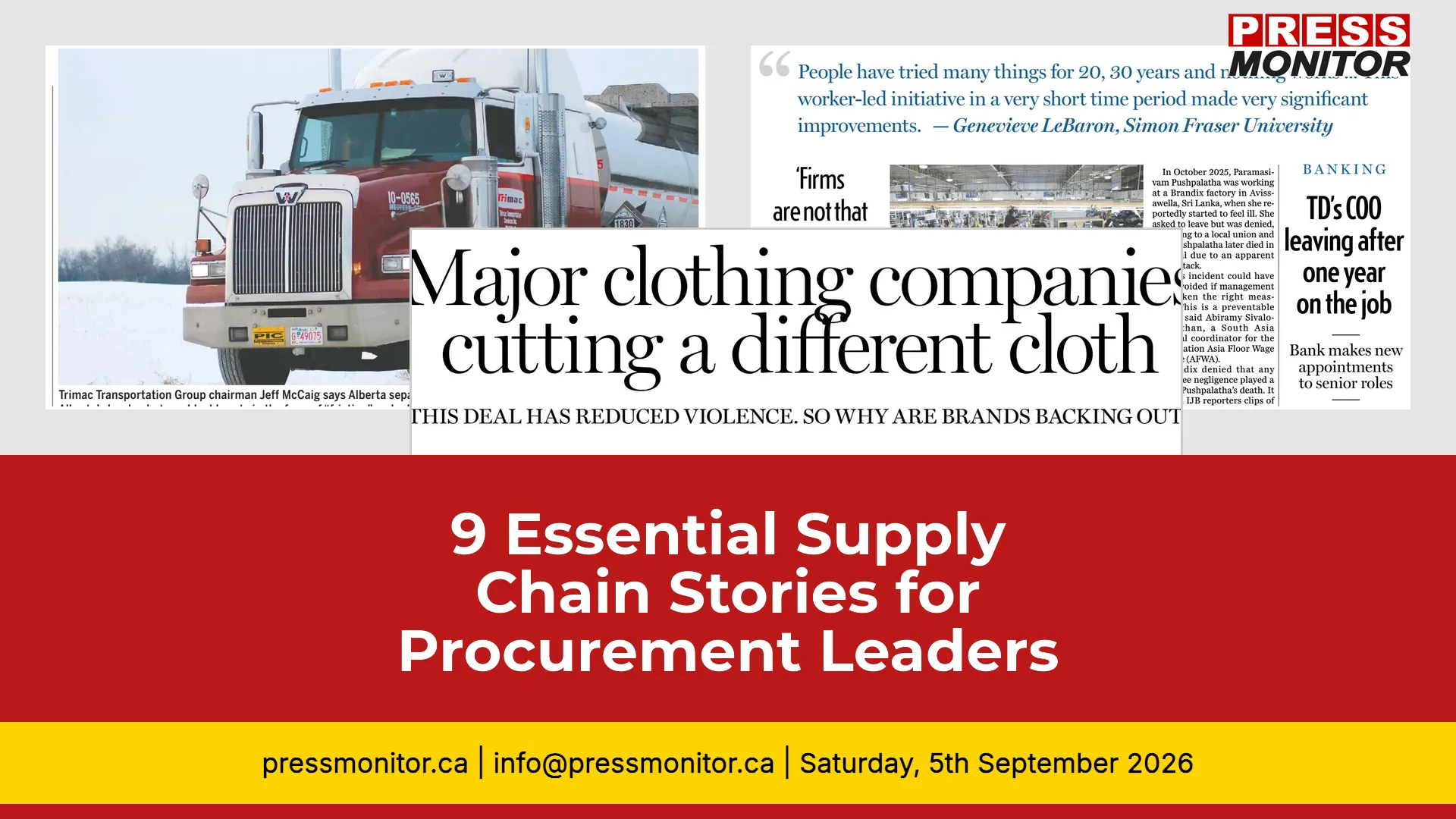
According to Press Monitor's tracking of Canadian publications, this press review delivers nine essential stories shaping Canada's supply chain and procurement landscape today. Powered by media monitoring and media intelligence, our print media monitoring turns Canadian print data into actionable news on supply chain developments.
1. Alberta Separation Would Add Supply Chain Friction
Edmonton Journal reports that Trimac Transportation Group chairman Jeff McCaig says Alberta's separation from Canada would create costly supply chain friction through duplicated regulations and added transaction costs, similar to Brexit. The Canada West Foundation report released Aug. 27 examines the economic implications of separation for industries like trucking and aviation. McCaig warned that while freight would continue crossing borders, businesses would face new layers of documentation and regulatory requirements. Trimac Transportation Group chairman Jeff McCaig warns that Alberta's separation from Canada would create costly supply chain friction through duplicated regulations and added transaction costs, similar to Brexit. The Canada West Foundation report released Aug. 27 examines the economic implications for trucking and aviation. Why it matters: Any border disruption between Alberta and the rest of Canada would ripple through national logistics networks. Key detail: New layers of documentation and regulatory requirements would slow freight movement. Source: Edmonton Journal. Next step: Monitor parliamentary debate on separation referenda.
2. Canadian Brands Lack Supply Chain Transparency
Financial Post Magazine reports that Canadian brands lack supply chain transparency despite worker protections woven into Dindigul-style agreements. Of the 25 Canadian clothing brands reviewed by the IJB, only 10 publicly disclose the factories from which they source garments as no laws in Canada require them to do so. Worker-led initiatives in Dindigul have made significant improvements in gender-based violence and harassment but protections for factory workers are missing engagement from brands. Of the 25 Canadian clothing brands reviewed by the IJB, only 10 publicly disclose the factories from which they source garments as no laws in Canada require them to do so. Worker-led initiatives in Dindigul have made significant improvements in gender-based violence and harassment but protections for factory workers are missing engagement from brands. Why it matters: Without transparency, brands cannot verify ethical sourcing or ensure worker safety. Key detail: 80 percent of brands reviewed fail to disclose supplier facilities. Source: Financial Post Magazine. Next step: Advocate for mandatory supply chain disclosure legislation.
3. Dindigul Agreement Brands Backing Out
National Post reports that a historic labour contract signed in Dindigul, India, in 2O22 improved working conditions for garment workers producing clothing for Canadian brands. However, major clothing brands like Lululemon and Aritzia are pulling out of the agreement or refusing to sign similar ones now that the initial term expired in October 2O25. Researchers at Simon Fraser University found over 8O per cent of workers reported more respect and 87 per cent reported increased wages, but factory executives say brands avoid factories with binding agreements. A historic labour contract signed in Dindigul, India, in 2022 improved working conditions for garment workers producing clothing for Canadian brands. However, major clothing brands like Lululemon and Aritzia are pulling out of the agreement or refusing to sign similar ones now that the initial term expired in October 2025. Why it matters: Worker protections built over three years are unraveling as brands prioritize cost over accountability. Key detail: 87 percent of workers reported increased wages under the agreement. Source: National Post. Next step: Track which brands are exiting the agreement.
4. Brandix Worker Death Sparks Union Outcry
The National Post reports that GLJ Pushpalatha died in hospital after an apparent heart attack at a Brandix factory in Sri Lanka, prompting the Asia Floor Wage Alliance to call it a preventable death. Brandix denied employee negligence and showed CCTV footage of the worker, while buyer Victoria's Secret stated it has clear standards but has not met with the local union. Lululemon sources from Brandix but did not comment, and Aritzia said it has not sourced from the factory since 2024. GLJ Pushpalatha died in hospital after an apparent heart attack at a Brandix factory in Sri Lanka, prompting the Asia Floor Wage Alliance to call it a preventable death. Brandix denied employee negligence and showed CCTV footage of the worker, while buyer Victoria's Secret stated it has clear standards but has not met with the local union. Lululemon sources from Brandix but did not comment, and Aritzia said it has not sourced from the factory since 2024. Why it matters: Fatal workplace incidents expose gaps in brand accountability across complex supply chains. Key detail: Multiple major Canadian-connected brands source from the same factory. Source: National Post. Next step: Review your tier-2 and tier-3 supplier relationships.
5. Ontario Teachers Question Supply Prices
The Daily Press (timmins) reports that Ontario elementary teachers found some school supplies on the government-run Staples portal cost more than on Staples' main website, with a pack of ten Crayola markers priced at $4.82 on the portal versus $2 on the main site. Teachers and the Elementary Teachers' Federation of Ontario questioned whether the portal, part of a $750 annual Classroom Supplies Fund initiative by the Ford government, actually offers the lowest prices. Education Minister Paul Calandra advised teachers to notify their principals rather than complain on social media. Ontario elementary teachers found some school supplies on the government-run Staples portal cost more than on Staples' main website, with a pack of ten Crayola markers priced at $4.82 on the portal versus $2 on the main site. Teachers and the Elementary Teachers' Federation of Ontario questioned whether the portal, part of a $750 annual Classroom Supplies Fund initiative by the Ford government, actually offers the lowest prices. Why it matters: Government procurement portals must deliver genuine savings, not just convenience. Key detail: A 141 percent price markup on basic classroom supplies. Source: The Daily Press (Timmins). Next step: Audit your organization's preferred vendor pricing.
6. 70% of Canadian Small Businesses Hit by Tariffs
Toronto Sun reports that a new poll by Merchant Growth shows 70% of Canadian small businesses depend on U.S. ties and that the counter‑tariffs taking effect on September 8 will hurt them. The survey found that 20% consider U.S. ties core to revenue, 19% important but not critical, and 16% already feel tariff‑related cost pressure. Businesses are cutting spending, delaying hiring, and some are switching to Canadian or non‑U.S. suppliers. A new poll by Merchant Growth shows 70% of Canadian small businesses depend on U.S. ties and that the counter-tariffs taking effect on September 8 will hurt them. The survey found that 20% consider U.S. ties core to revenue, 19% important but not critical, and 16% already feel tariff-related cost pressure. Businesses are cutting spending, delaying hiring, and some are switching to Canadian or non-U.S. suppliers. Why it matters: Tariff impacts are hitting the smallest players hardest, threatening jobs and local economies. Key detail: Nearly one in five small businesses already feel cost pressure from tariffs. Source: Toronto Sun. Next step: Assess your supply chain exposure to U.S. trade policy shifts.
7. Canadian Maker May Shift to U.S.
The Welland Tribune reports that a Canadian Muskoka chair maker hit hard by U.S. tariffs is considering moving the bulk of its manufacturing to the United States. DFC Woodworks Inc. faces a fifty percent duty on furniture exports and might downsize its Kemptville, Ontario operation. The family-run business has been making outdoor wooden patio furniture since nineteen fifty-five and exports about seventy percent of its goods to the U.S. A Canadian Muskoka chair maker hit hard by U.S. tariffs is considering moving the bulk of its manufacturing to the United States. DFC Woodworks Inc. faces a fifty percent duty on furniture exports and might downsize its Kemptville, Ontario operation. The family-run business has been making outdoor wooden patio furniture since 1955 and exports about 70 percent of its goods to the U.S. Why it matters: Tariff-driven offshoring threatens domestic manufacturing jobs and supply chain resilience. Key detail: 70 percent of DFC Woodworks' revenue comes from U.S. exports. Source: The Welland Tribune. Next step: Evaluate nearshoring options and domestic supplier alternatives.
8. Food Prices Hit 3-Year High
{source_name} reports that global food prices reached their highest level since late 2022 in August, driven by extreme weather, drought, and disruptions in the Black Sea region. The United Nations Food and Agriculture Organization said its Food Price Index averaged 133.3 points, with rising costs across cereals, vegetable oils, sugar, meat, and dairy as supply risks grow. The agency also cut its 2026 global cereal production forecast by 3.4 million tonnes to 2.98 billion tonnes, marking the largest annual decline since 2018. Global food prices reached their highest level since late 2022 in August, driven by extreme weather, drought, and disruptions in the Black Sea region. The United Nations Food and Agriculture Organization said its Food Price Index averaged 133.3 points, with rising costs across cereals, vegetable oils, sugar, meat, and dairy as supply risks grow. The agency also cut its 2026 global cereal production forecast by 3.4 million tonnes to 2.98 billion tonnes, marking the largest annual decline since 2018. Why it matters: Rising food costs cascade through supply chains, increasing input costs for manufacturers and retailers alike. Key detail: Global cereal production forecast cut by 3.4 million tonnes. Source: The Globe and Mail via Reuters. Next step: Review commodity hedging strategies and alternative sourcing.
9. C$14.1 Million for 27 Nova Scotia Businesses
The Cape Breton Post reports that the federal government is providing C$14.1 million in funding to 27 Nova Scotia businesses affected by the ongoing trade war with the United States. Sean Fraser, minister of justice and attorney general of Canada, announced the funding in Dartmouth on Wednesday to help companies caught in the tariff crosshairs. The Regional Tariff Response Initiative aims to boost productivity, lower costs, and strengthen supply chain resilience across all sectors. The federal government is providing C$14.1 million in funding to 27 Nova Scotia businesses affected by the ongoing trade war with the United States. Sean Fraser, minister of justice and attorney general of Canada, announced the funding in Dartmouth to help companies caught in the tariff crosshairs. The Regional Tariff Response Initiative aims to boost productivity, lower costs, and strengthen supply chain resilience across all sectors. Why it matters: Government intervention can buffer regional businesses against trade policy shocks, but long-term resilience requires structural adaptation. Key detail: C$14.1 million distributed across 27 businesses. Source: Cape Breton Post. Next step: Monitor whether similar programs expand to other provinces.
Which of these stories will have the biggest impact on your supply chain strategy? Stay informed with Press Monitor's daily tracking of Canadian print media.