9 Pivotal Industrials & Manufacturing Stories for Executives


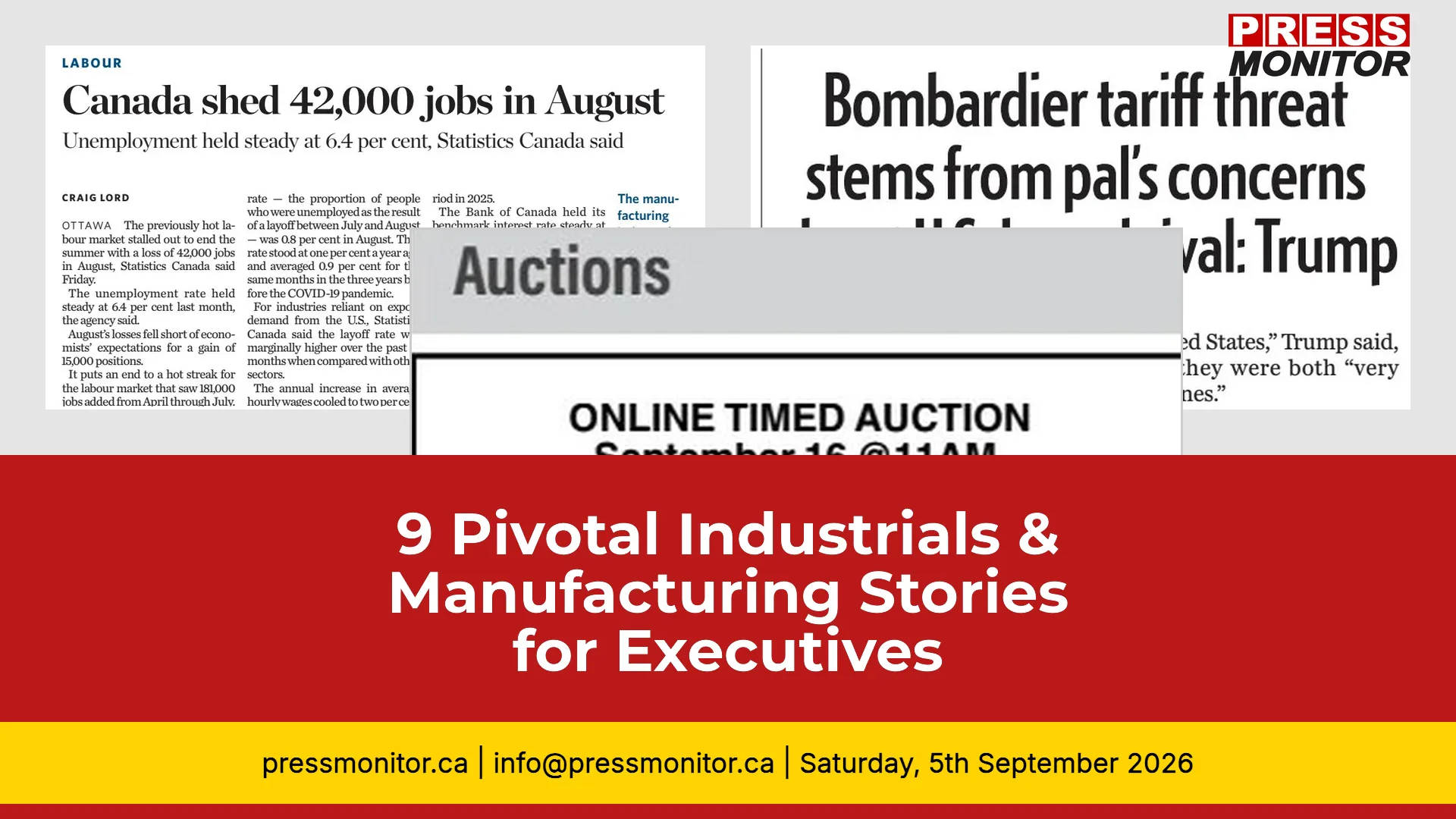
Tracking real-time shifts in Industrials & Manufacturing requires precision. According to Press Monitor's tracking of Canadian publications, today's print landscape reveals critical developments across aerospace, labor markets, and industrial asset liquidations. This press review distills the most impactful data points for decision-makers leveraging advanced media intelligence.
1. Canada Loses 42,000 Jobs in August
The Hamilton Spectator reports that Canada lost 42,000 jobs in August as the labour market stalled, with the unemployment rate holding steady at 6.4%, down from a hot streak that saw 18,000 jobs added from April through July. Statistics Canada reported that the public sector shed 20,000 positions for a third straight month, manufacturing gained 22,000 jobs despite US tariffs taking effect on $28 billion in Canadian goods, and young workers aged 15 to 24 faced 19,000 job losses in the month.
Why it matters: Labor market signals directly impact production capacity and supply chain forecasting for industrial operators.
Key detail: Despite a headline loss of 42,000 positions, the unemployment rate held steady at 6.4%. Manufacturing stood out as the sole bright spot, adding approximately 22,000 jobs, underscoring sector resilience amid broader economic headwinds.
Source: The Hamilton Spectator
Next step: Review Q3 hiring trends to adjust workforce planning models.
2. Trump Threatens 50% Tariff on Bombardier
Vancouver Sun reports that U.S. President Donald Trump said the 50 per cent tariff threat targeting Canada's aircraft sector was prompted by a friend who could not buy a Gulfstream corporate jet because Canada would not certify it. Trump made the remark during a six-minute rant in the Oval Office, stating he immediately imposed a major tariff on Bombardier until the planes got certified. The anecdote appeared to reveal what was behind his threat to decertify Canadian-made aircraft and impose tariffs back in January.
Why it matters: Aerospace manufacturers face immediate regulatory and trade barriers that could disrupt export pipelines and certification timelines.
Key detail: U.S. President Donald Trump cited a personal complaint regarding Gulfstream jet certification delays to justify a 50% tariff threat on Bombardier. Transport Canada granted approval weeks after the initial threat, highlighting volatile diplomatic leverage.
Source: Vancouver Sun
Next step: Monitor federal aviation policy updates and reassess cross-border logistics contracts.
3. C$20 Million Industrial Assets Up For Auction
Financial Post Magazine reports that a timed online auction for the assets of Innovation Virentia Inc.'s protein processing facility in Bécancour, Quebec, is set to end on September 16, 2026. The sale, conducted by C3 Auctions & Partners, features more than C$20 million in installed assets, including VetterTec spraydryers, GEA separators, Qualtech SS tanks, and various industrial equipment. Prospective bidders can view the complete catalogue and register online at BidSpotter.com or visit C3.com for a direct link and 3D facility tour.
Why it matters: Large-scale asset liquidations present strategic acquisition opportunities for expanding industrial capacity at discounted valuations.
Key detail: Innovation Virentia Inc.'s protein processing facility in Bécancour, Quebec, features over C$20 million in installed equipment, including VetterTec spray dryers and GEA separators. Bidding closes September 16 via BidSpotter.
Source: Financial Post Magazine
Next step: Evaluate capital expenditure budgets against available secondary market inventory.
4. Canada's Counter-Tariffs Hit US States
Saskatoon Starphoenix reports that Canada's new counter-tariffs on U.S. goods are primarily designed to protect Canadian companies' domestic market share, but with November's U.S. midterm elections looming, the levies will have economic and political effects south of the border, particularly in battleground states such as Michigan, Ohio and Iowa. The federal government says the C$27.6 billion in counter-tariffs set to take effect in less than a week will target industries including steel, aluminum, motor vehicles, dairy products, appliances and industrial equipment.
Why it matters: Retaliatory trade measures create ripple effects across North American supply chains, particularly affecting automotive and steel sectors.
Key detail: A C$27.6 billion counter-tariff package targeting U.S. goods will take effect shortly, heavily impacting battleground states like Michigan, Ohio, and Iowa. The strategy aims to protect domestic market share while applying political pressure ahead of midterm elections.
Source: Saskatoon Starphoenix
Next step: Stress-test supplier dependencies and identify alternative sourcing regions.
5. Birla faces mayoral scrutiny over Hamilton soot
{source_name} reports that mayoral candidates Loomis, Horwath, and Cooper are proposing stricter measures against Birla and industrial emissions amid Hamilton's decade-long soot crisis. The MECP investigation into Birla continues, while past councils allocated funds for air monitors and the city's mobile monitors are being replaced. Candidates discussed a bylaw similar to Oakville's Health Protection Air Quality Bylaw and broader decarbonization efforts.
Why it matters: Environmental compliance and community relations are increasingly tied to operational licensing and municipal support for heavy industry.
Key detail: Mayoral candidates in Hamilton are proposing stricter air quality bylaws following a decade-long soot crisis linked to Birla Carbon emissions. The MECP investigation continues as local governments weigh decarbonization mandates.
Source: The Hamilton Spectator
Next step: Align ESG reporting frameworks with emerging municipal enforcement standards.
6. Carney rejects US trade deal, Canadians rally for independence
The Standard reports that Prime Minister Mark Carney’s decision to walk away from a trade deal with the US has electrified Canadians and awakened a desire for a more independent Canada. The article contrasts this moment with the 1987 Canada-US Free Trade Agreement signed by Brian Mulroney, which former negotiator Simon Reisman opposed, and highlights his support for the earlier Canada-US Auto Pact that increased Canadian economic control. It suggests that Carney’s rejection of the Trump trade deal may make Canadians less receptive to his Toronto investment summit aimed at foreign ownership of national infrastructure and more insistent that Canadians are in charge of their economy.
Why it matters: Sovereign trade positioning reshapes long-term industrial policy and foreign direct investment appetites.
Key detail: Prime Minister Mark Carney’s rejection of a proposed U.S. trade framework has sparked renewed domestic focus on economic self-reliance, contrasting sharply with historical free-trade agreements and signaling a tougher stance on foreign infrastructure ownership.
Source: The Standard (st. Catharines)
Next step: Adjust partnership strategies to align with heightened national sovereignty priorities.
7. C$1,015 Annual Income Loss From Trade War
Ottawa Citizen reports that the Canada-US trade war has mixed effects on housing development. While tariffs on softwood lumber and steel may lower material costs for Canadian builders, they also restrict manufactured goods choices and cause shipping delays. A report by Oxford Economics estimates Canada's GDP difference at 1.9 percent and average household income loss at C$1,015 annually over ten years.
Why it matters: Macroeconomic drag from ongoing disputes impacts consumer spending power and downstream demand for manufactured goods.
Key detail: Oxford Economics projects a 1.9% GDP divergence and an average household income reduction of C$1,015 annually over the next decade. While softwood lumber tariffs may temporarily lower construction material costs, shipping delays and restricted goods choices persist.
Source: Ottawa Citizen
Next step: Model demand elasticity scenarios for residential and commercial real estate sectors.
8. TSX Materials Index Rises 3 O7 Percent
Times Colonist reports that the S&P/TSX Capped Materials Index gained 3 O7 percent while the Information Technology Index surged 43.67 percent. Consumer Staples and Utilities showed modest increases, and the Health Care Index remained unchanged.
Why it matters: Equity performance in materials and industrials reflects investor sentiment toward commodity cycles and manufacturing output.
Key detail: The S&P/TSX Capped Materials Index gained 3.07 percent, outperforming other sectors alongside a surge in technology equities. Utilities and consumer staples posted modest gains, indicating defensive positioning amid trade volatility.
Source: Times Colonist
Next step: Benchmark portfolio allocations against sector rotation trends.
9. Canadian Dollar at 1.3840 US
Times Colonist reports that the Canadian dollar averaged 1.3840 against the US dollar on Friday, September 4, slightly below the previous day's 1.3789. Sector indexes showed gains across materials, industrials, and financials, while the S&P/TSX Capped Information Technology Index surged 3.67 percent. Currency data listed the US dollar at 1.3840, the euro at 1.6038, and the British pound at 1.8665 in Canadian funds.
Why it matters: Currency fluctuations directly affect import costs for raw materials and export competitiveness for Canadian manufacturers.
Key detail: The loonie averaged 1.3840 against the U.S. dollar on September 4, slightly weakening from prior sessions. Broader sector indexes showed gains across industrials and financials, suggesting market adaptation to exchange rate pressures.
Source: Times Colonist
Next step: Hedge foreign exchange exposure for upcoming procurement cycles.
Closing: Navigating today's industrial landscape demands real-time visibility. Effective print media monitoring ensures you never miss a regulatory shift or market signal. Our media monitoring protocols verify every data point before it reaches your desk. Which of these developments will reshape your Q4 strategy? Share your insights below. Tracked by Press Monitor.
