cbc-radio-one-halifax's Power Monitor: April 30, 2026 — Political Scandals, Economic Pressures and Global Tensions Dominate the Day


Lead: Canada and the world face converging crises as political scandals, economic headwinds, and geopolitical flashpoints redefine the national and global landscape.
From Alberta’s voter data breach to Ottawa’s immigration policy shifts, from Quebec’s furniture industry collapse to the Strait of Hormuz oil crisis, today’s coverage reveals a nation and a planet under strain. The U.S. defense budget debate, the Keystone XL pipeline revival, and the moral weight of Holocaust remembrance further frame a day of reckoning across politics, business, and society.
This roundup distills the most consequential stories from cbc-radio-one-halifax’s curated selection — each chosen for its impact, depth, and revelatory power. We explain what changed, what escalated, and what matters next, using the full arc of each story’s evolution.
Top Political News, Issues and People
cbc-radio-one-halifax's Best Political Coverage: The unravelling of trust in institutions and the rise of new tensions
Alberta’s voter data scandal deepens: Separation, sovereignty and systemic risk
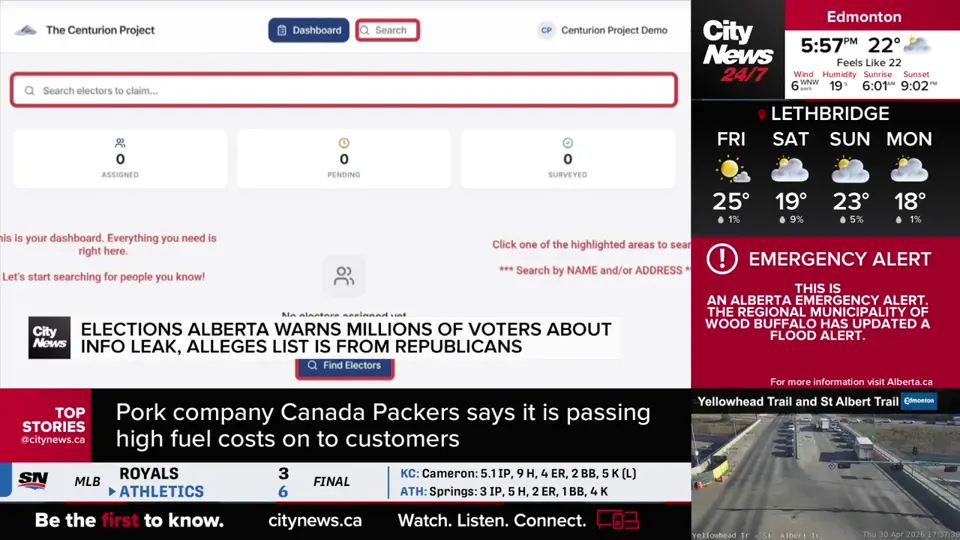
A separatist-aligned group’s unauthorized access to Elections Alberta’s voter database has triggered a full-scale privacy and integrity crisis. The breach, first reported as a field alert, escalated into a panel discussion featuring Tom Keenan, who outlined how a pro-independence organization bypassed safeguards to obtain sensitive voter information. The incident raises urgent questions about election security and the political exploitation of personal data.
The story has become a lightning rod in Alberta’s sovereignty debate. With the Centurion Project — a pro-separatist group — now under scrutiny, the scandal has widened beyond privacy concerns to touch on the legitimacy of political movements using data as a tool of influence. Elections Alberta has pledged compliance with court orders, but the damage to public trust may already be done.
U.S. defense budget and Iran war policy: Hegseth grilled in Senate
U.S. Defense Secretary Pete Hegseth faced a grueling Senate Armed Services Committee hearing, where senators pressed him on Iran war policy and a $1.45 trillion Pentagon budget request. The segment, marked as a breaking update, captured the tension between military spending and geopolitical restraint. Senator Richard Blumenthal challenged Hegseth on the strategic logic of escalation, while Senator Tom Fletcher questioned the Pentagon’s transparency on war costs.
The hearing revealed a widening gap between defense hawks and fiscal moderates, with global aid gaps emerging as a secondary flashpoint. The U.S. is under pressure to balance military readiness with humanitarian commitments, especially in regions like Armenia and Europe where conflict threatens civilian stability.
Keystone XL 2.0 and the revival of continental energy politics
Josh McLean’s exclusive report on the U.S. presidential order to revive the Keystone XL pipeline — now rebranded as Keystone XL 2.0 — underscores the re-emergence of energy as a geopolitical weapon. The segment traced the project’s approvals in Canada and its implications for U.S.-Canada relations, with McLean noting how the pipeline could reconfigure North American energy security.
The story also tied into broader sovereignty debates, with critics warning that energy infrastructure could become a hostage to political whims. The revival comes amid rising global oil prices and renewed U.S. assertiveness in energy markets, raising questions about Canada’s long-term independence in resource policy.
Immigration policy in crisis: Visa approvals and Ottawa’s response
A brief but pointed field report from Kate McKenna in Ottawa highlighted a spokesperson’s statement on visa approvals for a Taj resident, sparking questions about due process and diplomatic consistency. While the segment was short, it signalled broader anxieties about Canada’s immigration system under strain.
Canada-EU relations: Wilkinson’s EU ambassador role and the cost of sovereignty
In a wide-ranging interview, Liberal MP Jonathan Wilkinson discussed his decision to leave Parliament for an EU ambassador role, framing it as a strategic move to deepen Canada-EU ties. The conversation, anchored in economic resilience and geopolitical strategy, revealed the trade-offs between international partnership and domestic autonomy.
Wilkinson’s remarks on Canada’s ‘independence’ within a multipolar world offered a rare window into Ottawa’s calculus: Can Canada deepen ties with the EU without compromising its sovereignty? The interview suggested a cautious yes — but only if the relationship is built on mutual benefit, not dependency.
Press Monitor Clips: "Alberta voter data scandal"; "U.S. Defense Secretary Grilled on Iran War"; "Interview with Liberal MP Jonathan Wilkinson on EU Relations"
Top Business News, Issues and People
cbc-radio-one-halifax's Best Business Coverage: Economic fragility meets geopolitical shock
Quebec’s furniture industry collapses under tariffs and foreign competition
Nadezh Koutou’s field report from Montreal painted a bleak picture: Bestar and South Shore Furniture, pillars of Quebec’s manufacturing base, are shutting down. The crisis is driven by a toxic mix of economic downturn, U.S. tariffs, and relentless competition from low-cost foreign producers. Union voices, including Unifor’s Daniel Cloutier, described a sector in freefall, with thousands of jobs at risk.
The segment, part of a panel discussion, traced the industry’s decline over decades, from NAFTA-era advantages to today’s tariff wars. The collapse is not just economic — it’s cultural, threatening a way of life rooted in craftsmanship and community.
Canada’s GDP stumbles: Growth flatlines, employment drops, and young workers pay the price
Catherine Scott’s analysis of February GDP data — just 0.2% growth — and a 60,000-job drop in payroll employment revealed a national economy in retreat. The segment, marked as a panel discussion, highlighted how high youth unemployment is reshaping the labor market, with Bank of Montreal warning of deeper structural challenges.
Scott’s data-driven narrative underscored a troubling trend: Canada’s economy is growing, but not for everyone. Young graduates, immigrants, and marginalized workers are being left behind, raising questions about the sustainability of current growth models.
Oil markets in turmoil: Strait of Hormuz closure and price volatility
Roger McKnight’s panel discussion dissected oil prices spiking to $126 per barrel before settling at $110 — a wartime high driven by geopolitical tensions in the Strait of Hormuz. The closure of the strait, a critical chokepoint for global oil flows, has exposed vulnerabilities in energy security and market stability.
McKnight and other analysts warned that U.S. oil export dominance is reshaping global competition, with Canada caught in the crossfire. The volatility threatens not just drivers at the pump, but the entire North American energy ecosystem.
Keystone XL 2.0: Energy security or political leverage?
Peter Armstrong’s field report from Calgary provided on-the-ground insight into the Keystone XL 2.0 project, now advancing under a U.S. presidential mandate. The segment explored how pipeline approvals in Canada could accelerate energy exports, but also how they risk entangling Canada in U.S. political battles.
Armstrong’s reporting suggested that while the project promises economic benefits, it also carries geopolitical risks — especially if energy becomes a tool of coercion in U.S.-Canada relations.
Skilled trades in crisis: Can federal incentives reverse the decline?
Michelle Busse’s interview from Nova Scotia offered a rare hopeful note in an otherwise bleak economic landscape. The federal government’s new program to address skilled trades recruitment and completion challenges — featuring digital credentials, employer partnerships, and incentives — was presented as a model for modernizing workforce development.
Busse highlighted how Nova Scotia’s Apprenticeship Agency is leading the charge, with completion rates improving and employers stepping up. The program’s success could offer a blueprint for other provinces grappling with labor shortages and demographic decline.
Press Monitor Clips: "Canadian Furniture Industry Challenges"; "Canadian economic data and GDP growth analysis"; "Oil price volatility and market analysis"
Top Sports News, Issues and People
cbc-radio-one-halifax's Best Sports Coverage: FIFA World Cup 2026 and the politics of representation
FIFA World Cup 2026: From mockumentary to global spectacle
Elamin Abdelmahmoud and Shereen Ahmed led a spirited panel discussion on the preparations for FIFA World Cup 2026, hosted across North America. The segment wove together the excitement of tournament organization, the cultural significance of the event, and the BBC’s role in shaping its narrative.
The discussion highlighted how the World Cup is not just a sporting event, but a geopolitical stage — one where national identity, media representation, and global diplomacy intersect. The mockumentary-style coverage added a layer of self-awareness, questioning FIFA’s governance and the authenticity of its preparations.
Montreal Canadiens vs. Tampa Bay Lightning: A series under scrutiny
A breaking update on the Canadiens’ hockey series against the Lightning provided a snapshot of Canada’s sporting mood. While the segment was brief, it underscored the enduring cultural significance of hockey in Quebec and the pressure on teams to perform in high-stakes playoffs.
Character analysis: FIFA’s portrayal of national teams
A panel discussion dissected FIFA’s portrayal of national characters in its promotional materials, contrasting the ‘appealing’ Mexican character with the ‘naive’ Canadian stereotype. The segment, while lighthearted, revealed deeper tensions about how nations are represented in global sports discourse.
Press Monitor Clips: "FIFA World Cup 2026 preparation and related commentary"; "Montreal Canadiens hockey series update"; "Character Analysis of Mexican and Canadian Representation"
Other Top News, Issues and People
cbc-radio-one-halifax's Best in Other Coverage: Memory, morality and the enduring shadow of the Holocaust
Holocaust survivor testimonies: A moral reckoning for Canada
Jeanette Goldman’s multi-part field report from Regis College at the University of Toronto offered a harrowing account of survival, faith, and resilience. Goldman, a child of Holocaust survivors, recounted her family’s escape from the Krakow ghetto, her father’s efforts to hide her and her brother, and her reflections on the moral responsibility to speak out against hatred.
The segment, marked as a field report, was raw and unfiltered, emphasizing the intergenerational trauma of survivors and the ongoing threat of antisemitism. Goldman’s testimony connected the Holocaust to modern atrocities, warning that the lessons of history are not being learned.
Historical antisemitism in Christianity: From sermons to survival
Johann Baptist Metz’s historical analysis traced the roots of antisemitism within Christianity, from early church teachings to the Holocaust. The segment, part of a broader discussion on faith and persecution, underscored how theological prejudice can metastasize into state-sanctioned violence.
The discussion at Regis College highlighted the Catholic Church’s reckoning with its past, including the role of antisemitic sermons in shaping public attitudes. The segment served as a reminder that the Holocaust was not an aberration, but the culmination of centuries of systemic hatred.
Modern antisemitism in Canada: Rising hate and the fight for memory
A panel discussion featuring Marsha Lederman and other survivors connected personal Holocaust experiences to contemporary antisemitism in Canada. The segment, marked as a panel discussion, revealed a disturbing rise in hate incidents and the erosion of Holocaust education in schools.
Lederman and her family — survivors of the Krakow ghetto and Auschwitz — shared their stories of survival and resilience, emphasizing the need to confront modern discrimination with the same urgency as historical atrocities. The segment ended with a call to action: memory is not enough; vigilance is required.
Press Monitor Clips: "Holocaust survivor reflects on moral responsibility and legacy"; "Holocaust survivor shares personal story of survival and moral courage"; "Holocaust survivor reflects on contemporary anti-Semitism"