citynews-vancouver’s Daily Power Capsule: Global Tensions, Economic Shifts and Local Struggles Dominate April 19, 2026


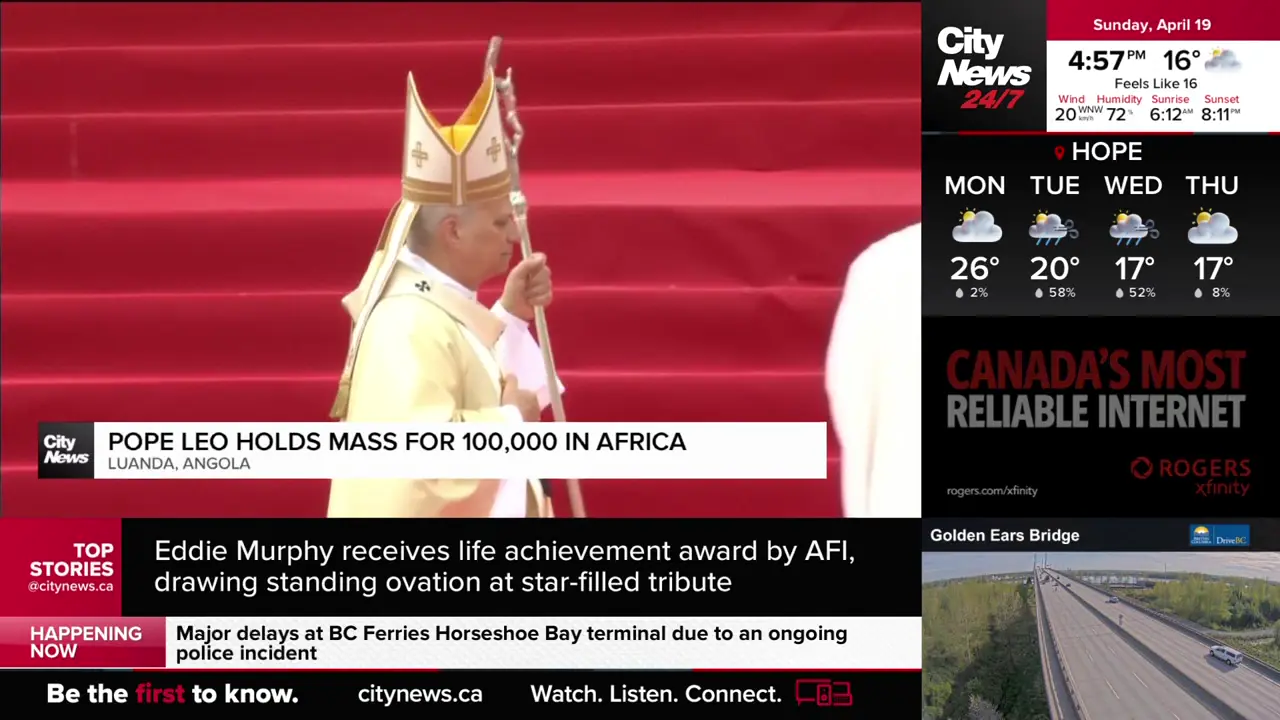
A day of seismic shifts on the world stage—from Pope Leo’s moral clarion call in Angola to Donald Trump’s combative diplomacy—has reframed Canada’s place in a fracturing global order. In Ottawa, Prime Minister Justin Trudeau delivered a blunt rebuke of U.S. trade policy, warning that Canada must assert its economic sovereignty or risk being sidelined in a new era of protectionism. Meanwhile, Finance Minister François-Philippe Champagne faced down a storm of criticism over a controversial Canada-China EV deal that critics say sacrifices Canadian jobs for cheap imports. Back in Vancouver, the city’s fragile balance between growth and environmental stewardship was tested as protests erupted over LNG Canada’s expansion, while gridlock on the Iron Workers Bridge brought the Lower Mainland to a standstill. In the arts, a beloved Vancouver theatre teetered on the brink of closure, threatening hundreds of jobs and a cultural landmark. And halfway across the world, a mass shooting in Louisiana left eight children dead, a stark reminder of the fragility of community safety in an age of unchecked violence.
Top Political News, Issues and People
Prime Minister Justin Trudeau’s 10-minute address to the nation was a watershed moment in Canada-U.S. relations, marking one of the most direct critiques of Donald Trump’s trade agenda since the former president’s return to power. Speaking from Ottawa, Trudeau condemned what he described as ‘unilateral economic coercion’ by Washington, singling out tariffs on Canadian lumber, steel, and energy exports as existential threats to Canada’s industrial base. ‘We cannot allow our economy to become a bargaining chip in someone else’s political game,’ Trudeau declared, a line that resonated deeply in Alberta’s oilpatch and Ontario’s auto sector. The speech capped weeks of escalating tensions after Trump’s administration threatened to impose a 25% tariff on all Canadian energy imports unless Ottawa rolled back subsidies for LNG projects and opened its market to more U.S. electric vehicles. Analysts note that Trudeau’s rhetoric signals a strategic pivot: Canada is no longer content to be a passive player in North American trade, but is instead positioning itself as a defender of multilateralism and environmental standards.
Pope Leo’s Africa Tour and the Trump Debate: A Moral Counterpoint to Global Divisions
Pope Leo’s four-nation Africa tour reached its emotional zenith in Luanda, Angola, where he celebrated mass for over 100,000 worshippers, urging them to overcome ‘decades of conflict and division.’ The pontiff’s visit came amid a global firestorm after his televised debate with Donald Trump, in which he accused the U.S. president of stoking ‘dangerous divisions’ through inflammatory rhetoric and protectionist policies. ‘No leader has the right to exploit fear for political gain,’ Pope Leo said, a thinly veiled rebuke of Trump’s ‘America First’ agenda. Canadian political observers note that the Pope’s intervention has injected a moral dimension into debates over trade and sovereignty, complicating Ottawa’s efforts to balance its alliance with Washington against its commitment to global stability. ‘This is not just about tariffs or GDP numbers,’ said University of British Columbia political scientist Dr. Elaine Chan. ‘It’s about the soul of international cooperation.’
Canada-China EV Deal: Champagne Under Fire as Automakers Warn of ‘Subsidized Invasion’
Finance Minister François-Philippe Champagne is facing a political firestorm over a new trade agreement with China that will see Beijing drop tariffs on Canadian canola in exchange for selling up to 49,000 electric vehicles into Canada annually. The deal, announced in Ottawa, was immediately condemned by the Canadian Vehicle Manufacturers Association, which warned that subsidized Chinese EVs could ‘flood the market’ and undercut domestic production. ‘This is not a trade deal—it’s a Trojan horse,’ said association president Brian Kingston. The controversy deepens Champagne’s already strained relationship with the auto sector, which has accused his government of failing to protect jobs amid a global shift toward electrification. Meanwhile, the IMF’s latest projections show Canada’s GDP growth at 1.5% for 2026—better than most G7 peers but still lagging behind the U.S. at 2.4%. ‘Canada is caught between a rock and a hard place,’ said Scotiabank chief economist Jean-François Perrault. ‘Do we prioritize cheap imports or protect our industrial base?’
Canada-China Trade Agreement: Canola Tariffs and EV Sales in the Crossfire
The Canada-China trade agreement, unveiled in a hastily arranged press conference, represents a high-stakes gamble by Ottawa to diversify its trade relationships amid rising U.S. protectionism. Under the deal, China will reduce tariffs on Canadian canola from 3% to 0%, a move that could save Canadian farmers an estimated $200 million annually. In return, Canada will allow Chinese automakers to sell up to 49,000 electric vehicles in Canada over the next three years, with no reciprocal tariffs. The agreement has drawn sharp criticism from opposition MPs, who argue that it undermines Canada’s commitment to ‘responsible trade’ and environmental standards. ‘We are trading away our principles for short-term gains,’ said NDP trade critic Charlie Angus. The deal also raises questions about Canada’s compliance with the USMCA/KUSMA trade review, which is currently underway in Washington. Analysts warn that the agreement could trigger retaliatory measures from the U.S., further complicating Canada’s trade position.
Press Monitor Clips: Canada-US Relations Under Trump: Prime Minister Trudeau’s Address; Canada-China EV Deal and U.S.-Canada Trade Review; Pope Leo's Africa Tour and Global Political Commentary
Top Business News, Issues and People
LNG Canada Protests: Climate Activists Clash with Energy Sector Over Public Funds and Environmental Harm
Vancouver’s environmental movement took to the streets this week to protest the proposed expansion of LNG Canada’s Phase 2 project, arguing that the $14 billion initiative will lock the province into decades of fossil fuel dependence while doing little to address the housing crisis or transit woes. ‘This project is a relic of the past,’ said Isabelle Sue-Samoysenis, a spokesperson for Wilderness Canada. ‘We should be investing in renewable energy, not doubling down on gas.’ The protests have drawn support from local Indigenous groups, who argue that the project violates treaty rights and threatens sacred lands. Meanwhile, proponents of the project, including former Vancouver mayor Gregor Robertson, insist that LNG exports are critical to British Columbia’s economic future. ‘This is about energy security and jobs,’ Robertson argued in a panel discussion. ‘We cannot afford to turn our backs on a $14 billion investment that will create thousands of high-paying jobs.’ The debate has exposed deep divisions within the province’s political and environmental communities, with no clear resolution in sight.
Iron Workers Bridge Gridlock: Vancouver’s Economic Lifelines Strangled by Political Inaction
The Iron Workers Bridge, a critical artery for the Lower Mainland’s commuters and freight haulers, has become a symbol of Vancouver’s infrastructure crisis. Severe congestion at the bridge has added an average of 45 minutes to daily commutes, costing local businesses an estimated $2 million per day in lost productivity. ‘This is not just an inconvenience—it’s an economic emergency,’ said North Vancouver District mayor Mike Little. The crisis has intensified calls for provincial intervention, with critics blaming years of inaction by both the provincial and federal governments. ‘We’ve been warning about this for a decade,’ said Stuart Muir, a transportation analyst. ‘Now we’re paying the price.’ The gridlock has also raised concerns about the region’s ability to attract and retain talent, with some tech firms reportedly reconsidering expansion plans due to the worsening commute.
Canada’s Economic Outlook: IMF Projects Modest Growth but Warns of Debt and Deficit Risks
The International Monetary Fund’s latest World Economic Outlook has delivered a mixed verdict on Canada’s economic prospects. While the fund projects GDP growth of 1.5% in 2026—higher than most G7 peers except the U.S.—it also warns that Canada’s debt-to-GDP ratio, currently at 43%, could rise to 50% by 2028 if current spending trends continue. Finance Minister François-Philippe Champagne defended the government’s fiscal strategy, pointing to increased investments in defense and infrastructure as necessary steps to ‘future-proof’ the economy. ‘We are balancing growth with responsibility,’ Champagne said in a panel discussion. However, critics argue that the government’s spending plans are unsustainable and could leave Canada vulnerable to future shocks. ‘We’re mortgaging our children’s future for short-term gains,’ said Conservative finance critic Pierre Poilievre.
Canada-China EV Trade Deal: Automakers Warn of ‘Subsidized Invasion’ as Chinese EVs Flood the Market
The Canada-China EV trade deal has sent shockwaves through Canada’s auto sector, with industry leaders warning that subsidized Chinese electric vehicles could ‘flood the market’ and undercut domestic production. The Canadian Vehicle Manufacturers Association has called for urgent government intervention, arguing that the deal violates the spirit of the USMCA/KUSMA trade agreement. ‘This is not fair trade—it’s subsidized dumping,’ said association president Brian Kingston. The controversy has reignited debates about Canada’s industrial strategy, with some analysts calling for a ‘Buy Canadian’ policy to protect domestic automakers. Meanwhile, the deal has also raised concerns about forced labor in China’s auto supply chain, with human rights groups urging Ottawa to impose stricter due diligence requirements on imported vehicles.
Press Monitor Clips: LNG Controversy and Energy Policy Debate; Canada's economic growth outlook and government investments; Canada-China EV Trade Deal and Industry Concerns
Top Sports News, Issues and People
BC Sports Hall of Fame 2026: A Celebration of Athletic Legacy and Community Spirit
The 2026 BC Sports Hall of Fame induction ceremony shone a spotlight on the enduring power of sport to unite communities and inspire generations. Among the inductees were CFL legend Doug Brown, Olympic bobsled champion Justin Cripps, and women’s soccer pioneer Silvana Bertini. The ceremony, held in downtown Vancouver, was a testament to the province’s rich sporting heritage, from the 2010 Winter Olympics to the rise of women’s soccer. ‘These athletes are more than just competitors—they are builders of community,’ said BC Sports Hall of Fame chair Les Wilson. The event also honored three builders and coaches, including Jim Clive, a longtime advocate for beach volleyball in British Columbia. ‘Sport is a force for good,’ said Clive. ‘It teaches discipline, resilience, and the value of teamwork.’ The induction ceremony comes at a time when British Columbia’s sporting community is grappling with the legacy of the 2026 FIFA World Cup, which is set to bring thousands of fans and athletes to the province next summer.
Press Monitor Clips: BC Sports Hall of Fame 2026 Induction Ceremony; BC Sports Hall of Fame Induction Ceremony; Celebrating 20 Years of Sports Legacy
Other Top News, Issues and People
Cryoablation Breakthrough: Minimally Invasive Cancer Treatment Gains Traction in Vancouver
A revolutionary cancer treatment is gaining ground in Vancouver’s medical community, offering hope to patients with breast, colon, liver, kidney, and prostate cancers. Cryoablation, a minimally invasive technique that uses liquid nitrogen to freeze and destroy tumors, is being hailed as a game-changer in oncology. ‘This is a paradigm shift in cancer care,’ said Dr. Richard Fine, a pioneer in cryoablation technology and founder of IceCure Medical. The procedure, which can be performed under local anesthesia, reduces recovery times and minimizes scarring compared to traditional surgery. Clinical trials are underway at the West Cancer Center, with early results showing a 90% success rate in treating early-stage tumors. ‘Patients are going home the same day,’ said Fine. ‘There’s no need for weeks of recovery or chemotherapy.’ The technology is also being explored as a potential alternative to radiation therapy for certain types of cancer.
Mass Shooting in North Louisiana: Eight Children Killed in Domestic Disturbance
A mass shooting in a quiet North Louisiana neighborhood has left eight children dead and a community in mourning. The attack, which unfolded in a domestic disturbance, has sent shockwaves across the U.S., reigniting debates about gun control and mental health. Local authorities have launched a manhunt for the shooter, who remains at large. The tragedy has drawn condemnation from political leaders, including U.S. Vice President J.D. Vance, who called it ‘a senseless act of violence that defies explanation.’ The shooting has also raised questions about the role of social media in radicalizing individuals and the effectiveness of law enforcement’s response to domestic disturbances. ‘This is a failure of our systems,’ said Shreveport Mayor Adrian Perkins. ‘We must do better.’
Iran-U.S. Negotiations and Israel-Lebanon Ceasefire: A Fragile Peace in the Middle East
The Middle East remains a powder keg as Iran and the U.S. engage in high-stakes negotiations in Islamabad, Pakistan. The talks, which have been underway for weeks, aim to de-escalate tensions in the Strait of Hormuz, a critical shipping lane for global oil supplies. Meanwhile, a fragile ceasefire between Israel and Lebanon is holding, though the presence of Israeli troops in southern Lebanon has raised concerns about a potential escalation. ‘The situation is precarious,’ said U.S. State Department spokesperson Matthew Miller. ‘One wrong move could plunge the region into chaos.’ The negotiations come amid a backdrop of global conflicts, from the war in Ukraine to the ongoing crisis in Gaza. ‘The world cannot afford another major conflict,’ said UN Secretary-General António Guterres.
Vancouver Theatre Faces Closure: Arts Community Mobilizes Against Financial Crisis
A beloved Vancouver theatre is on the brink of closure, threatening hundreds of jobs and a cultural landmark that has served the community for decades. The theatre, which has hosted everything from indie plays to community events, has been struggling financially for years, and the COVID-19 pandemic dealt a final blow. ‘This is not just about a building—it’s about the soul of our community,’ said Damien Petty, a longtime advocate for the arts. The closure has sparked outrage among local residents, who have launched a petition demanding that the Vancouver City Council and Park Board intervene. ‘We cannot let this happen,’ said Kristen Schneider, a local artist. ‘The arts are the heartbeat of our city.’ The crisis has also raised questions about the sustainability of Vancouver’s cultural sector, which has long relied on a patchwork of funding sources.
Canada’s Fiscal Health: IMF Warns of Rising Debt and Deficit Risks
Canada’s fiscal position is under the microscope as the International Monetary Fund releases its latest projections, showing the country’s debt-to-GDP ratio at 43%—far lower than the U.S.’s 120%, but still a cause for concern. The IMF warns that Canada’s debt could rise to 50% by 2028 if current spending trends continue, raising questions about the sustainability of the government’s fiscal strategy. Finance Minister François-Philippe Champagne defended the government’s approach, pointing to increased investments in defense and infrastructure as necessary steps to ‘future-proof’ the economy. ‘We are balancing growth with responsibility,’ Champagne said. However, critics argue that the government’s spending plans are unsustainable and could leave Canada vulnerable to future shocks. ‘We’re mortgaging our children’s future for short-term gains,’ said Conservative finance critic Pierre Poilievre.
Press Monitor Clips: Cryoablation for Cancer Treatment: Advances in Minimally Invasive Surgery; Mass Shooting in North Louisiana: Details and Aftermath; Iran-U.S. Negotiations, Israel-Lebanon Ceasefire, and Global Conflicts