11 Essential Automotive & Vehicles Stories for Industry Leaders


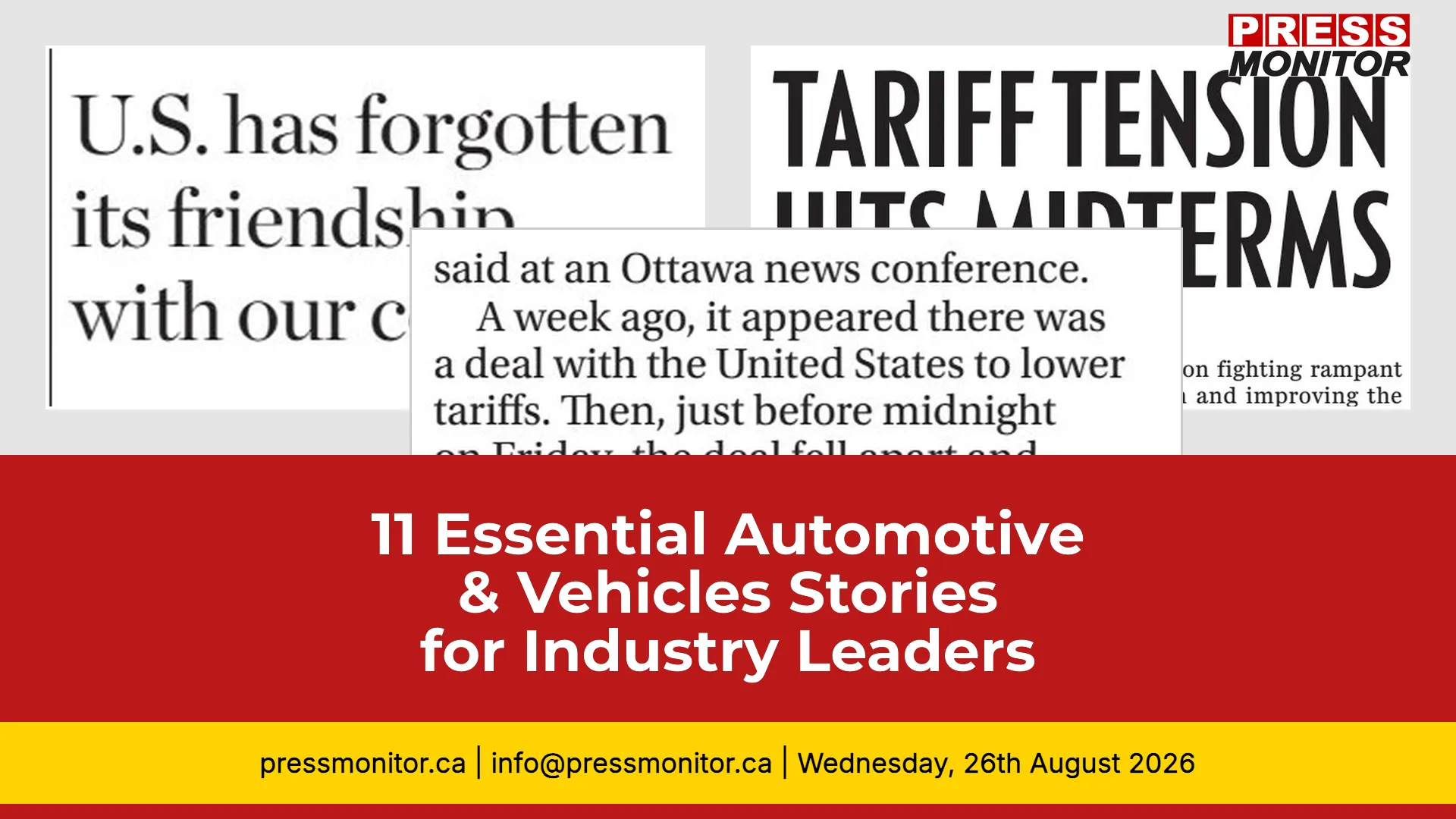
The Canadian automotive industry is at a crossroads. With trade negotiations collapsing, retaliatory tariffs escalating, and a massive EV recall dominating headlines, staying informed is no longer optional—it's a competitive necessity. According to Press Monitor's tracking of Canadian publications, these 11 stories capture the day's most critical developments. Here's your daily media monitoring briefing on news on automotive trade and policy.
1. Carney's Retaliation and Free Trade End
The Toronto Star reports that Prime Minister Mark Carney has the full support of Canadian citizens on the Trump administration’s tariffs. Canadians back Carney’s retaliation against the American tariffs on $28 billion in Canadian exports.
Why it matters: Prime Minister Mark Carney's decision to end free trade talks with the U.S. marks a historic shift in Canada-U.S. relations, with immediate implications for the auto sector.
Key detail: Carney has the full support of Canadians for his dollar-for-dollar tariff retaliation, set to begin September 8. The move effectively ends more than 60 years of economic integration.
Source: Toronto Star, Winnipeg Sun, Vancouver Sun (tracked by Press Monitor)
Next step: Auto industry leaders should prepare for sustained tariff impacts and explore new international partnerships.
Question: How is your supply chain adapting to a post-free-trade reality?
2. Trump Imposes New Tariffs Amid Midterm Push
"Selon The Calgary Herald, le décollapseement d’un accord commercial entre les États-Unis et le Canada, ainsi que l’annonce du président Trump d’imposer de nouvelles tarifs sur les biens canadiens, a ajouté un nouveau choc aux élections américaines déjà dominées par les préoccupations relatives aux prix. Les États-Unis qui dépendent du commerce international, dont la Maine, Michigan et Iowa, sont parmi ceux qui sont à l’avant-garde de la bataille pour le contrôle du Congrès. Certains républicains dans ces États ont exhorté Trump à reculer, notamment Sen. Susan Collins, qui est en lice pour un siège au Maine. "Imposer de nouvelles tarifs au Canada est une erreur," a déclaré Collins à C-SPAN lundi. "Nous devons revenir à la relation économiquement bénéfique et amicale que nous avons avec nos voisins canadiens.", l’escalade du conflit commercial avec le Canada a affecté particulièrement le Michigan, où l’industrie automobile opère librement à travers la frontière, et les inquiétudes sont grandes quant à la menace de prix plus élevés sur les biens de consommation, notamment l’essence, les automobiles et les bâtons de hockey."
Why it matters: The collapse of a trade deal adds shock to U.S. midterm elections, with key states like Michigan and Maine feeling the pain.
Key detail: Sen. Susan Collins (R-Maine) publicly opposed the tariffs, calling them a mistake. The tariffs threaten higher prices on cars, gas, and hockey sticks.
Source: Calgary Herald
Next step: Monitor political shifts in the U.S. that could alter trade policy.
Question: Are you tracking how U.S. midterm dynamics affect your business?
3. Failed US-Canada Tariff Deal
Edmonton Sun reports that a deal with the United States to lower tariffs fell apart, with Champagne refusing to give details while claiming to be standing up for Canada’s economy. The deal was deemed unacceptable due to the American push to keep 25% tariffs on medium- and heavy-duty pickup trucks made at Oshawa’s GM plant and soon to be made by Ford in Oakville.
Why it matters: A deal to lower tariffs fell apart, with Champagne refusing to detail the terms. The American push to keep 25% tariffs on GM and Ford pickups was unacceptable.
Key detail: The tariffs target medium- and heavy-duty pickup trucks made at Oshawa's GM plant and soon-to-be-built Ford Oakville facility.
Source: Edmonton Sun
Next step: Auto manufacturers should assess the impact on their production and pricing strategies.
Question: What is the cost of tariffs on your vehicle lineup?
4. US Tariffs Threaten Canadian Auto Industry
The Globe And Mail reports that U.S. President Donald Trump's social media threats to impose tariffs likely to annihilate the Canadian auto parts industry prompted restrained reactions from domestic executives. Linamar Corp. executives expressed confidence in the eventual prevalence of the USMCA due to undeniable economic benefits to all three countries. Magna International Inc. remained more circumspect, not commenting on ongoing trade negotiations.
Why it matters: Trump's social media threats to impose tariffs that could annihilate the Canadian auto parts industry have executives on edge.
Key detail: Linamar expressed confidence in USMCA, while Magna remained circumspect. The industry is bracing for a potential crisis.
Source: The Globe and Mail (by Andrew Willis)
Next step: Parts suppliers should review contingency plans and diversify markets.
Question: Is your company prepared for a worst-case tariff scenario?
5. Conservative Leader Poilievre on Bailouts
National Post reports that Conservative Leader Pierre Poilievre believes government bailouts won't be a long-term solution to keep Canada’s automotive industry afloat during the trade war with the United States. Poilievre emphasized the need for free trade between Canada and the U.S. to secure the industry's future.
Why it matters: Pierre Poilievre argues that government bailouts are not a long-term solution for the auto industry during the trade war.
Key detail: Poilievre emphasizes that free trade between Canada and the U.S. is crucial for the industry's future.
Source: National Post
Next step: Policy watchers should note the political push for free trade as an alternative to bailouts.
Question: What role should government play in supporting the auto sector?
6. Tesla Recalls 3 Million EVs in China
Toronto Star reports that Tesla has recalled nearly three million electric vehicles in China after regulators warned that electronic door handles could fail during crashes. The recall addresses a safety flaw that can trap occupants inside vehicles, a problem linked to over a dozen fatalities globally.
Why it matters: The recall of nearly three million electric vehicles in China over faulty door handles that can trap occupants is a massive safety and reputational issue.
Key detail: The flaw has been linked to over a dozen fatalities globally. Chinese regulators warned of the danger.
Source: Toronto Star (by Marco Chown Oved)
Next step: EV manufacturers should review door handle designs and regulatory compliance.
Question: How safe are your vehicle's electronic door systems?
7. Quebec Keeps Heavy Truck Door Open to US Sales
Le Journal de Montréal reports that the Quebec government keeps the door open for its state-owned enterprises to buy American heavy trucks, a practice Unifor criticizes as "deeply inconsistent" while steelworkers face U.S. tariffs.
Why it matters: Quebec's decision to allow state-owned enterprises to buy American heavy trucks is criticized by Unifor as inconsistent while steelworkers face U.S. tariffs.
Key detail: Unifor calls the practice deeply inconsistent, highlighting the tension between trade policy and labor solidarity.
Source: Le Journal de Quebec
Next step: Labor leaders and policymakers should address the contradiction.
Question: Should provinces align procurement with federal trade strategy?
8. U.S. Imposes New Tariffs on $276 Billion
“Selon {source_name}, Canada’s counter-tariff schedule stretches to l8 pages, covering a bewildering list of 7OO items, ranging from ornamental fish and seafood to golf clubs and fishing poles,” {source_name} reports that the federal government has announced new tariffs on 893 consumer and industrial products imported from the U.S., worth $276 billion. Steel & iron: 249 products, Seafood: 254 products. The tariffs are scheduled to take effect on Sept. 8. At home, Lane said Revival will be looking for more straightforward financial assistance than the package extended to businesses in 2O25 that the company didn’t qualify for. Ottawa, on Tuesday, unveiled $7.5 billion in spending on support programs to help businesses and workers weather tariff impacts.
Why it matters: The U.S. has placed tariffs on $276 billion worth of consumer and industrial products, including 249 steel and iron products and 254 seafood products.
Key detail: Canada's counter-tariff schedule covers 893 items, worth $276 billion. Ottawa also unveiled $7.5 billion in support programs.
Source: Vancouver Sun
Next step: Businesses should check if their products are on the tariff lists and apply for support.
Question: Are you eligible for Ottawa's business support programs?
9. Ottawa's Latest Tariffs: Higher Prices and More Questions
Toronto Sun reports that Ottawa has imposed new tariffs on nearly $28 billion worth of American goods, starting on September 8. Tariffs ranging from 15% to 50% will be applied to a wide range of American imports, including kitchen appliances, meat, fish, and various industrial inputs. This move is Canada's response to the United States' tariffs on Canadian goods, which will have significant consequences for Canadian workers, businesses, and communities.
Why it matters: Canada's retaliatory tariffs on nearly $28 billion of American goods will raise prices for consumers and businesses.
Key detail: Tariffs range from 15% to 50% on kitchen appliances, meat, fish, and industrial inputs, effective September 8.
Source: Toronto Sun
Next step: Companies should adjust pricing and sourcing strategies.
Question: How will these tariffs affect your input costs?
10. Canadians Urge Strength Amid U.S. Threats
Times Colonist reports that several British Columbians are calling for Canada to resist economic coercion and tariffs from the United States. Citizens are urging a shift toward buying local and supporting the domestic agricultural sector to ensure national sovereignty.
Why it matters: British Columbians are calling for resistance to economic coercion and a shift toward buying local to ensure sovereignty.
Key detail: Citizens are urging support for the domestic agricultural sector and local businesses.
Source: Times Colonist
Next step: Brands and retailers should highlight local sourcing in their messaging.
Question: Are you capitalizing on the 'buy local' sentiment?
11. Ontario Voters' Historical Opposition to Free Trade
The Toronto Star reports that if it was up to Ontario voters, Canada would never have signed the initial 1989 Free Trade Agreement. Concerns about job losses heavily impacted PC support in ridings like London East and Northumberland.
Why it matters: Historical context: if it were up to Ontario voters, Canada would never have signed the 1989 Free Trade Agreement. Concerns about job losses resonate today.
Key detail: The article reflects on how free trade fears shaped political support in ridings like London East and Northumberland.
Source: Toronto Star (by Mark McQueen)
Next step: Use historical lessons to inform current trade policy advocacy.
Question: What can we learn from past trade debates?
This daily press review is powered by Press Monitor's media intelligence, tracking Canadian print media to keep you ahead of the curve. From tariffs to recalls, we've got the stories that matter. Stay informed, stay competitive.