13 Essential Accounting and Tax Stories for CFOs


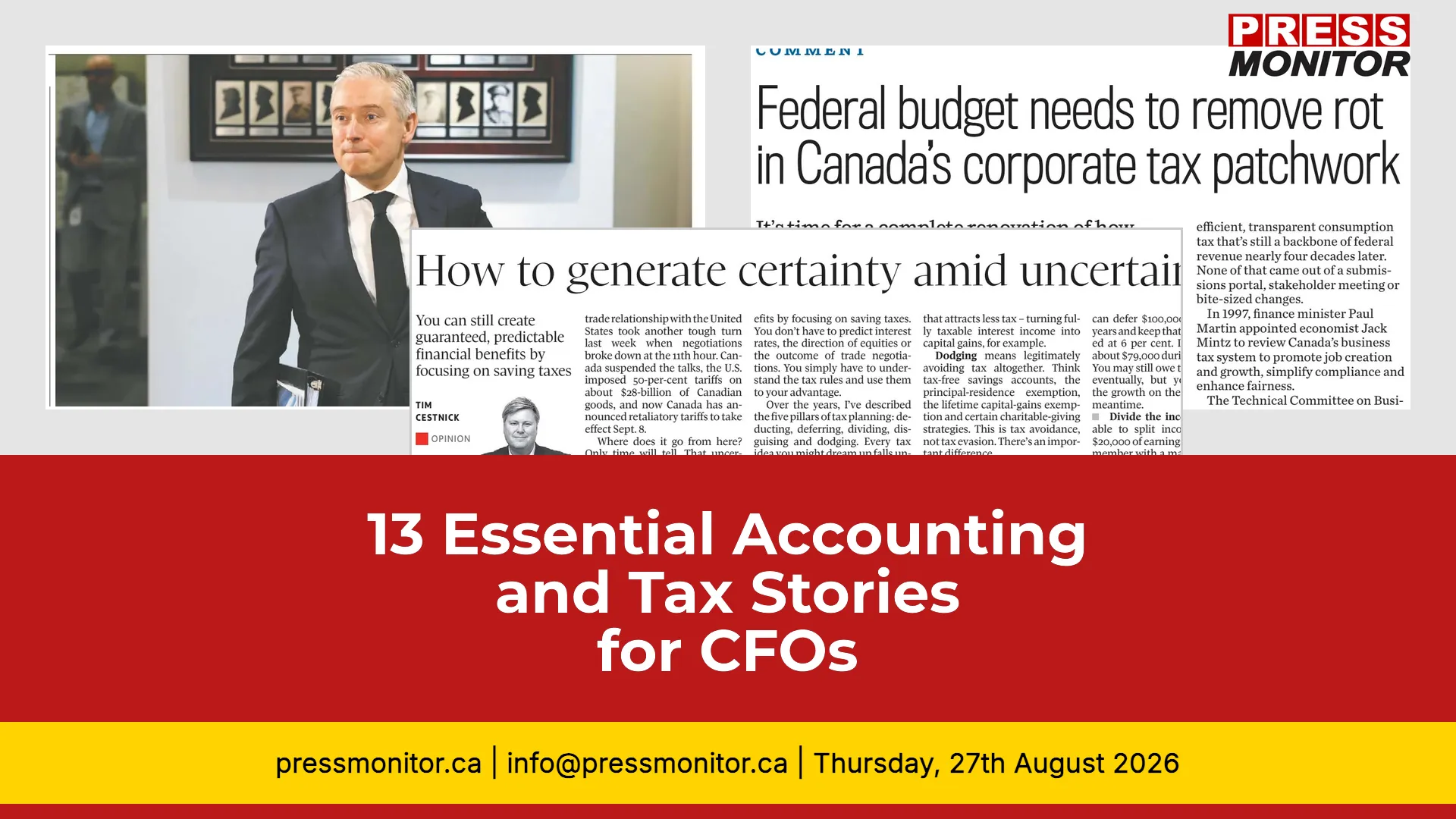
Stay ahead of Canada's evolving accounting, tax, and corporate secretarial landscape. According to Press Monitor's tracking of Canadian publications, the latest headlines reveal critical shifts in corporate tax policy, TFSA rules, and municipal governance. Here are 13 essential stories powered by print media monitoring.
1. Champagne to Review Canada’s Corporate Tax System
Finance Minister Frangois-Philippe Champagne needs to deliver the meaningful review of Canada’s corporate tax system promised by the Liberals during the 2025 election campaign, Kim Moody writes. HYUNGCHEOL PARK FILES
Why it matters: Finance Minister Francois-Philippe Champagne is under pressure to deliver a meaningful review of Canada’s corporate tax system, a promise from the 2025 Liberal campaign. This could reshape tax policy for years.
Key detail: Kim Moody, FCPA, TEP, calls for a comprehensive overhaul.
Source: Regina Leader-post and Saskatoon Starphoenix
Next step: Monitor the upcoming budget for proposed changes.
2. Federal Budget Needs to Remove Rot in Canada’s Corporate Tax Patchwork
Regina Leader-post reports that it’s time for a complete renovation of Canada’s corporate tax system. The government seems determined to patch it rather than undertake a full rebuild.
Why it matters: The government is patching rather than rebuilding the tax system. A full renovation is overdue.
Key detail: Kim Moody argues that incremental fixes will not solve structural issues.
Source: Regina Leader-post and Saskatoon Starphoenix
Next step: Watch for signals from the Finance Minister on comprehensive reform.
3. Tax Focus: Five Pillars of Strategy Amid Trade Uncertainty
THE GLOBE AND MAIL reports that tax planning offers predictable financial benefits amid trade uncertainty. The article outlines five tax strategy pillars - deducting, deferring, dividing, disguising, and dodging - with examples demonstrating how taxpayers can build wealth through legal savings and investments. Retirement savings and retirement income splitting are highlighted as key components of long-term wealth building.
Why it matters: With trade uncertainty, tax planning offers predictable financial benefits.
Key detail: The article outlines deducting, deferring, dividing, disguising, and dodging—with legal examples.
Source: The Globe and Mail
Next step: Review your tax strategy against these pillars.
4. Vancouver Woman Fined $100,000 for Tax Evasion
The Times Colonist reports that a Vancouver woman, Thi Nhan Nguyen, also known as Lynn Nguyen, has been sentenced to a nine-month conditional sentence after evading more than $100,000 in income taxes by pretending a rental property was her principal residence.
Why it matters: Tax evasion carries severe penalties. This case highlights CRA enforcement.
Key detail: Thi Nhan Nguyen pretended a rental property was her principal residence, evading over $100,000 in income taxes.
Source: Times Colonist
Next step: Ensure all property designations are accurate in your filings.
5. Single-Family Homes Benefit Most From Ontario’s HST Rebate
"Selon The Globe And Mail (ottawa/quebec Edition), les ventes de maisons unifamiliales, et non d’immeubles de condos, sont les principales bénéficiaires de la remise de l’HST en Ontario. Les ventes de maisons individuelles ont atteint un niveau record en juillet, tirées par cette incitation fiscale. Malgré l’intention des gouvernements fédéral et provincial d’utiliser la mesure pour se débarrasser des stocks de condos non vendus et relancer l’industrie de la construction, elle a principalement stimulé les ventes de maisons unifamiliales. Les transactions de maisons unifamiliales ont dépassé les 10 ans d’média par 50 %, atteignant un maximum enregistré depuis 2021."
Why it matters: The HST rebate, intended to clear condo inventory, is instead boosting single-family home sales.
Key detail: Single-family home sales in July hit a record high, 50% above the 10-year average.
Source: The Globe and Mail and Toronto Star
Next step: Homebuyers and developers should adjust strategies based on this trend.
6. TFSA Limit $10,900 for 2026
The Hamilton Spectator reports that Canadian savers can contribute up to $10,900 to their Tax-Free Savings Account in 2026, calculated based on total contributions, not investment market value. Financial advisor Thie Convery advises logging into the Canada Revenue Agency account at canada.ca to check personal contribution room.
Why it matters: The annual TFSA contribution limit increases, affecting savings and investment planning.
Key detail: The limit is based on total contributions, not market value. Check your CRA account.
Source: The Hamilton Spectator
Next step: Log into your CRA My Account to verify your contribution room.
7. Understanding TFSA Contribution Room
The Hamilton Spectator reports that TFSA contribution room is calculated based on contributions and not market value. Individuals need to monitor their contributions and withdrawals to avoid penalties.
Why it matters: Avoid overcontribution penalties by understanding how room is calculated.
Key detail: Contribution room is determined by deposits and withdrawals, not market value.
Source: The Hamilton Spectator
Next step: Monitor your contributions and withdrawals regularly.
8. $109K TFSA Contribution Room Demystified
{source_name} reports that tax-free savings accounts (TFSAs) allow Canadians to grow investments without taxation on earnings or withdrawals. Contribution room is calculated annually by the Canada Revenue Agency based on deposits and withdrawals. The article clarifies that market values do not affect contribution limits and provides guidance on checking balances via CRA's My Account portal.
Why it matters: The cumulative TFSA limit has reached $109,000, offering significant tax-free growth potential.
Key detail: Market values do not affect contribution limits; only deposits and withdrawals matter.
Source: The Hamilton Spectator
Next step: Use the CRA My Account portal to check your personal limit.
9. TFSA Rules Explained
The Hamilton Spectator reports that TFSAs, established by the federal government in 2009, are tax-free savings accounts available to any Canadian aged 18 and older who has a valid SIN and is a resident of Canada. The annual contribution limit is indexed to inflation and the total current cumulative limit is $109,000. Unused contribution room in any year can be carried forward indefinitely to future years. There are significant penalties if there are overcontributions.
Why it matters: TFSAs are a cornerstone of Canadian personal finance. Knowing the rules maximizes benefits.
Key detail: Unused contribution room carries forward indefinitely. Overcontributions incur penalties.
Source: The Hamilton Spectator
Next step: Ensure you have not exceeded your contribution limit.
10. Elected Officials' Expenses Exceed Benchmark Rates
Montreal Gazette reports that more than half of the hotel and meal expenses audited for Montreal elected officials in 2025 exceeded the federal benchmark rates used for city employees, according to the city’s auditor general. The annual report also found that Montreal remains far from its waste-reduction target and is falling behind on nearly half of the auditor’s recommendations.
Why it matters: Montreal’s auditor general found that over half of audited hotel and meal expenses for officials exceeded federal benchmarks.
Key detail: The city also lags on waste-reduction targets and auditor recommendations.
Source: Montreal Gazette
Next step: Organizations should review their expense policies against these findings.
11. Montreal's Financial Audit
Montreal's Auditor General delivered her final audit, revealing issues in officials' spending, zero-waste targets, disaster preparedness, and the implementation of previous recommendations.
Why it matters: The final audit by the city’s auditor general reveals systemic issues in spending, disaster preparedness, and recommendation implementation.
Key detail: Only half of the auditor’s recommendations have been fully implemented.
Source: Montreal Gazette
Next step: Compare your own governance practices to these benchmarks.
12. Is Montreal Prepared for a Major Disaster?
Montreal Gazette reports that Montreal can respond to major emergencies, but lacks an approved civil-security management framework and has not determined its resources adequacy. The city has no dedicated financial reserve for disaster-related costs and has not implemented a systematic compliance-testing program for its emergency shelters.
Why it matters: Montreal lacks an approved civil-security framework and has no dedicated financial reserve for disasters.
Key detail: Emergency shelters have not undergone systematic compliance testing.
Source: Montreal Gazette
Next step: Assess your organization’s emergency preparedness and reserves.
13. Potential Investment Super Cycle in Canada
The Globe And Mail reports that TD Economics has outlined an optimistic analysis for Canada, suggesting that if the government takes certain steps, including increasing the competitiveness of its tax and regulatory systems, scaling high-growth companies, and ensuring access to skilled labour, it could unlock an 'investment super cycle.'
Why it matters: TD Economics suggests that with the right tax and regulatory changes, Canada could unlock an investment super cycle worth over $1 trillion.
Key detail: The analysis comes ahead of PM Carney’s investment summit.
Source: The Globe and Mail
Next step: Stay tuned to policy developments that could trigger this cycle.
Stay informed with Press Monitor's daily print media monitoring. Which of these stories impacts your role most? Let us know in the comments.