13 Pivotal Trade Stories for Trade Professionals


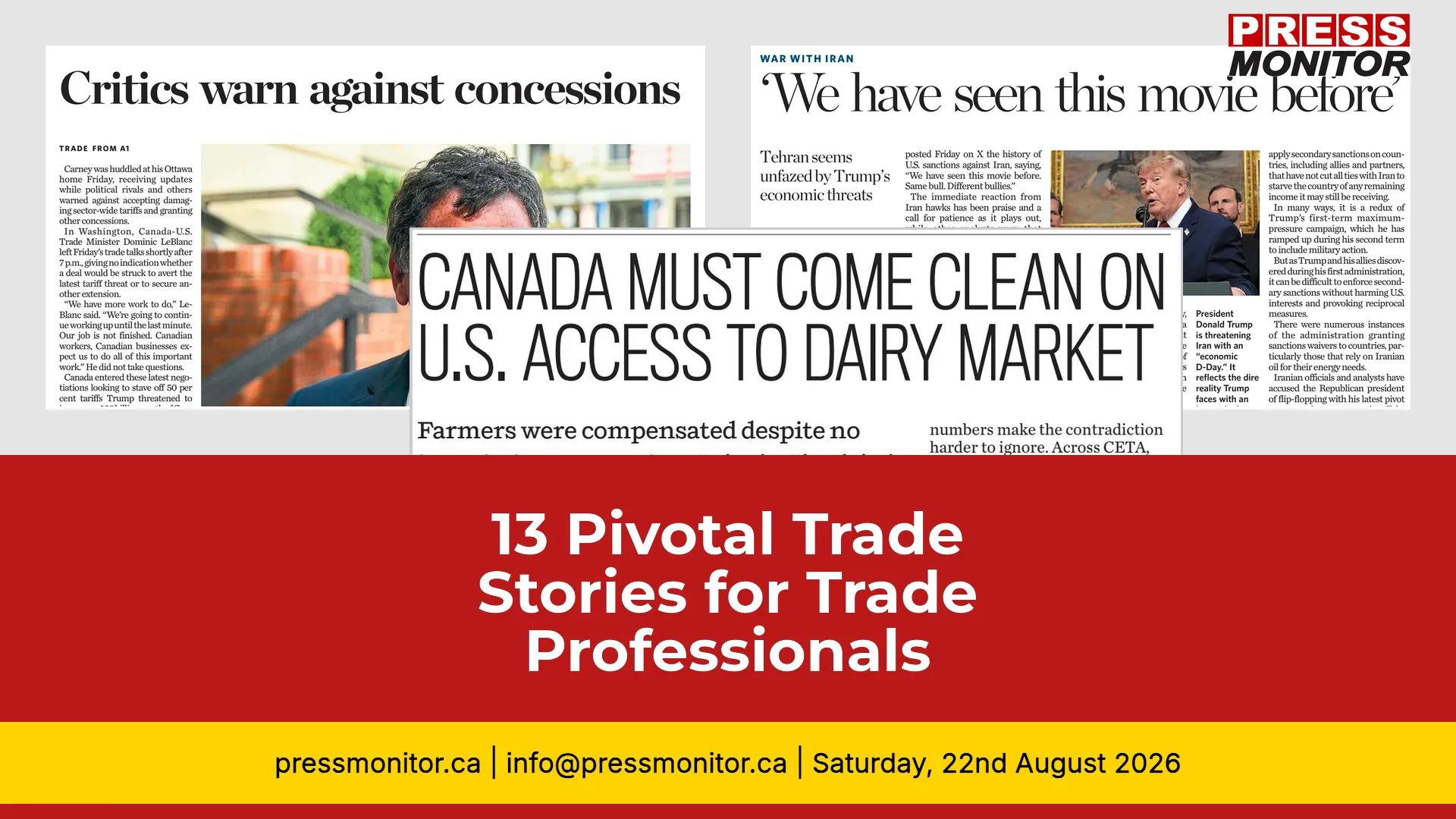
Welcome to your daily press review powered by Press Monitor — tracking trade policy across Canadian print media. These 13 stories capture the most critical developments in Canada-US trade negotiations, tariffs, and global trade dynamics. Use this media monitoring to stay ahead of shifts that could impact your supply chain, compliance, and market access.
1. Intense Talks in Washington as Tariff Deadline Looms
According to a front-page report in The Toronto Star, trade talks are proceeding to a critical juncture in Washington as divisions within Canada’s negotiating team become apparent. With US tariffs set to take effect at midnight, President Trump signaled a deal may be within reach while Prime Minister Mark Carney remained largely out of sight. The US is pursuing a comprehensive trade deal with both Canada and Mexico, while seeking concessions on existing tariffs and pushing for engagement on the CUSMA agreement, sparking considerable political and economic uncertainty in Canada.
Why it matters: Divisions within Canada's team and Trump's pressure create uncertainty.
Key detail: US tariffs on $28B of Canadian goods were set to take effect at midnight, but Trump signaled a deal may be near.
Source: Toronto Star (front page)
Next step: Monitor if Team Canada holds together and what concessions emerge.
2. Trump's New Sanctions on Iran Threaten Global Trade
A front-page report in The Standard says Trump is escalating economic pressure on Iran with unprecedented sanctions to halt its nuclear program and open the Strait of Hormuz. Iran dismisses the threats as familiar, citing decades of failed U.S. efforts, while analysts warn Trump may struggle to enforce secondary sanctions without unintended consequences.
Why it matters: Secondary sanctions could disrupt oil markets and supply chains for China and India.
Key detail: Unprecedented economic warfare to halt Iran's nuclear program and reopen Strait of Hormuz.
Source: The Standard (front page)
Next step: Assess exposure to Iran-linked trade and prepare contingency plans.
3. C$500M to C$700M in Dairy Access Unused
{source_name} reports that Canada has made approximately C$413 million of preferential dairy access available to the United States since July 2020, but only about C$164 million has been used. That leaves roughly C$249 million, or 60 per cent of the negotiated access, unused, representing an estimated C$500 million to C$700 million in American dairy products that could have entered Canada.
Why it matters: Canada's failure to utilize negotiated dairy quotas weakens its negotiating position.
Key detail: Only 60% of preferential access used since 2020, leaving millions in potential US dairy imports untapped.
Source: Regina Leader-Post
Next step: Expect US pressure to fully open the dairy market in ongoing talks.
4. Trump Seeks Keystone XL Revival Amid New Trade Deal
"Selon {source_name} reports that U.S. President Donald Trump is pushing for the reinstatement of the Keystone XL pipeline project, coinciding with a new trade deal with Canada and the imposition of tariffs on Canadian exports. This move aims to secure continued access to oil for the U.S. economy and represents a potential political win for the president, though the investment case and geopolitical alignment remain uncertain," reported {source_name}.
Why it matters: Pipeline revival could lock in Canadian oil exports and reduce tariff risk.
Key detail: Trump pushes for Keystone XL as part of a broader trade deal that may avoid 50% tariffs.
Source: Saskatoon StarPhoenix
Next step: Evaluate impact on energy sector and cross-border investment.
5. Call to End Booze Ban Exposes Cracks in 'Team Canada'
The Globe And Mail reports that as the clock ticked on a trade deal to avert U.S. President Donald Trump’s threat of a new round of punishing tariffs, clear cracks between Canada’s premiers and Prime Minister Mark Carney started to show. Ontario Premier Doug Ford has been completely silent on whether he will accede to a request from Mr. Carney to end the province’s ban on the sale of U.S. alcohol at its liquor stores.
Why it matters: Provincial unity fractures as Ontario Premier Doug Ford stays silent on ending US alcohol ban.
Key detail: Carney asked provinces to remove 'Buy Canadian' preferences and restock US beer.
Source: The Globe and Mail
Next step: Watch for Ford's decision — it could signal broader provincial alignment.
6. US Auto Tariffs Would Still Harm Canada's Industry
The Globe And Mail reports that U.S. proposed 15% auto tariffs would still harm Canada’s industry. Experts say the tariffs would erode automakers’ profitability and spur the domestic industry’s decline.
Why it matters: Even reduced 15% tariffs would erode automaker profitability and accelerate industry decline.
Key detail: Canada's auto sector faces structural challenges regardless of tariff levels.
Source: The Globe and Mail
Next step: Lobby for sector-specific relief in ongoing negotiations.
7. Trump Allows More Beef Imports Without Extra Tariffs
The Toronto Star reports that President Donald Trump announced that his administration will allow more temporary beef imports into the US without triggering higher tariffs. This move has drawn pushback from cattle producers and conservative rural-state Republicans.
Why it matters: Temporary relief for US consumers but angers cattle producers and rural Republicans.
Key detail: Administration authorizes more beef imports to combat domestic price pressures.
Source: Toronto Star
Next step: Canadian beef exporters may see increased access.
8. Ottawa's 'Win' Is a Retreat with Better Lighting
"Selon {source_name}, Ottawa est en train de se retirer avec une meilleure éclairage. Pour une année, Mark Carney avait déclaré qu’il n’accepterait pas une mauvaise affaire. En octobre 2025, il avait promis quelque chose de mieux que l’Accord Canada-États-Unis-Mexique déjà offert. Cette semaine, après qu’une autre date limite de droits de douane soit passée, son gouvernement célèbre un cadre qui ne fait ni l’un ni l’autre. Ce n’est pas mieux que CUSMA. Ce n’est pas l’accord complet que le Canada a passé un an à la traquer. Il ne laisse toujours pas de droits de douane américains sur l’acier, l’aluminium, les voitures, et qui sait quoi d’autre. En juillet, l’ancienne négociatrice de Carney, Kirsten Hillman, avait déclaré qu’éliminer ces droits de douane était l’objectif. Carney lui-même avait reconnu que cet objectif était peu probable, disant qu’il n’y avait pas beaucoup de preuves que Washington accepterait des droits de douane sans frais avec qui que ce soit. Commençons par ce qui est réellement sur la table. Les droits de douane sur l’acier et l’aluminium diminuent d’environ 50 % à 25 %. Les droits de douane sur les voitures tombent de 25 % vers 15, peut-être moins. La menace de Trump de 50 % de droits de douane sur 20 milliards de dollars de biens, celle qui devait frapper à minuit mercredi, est retirée de la table si l’accord est conclu. Le bois de sapin est laissé de côté. En échange, Carney demande aux provinces de restocker la bière américaine, de supprimer les préférences ‘achats canadiens’ et d’ouvrir davantage le marché du lait aux producteurs américains, le tout sans toucher à la gestion de l’approvisionnement. Cette dernière partie vaut la peine d’être examinée. La gestion de l’approvisionnement survit au titre, mais l’accès au marché que Carney accorde porte atteinte à celle-ci, même si subtilement. Il s’agit d’une concession déguisée en préservation."
Why it matters: Analysis suggests the deal is not better than CUSMA and leaves tariffs on steel, aluminum, and autos.
Key detail: Dairy concessions are disguised as preservation of supply management.
Source: Winnipeg Sun
Next step: Read the fine print to understand actual market access changes.
9. Carney's Deal: Time to Diversify?
The Globe And Mail reports that the fine print of the deal between Canadian and U.S. negotiators will reveal whether Mark Carney bought time for Canada to continue its economic strategy. The article discusses Canada's ability to diversify and modernize despite trade pressures from the U.S.
Why it matters: Canada must use this breathing room to modernize and reduce US dependency.
Key detail: The fine print of the deal will reveal how much time Carney bought.
Source: The Globe and Mail
Next step: Corporate strategists should evaluate diversification options.
10. Trump's Tariffs Have Not Brought Home Manufacturing Jobs
The Globe And Mail reports that since his return to office, U.S. President Donald Trump has imposed tariffs on almost every country, scrapping long-standing agreements with allies and rivals alike. Despite the administration’s claims, tariffs have not brought home manufacturing jobs and have not eased pressures around inflation.
Why it matters: Despite claims, tariffs have failed to revive US manufacturing and inflation pressures remain.
Key detail: Data shows no net job gains from tariff policy.
Source: The Globe and Mail
Next step: Use this as leverage in arguing for tariff removal.
11. Ottawa Escalates Trade War
The Globe And Mail reports that Ottawa fires back after rejecting U.S. trade deal. Federal government to respond with retaliatory levies on $28-billion worth of U.S. products.
Why it matters: After rejecting US deal, Canada retaliates with levies on $28B of US products.
Key detail: Retaliatory tariffs hit US goods as negotiations stall.
Source: The Globe and Mail
Next step: Companies should prepare for reciprocal tariff impacts.
12. Kinew Trades Fire with US
Manitoba Premier Wab Kinew criticized US President Donald Trump and Prime Minister Mark Carney while advocating for a tough stance in trade negotiations. He suggested Canadians avoid buying American products amid ongoing tariff discussions.
Why it matters: Manitoba Premier Wab Kinew criticizes Trump and Carney, urges buy Canadian.
Key detail: Kinew advocates for tough stance and avoiding American products.
Source: Calgary Sun
Next step: Provincial trade policies may diverge, creating compliance complexity.
13. Carney May Have Defendable Deal
The Chronicle Herald reports that Donald Trump has signed a deal with Canada to avert tariffs on $28-billion of Canadian products, potentially involving dairy concessions.
Why it matters: Trump signed a deal to avert tariffs on $28B of Canadian goods, possibly involving dairy concessions.
Key detail: The deal is described as 'defendable' by columnist John Ivison.
Source: The Chronicle Herald
Next step: Assess whether the deal holds up under scrutiny.
Closing: This press review highlights the volatility in Canada-US trade relations. For deeper analysis and real-time alerts, rely on Press Monitor's media intelligence — tracking every print mention so you don't miss a shift. What's your biggest takeaway from today's coverage?