15 Pivotal Trade Stories for Canadian Business Leaders


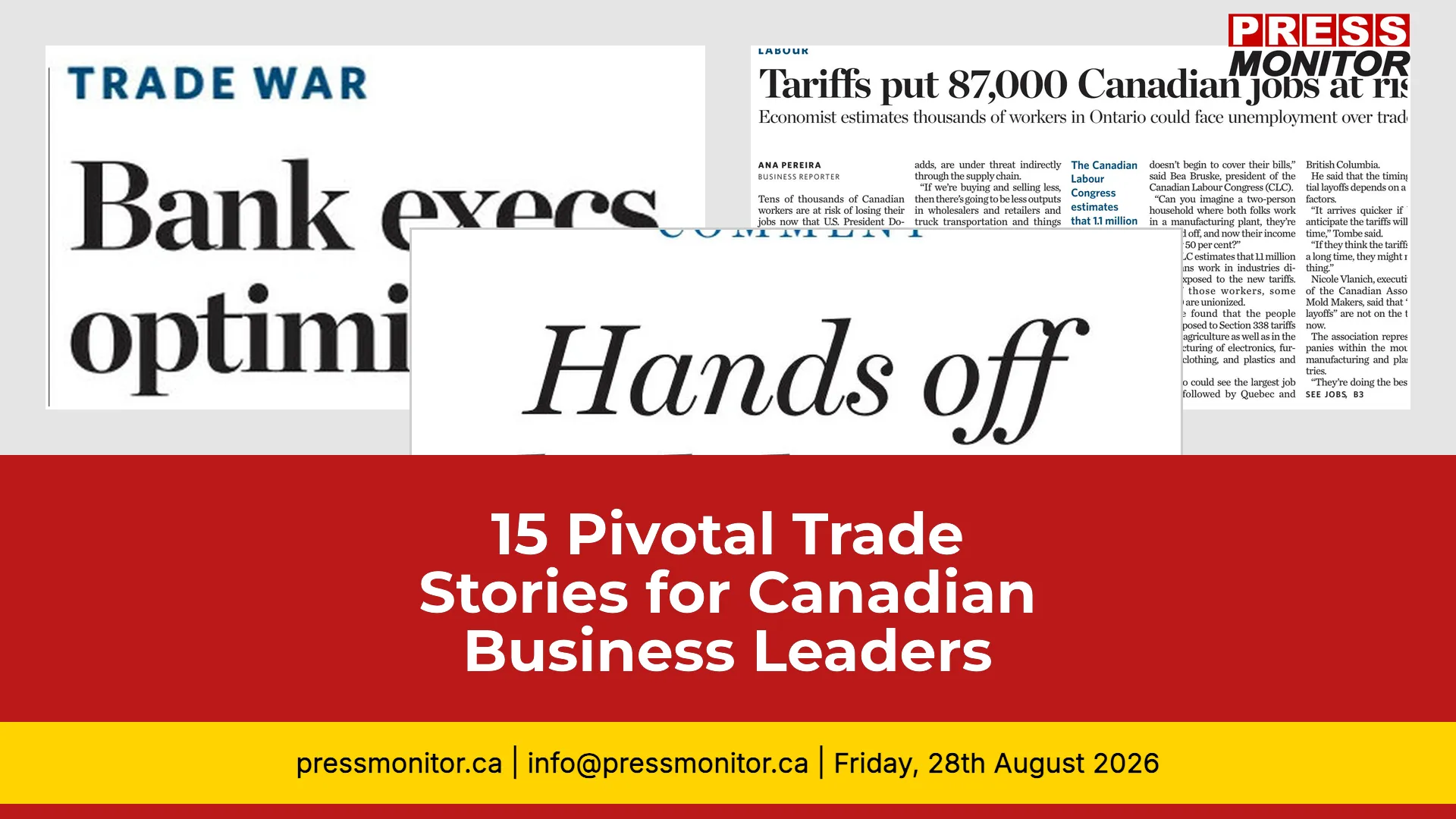
This press review, powered by Press Monitor's media monitoring, brings you the 15 most pivotal trade stories from Canadian print media. From bank optimism to job threats, here's what you need to know about the Canada-U.S. trade war.
1. Bank Executives Optimistic Amid Trade Tensions
The Toronto Star reports that Canada’s big banks see the economy as resilient despite renewed trade tensions. Executives from RBC and Scotiabank characterize the evolving trade situation as manageable for the domestic economy.
Why it matters: Canada's big banks see the economy as resilient despite renewed trade tensions, providing a reassuring signal to markets.
Key detail: Executives from RBC and Scotiabank characterize the evolving trade situation as manageable for the domestic economy.
Source: Toronto Star
Next step: Monitor bank earnings calls for further guidance.
2. Tariffs Put 87,000 Canadian Jobs at Risk
"According to one economist, Tariffs put 87,000 Canadian jobs at risk. University of Calgary professor Trevor Tombe estimated that 87,200 jobs are in jeopardy as a result of the new 50 per cent levies. Fifty-two thousand of those jobs are directly linked to exporters targeted by tariffs, while another 35,000 positions are under threat indirectly through the supply chain. ‘If we’re buying and selling less, then there’s going to be less output in wholesalers and retailers and truck transportation and things like that, because there’s just less stuff that needs to move around and get sold,’ said Tombe. While the impact of Section 338 tariffs on the broader labour market is expected to be relatively small, experts say the levies threaten to upend the livelihoods of individual workers, many of whom might already be struggling to make ends meet. The Canadian Labour Congress estimates that 1.1 million Canadians work in industries directly exposed to the new tariffs"
Why it matters: U.S. Section 338 tariffs threaten tens of thousands of jobs across multiple sectors.
Key detail: University of Calgary economist Trevor Tombe estimates 87,200 jobs are in jeopardy, with 52,000 directly linked to targeted exporters.
Source: Toronto Star, Hamilton Spectator, Welland Tribune, Standard
Next step: Companies should review supply chain exposure and prepare contingency plans.
3. Canada Removes U.S. Seafood Tariffs
Vancouver Sun reports that Finance Canada announced the removal of U.S. seafood and fish products from the list of tariffed goods based on feedback. This decision followed strong opposition from Canadian seafood producers who feared retaliatory tariffs from the U.S.
Why it matters: Ottawa reversed counter-tariffs on seafood after feedback from Canadian producers.
Key detail: Finance Canada removed fish and seafood from the retaliatory list to avoid broader economic harm.
Source: Vancouver Sun
Next step: Importers of U.S. seafood should monitor further policy shifts.
4. Canada-U.S. Trade War Escalates
The trade war between Canada and the United States has officially kicked into high gear after high-stakes talks between the two countries collapsed last weekend. President Donald Trump’s escalated tariffs came into effect on Saturday and series of Prime Minister Mark Carney’s cabinet members unveiled roughly $27.6 billion in counter-tariffs on Tuesday, to take effect on Sept. 8.
Why it matters: High-stakes talks collapsed, leading to $27.6 billion in Canadian counter-tariffs.
Key detail: President Trump's escalated tariffs took effect Saturday; Canada's response takes effect Sept. 8.
Source: Toronto Sun
Next step: Businesses should prepare for immediate cost increases.
5. Carney Eyes Bulletproof Trade Strategy
According to a Toronto Star report, Prime Minister Mark Carney isn't simply aiming to weather the current trade tensions with the U.S., but is seeking to establish a truly independent Canadian economy. He attributes his success as Bank of Canada governor to ‘levers’ he pulled during the 2008 crisis, while acknowledging the challenges of battling US economic influence. The article references historical debates about Canadian sovereignty and recent calls for ‘No, Eh!’ reflecting a long-standing desire for self-determination, suggesting Carney’s strategy is a deliberate effort to secure Canada’s future.
Why it matters: Prime Minister Carney aims to build a truly independent Canadian economy.
Key detail: He draws on his experience as Bank of Canada governor during the 2008 crisis.
Source: Toronto Star
Next step: Watch for policy announcements on economic sovereignty.
6. Canada-U.S. Trade Talks Collapse
The Vancouver Sun reports that the trade talks between the U.S. and Canada for an interim agreement on tariffs collapsed late Friday evening, after Prime Minister Mark Carney paused negotiations. U.S. Commerce Secretary Howard Lutnick said Canada walked away from a trade agreement with the U.S. due to 'political purposes' that involved Quebec’s forthcoming provincial election and Alberta’s referendum.
Why it matters: Interim agreement negotiations fell apart, with political accusations flying.
Key detail: U.S. Commerce Secretary Howard Lutnick claimed Canada walked away due to Quebec's election and Alberta's referendum.
Source: Vancouver Sun
Next step: Track political developments that could affect trade negotiations.
7. Trump's Tariff Plan Impacts U.S. Auto Sector
Vancouver Sun reports that President Trump's threat to raise tariffs on Canadian autos and auto parts to 50 per cent starting in January would wreak havoc on Ontario’s already battered auto sector — but also inflict significant pain on U.S. automakers, industry watchers say.
Why it matters: Proposed 50% tariffs on Canadian autos would hurt both Ontario and U.S. automakers.
Key detail: Industry watchers say the threat would wreak havoc on integrated North American supply chains.
Source: Vancouver Sun
Next step: Auto parts suppliers should assess tariff exposure.
8. Flavio Volpe Questions Trump's Threat
The Welland Tribune reports that Flavio Volpe argues Donald Trump's threat to impose a fifty percent tariff on Canadian cars and parts is not an industrial strategy but a threat to North American production. Volpe emphasizes that supply chains are integrated, and tariffs would force production closures.
Why it matters: The automotive leader argues tariffs are not industrial strategy but a threat to North American production.
Key detail: Volpe emphasizes supply chains are integrated, and tariffs would force production closures.
Source: Welland Tribune
Next step: Follow Volpe's advocacy for sector-specific relief.
9. War Propaganda: American Mind Struggle
Toronto Star reports that following Canada's new fifty per cent tariffs on roughly twenty-eight billion dollars in exports, the decisive front in the trade conflict is the American mind, described as a campaign of war propaganda.
Why it matters: The trade conflict is framed as a battle for American public opinion.
Key detail: Canada's 50% tariffs on $28 billion in exports are part of a campaign of economic warfare.
Source: Toronto Star
Next step: Monitor public sentiment in the U.S. as a key variable.
10. B.C. Builders Tally Price of Trade War
Vancouver Sun reports that companies in B.C’s construction sector are assessing the potential costs of counter-tariffs in the Canada-US trade dispute, which could increase construction costs by up to 10 percent.
Why it matters: Construction costs could rise up to 10% due to counter-tariffs.
Key detail: Companies in B.C.'s construction sector are assessing the potential cost increases.
Source: Vancouver Sun
Next step: Construction firms should renegotiate contracts with cost escalation clauses.
11. Canadians Brace for $400-Material Tariff Shock
Vancouver Sun reports that Canada announced a 18-page tariff plan targeting 400 construction material inputs, including steel, aluminum, fasteners, and lumber. Critics warn these new levies will surge costs before October’s PST rise and threaten already price-sensitive infrastructure projects during a critical election season in British Columbia.
Why it matters: Ottawa's 18-page tariff plan targets 400 construction materials, including steel and aluminum.
Key detail: Critics warn new levies will surge costs before October's PST rise, threatening infrastructure projects.
Source: Vancouver Sun
Next step: Municipalities should accelerate procurement to avoid higher costs.
12. Tariffs Spur Mayoral Rivals to Pitch Responses
Toronto Star reports that mayoral election rivals Brad Bradford and Olivia Chow pitched themselves as Toronto businesses’ best shield from Trump’s punishing tariffs while exposing the limits of mayoral might.
Why it matters: Toronto mayoral candidates Brad Bradford and Olivia Chow present themselves as business shields.
Key detail: The debate highlights the limits of mayoral power in a trade war.
Source: Toronto Star
Next step: Businesses in Toronto should engage with city hall on relief measures.
13. Canada's Tariff Strategy: Surgical Targeting
The Province reports that Ottawa intends to surgically target tariffs on items where Canadian consumers and businesses have alternatives, but alternatives for steel and aluminum are not easily interchangeable. This will require significant time and paperwork to rebuild the supply-chain network with different sources.
Why it matters: Ottawa aims to target tariffs where alternatives exist, but steel and aluminum are hard to replace.
Key detail: Rebuilding supply chains with different sources will require significant time and paperwork.
Source: The Province
Next step: Companies should explore alternative suppliers now.
14. Chapman's Ice Cream Ditches US Ingredients
The Province reports that Chapman’s Ice Cream is taking a stand against what it calls unjustified tariffs by sourcing more non-American ingredients. The company plans to convert over 70 percent of its U.S. ingredients by mid-2027 and will continue to use 100 percent Canadian dairy.
Why it matters: A Canadian company takes a stand against tariffs by sourcing more non-American ingredients.
Key detail: Chapman's plans to convert over 70% of its U.S. ingredients by mid-2027, using 100% Canadian dairy.
Source: The Province
Next step: Other food companies may follow suit; review your own supply chain.
15. Ottawa's Counter-Tariff Impacts on Construction
Vancouver Sun reports that Ottawa's counter-tariff schedule targeting construction inputs like steel and aluminum will complicate rebuilding the integrated supply chain network with the U.S. The construction sector, already a net importer of materials, fears increased costs from tariffs will further strain an already fragile situation.
Why it matters: Counter-tariffs on construction inputs complicate rebuilding integrated supply chains.
Key detail: The construction sector, already a net importer, fears increased costs from tariffs.
Source: Vancouver Sun
Next step: Construction firms should model cost impacts and communicate with clients.
Closing: Which of these stories is most pressing for your business? Share your thoughts in the comments. This media intelligence is brought to you by Press Monitor — your source for print media monitoring on trade.