19 Essential Financial Services Stories for Canadian Executives


Canada's financial sector is navigating a complex landscape of earnings beats, record consumer debt, trade tensions, and regulatory shifts. According to Press Monitor's tracking of Canadian publications, these 19 stories capture the key developments shaping the industry today. Here is your essential media monitoring roundup.
1. Scotiabank Beats Earnings Expectations
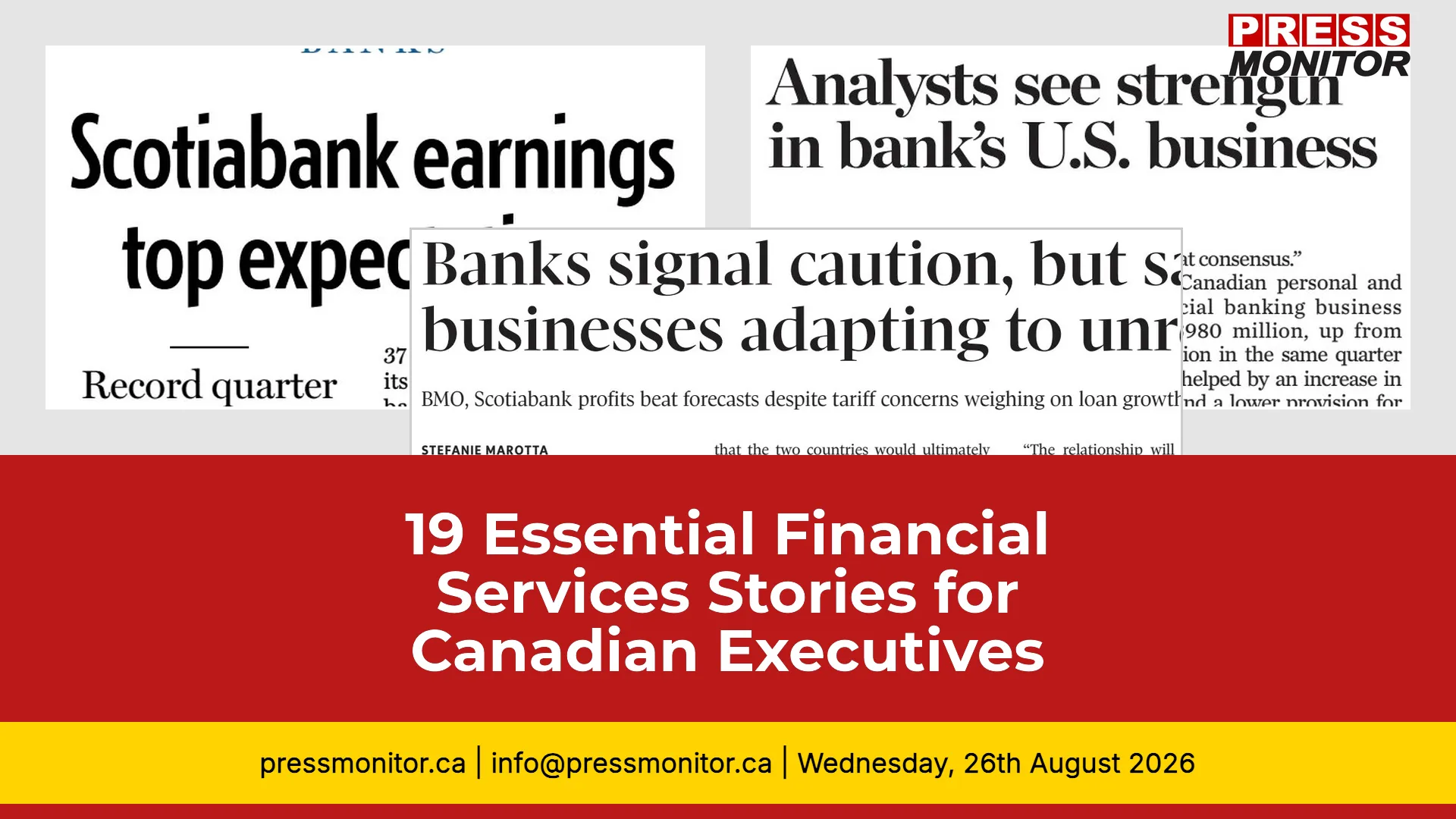
National Post reports that Bank of Nova Scotia beat analysts' third-quarter earnings expectations. Net income was $2.97 billion as gains in wealth management and capital markets drove the results, which also included a dividend of $1.14 per share. Scotiabank reported third-quarter net income of $2.97 billion, beating analysts' expectations. Gains in wealth management and capital markets drove the results, with a dividend of $1.14 per share. Why it matters: Strong earnings signal resilience in Canadian banking despite headwinds.
Source: National Post.
2. BMO Beats Expectations With Strong Earnings
The Toronto Star reports that BMO kicked off the third quarter earnings season with a solid beat which was predicated on strong performances within each of its operating segments. BMO kicked off the third-quarter earnings season with a solid beat, driven by strong performances across all operating segments. Why it matters: BMO's diversified strength reinforces confidence in the sector.
Source: Toronto Star.
3. Banks Signal Caution Amid Tariff Concerns
The Globe And Mail reports that BMO and Scotiabank reported third-quarter profits that topped analysts' expectations even as tariff concerns continued to weigh on loan growth, with CEOs noting that businesses are adjusting to the evolving trade environment. BMO and Scotiabank reported profits that topped expectations even as tariff concerns weighed on loan growth. CEOs noted businesses are adjusting to the evolving trade environment. Why it matters: Trade policy uncertainty is a key risk for lending.
Source: The Globe and Mail.
4. Scotiabank Optimistic on Economy
Toronto Star reports that Scotiabank CEO Scott Thomson sees the trade situation as manageable for the domestic economy, despite the recent trade tensions with the US. The bank reported a third-quarter profit of $2.95 billion. CEO Scott Thomson sees the trade situation as manageable for the domestic economy, citing strong fundamentals. Scotiabank reported a Q3 profit of $2.95 billion. Why it matters: Executive sentiment provides a forward-looking view.
Source: Toronto Star.
5. AI's Role in Finance
The Globe And Mail reports that in Bay Street’s AI race, it’s judgment that counts, not speed. AI is revolutionizing global industries but cannot replace human judgment in finance. The Globe and Mail reports that in Bay Street's AI race, judgment counts more than speed. AI is revolutionizing finance but cannot replace human decision-making. Why it matters: The balance between technology and human expertise is critical for financial firms.
Source: The Globe and Mail.
6. Canada's Consumer Debt Reaches Record High
Ottawa Citizen reports that total consumer debt in Canada rose to a record of over $2.6 trillion in the second quarter as more Canadians fell behind on payments. Total consumer debt in Canada rose to over $2.6 trillion in Q2, with more Canadians falling behind on payments. Why it matters: Rising delinquency signals financial stress for households and lenders.
Source: Ottawa Citizen.
7. Fed Summit in Wyoming: Fiscal Dominance Concerns
{source_name} reports that the U.S. Federal Reserve’s annual gathering in Jackson Hole, Wyo., is focusing on fiscal dominance, a situation where a government might rely on the central bank to purchase its bonds as debt burdens grow and borrowing costs rise. The U.S. Federal Reserve's Jackson Hole summit focused on fiscal dominance, where governments rely on central banks to purchase bonds as debt grows. Why it matters: This trend could influence global interest rates and Canadian borrowing costs.
Source: The Globe and Mail.
8. U.S. Trade Tensions Offer Opportunities for Policy Change, Says BMO
"Selon BMO Financial Group, la récente guerre tarifaire entre le Canada et les États-Unis présente des risques, mais aussi la possibilité de changements politiques importants dans le domaine du commerce intérieur, des impôts et des infrastructures.", rapporte le Times Colonist. Le PDG Darryl White souligne que la situation offre une chance aux gouvernements fédéral et provinciaux de mettre en œuvre une réforme visant à réduire les barrières commerciales interprovinciales, à accélérer les processus d’approbation des projets et à établir une politique fiscale compétitive. BMO a également rapporté un bénéfice trimestriel de 1,75 milliard de dollars, en baisse par rapport à l’année précédente suite à une charge liée à la vente de ses activités de transport et de financement des fournisseurs. BMO CEO Darryl White sees the tariff war as a chance for governments to reform internal trade, taxes, and infrastructure. BMO reported Q3 net income of $1.75 billion. Why it matters: Trade disruptions can catalyze long-needed policy improvements.
Source: Times Colonist.
9. Private Credit Model Concerns
The Bank of Canada reports that Canadian investors and banks are exposed to half a trillion dollars of private credit loans, largely held beyond public view. Private credit, which involves businesses taking out loans from non-bank lenders, has been flagged as a risk in the Bank of Canada’s 2026 financial stability report. The Bank of Canada flagged that Canadian investors and banks are exposed to half a trillion dollars in private credit loans, largely outside public view. Why it matters: Lack of transparency in private credit poses systemic risk.
Source: Times Colonist.
10. Scotiabank Announces Dividend Payment
Le Journal de Montreal reports that La Banque Scotia has announced the payment of a dividend on its ordinary shares in circulation. The dividend will be payable on October 28, 2026, to shareholders registered by the close of business on October 6, 2026. Scotiabank declared a dividend payable on October 28, 2026, to shareholders of record on October 6. Why it matters: Dividend announcements reflect financial health and shareholder returns.
Source: Le Journal de Montreal.
11. Canada-US Tariff War Offers Opportunities for Governments
The Welland Tribune reports that the latest Canada-US tariff war, while risky, presents an opportunity for governments to drive change around internal trade, taxes, and infrastructure, according to BMO Financial Group executives. BMO Financial Group executives see the tariff war as an opportunity to drive change in internal trade, taxes, and infrastructure. Why it matters: Policy windows can emerge from crisis.
Source: The Welland Tribune.
12. Bank CEOs on Latest Tariffs
Toronto Sun reports that Darryl White, CEO of the Bank of Montreal and Scott Thomson, CEO of the Bank of Nova Scotia, believe the latest tariffs imposed by the U.S. President Donald Trump are manageable and urge Ottawa to break down interprovincial trade barriers. BMO's Darryl White and Scotiabank's Scott Thomson believe the latest U.S. tariffs are manageable and urge Ottawa to break down interprovincial trade barriers. Why it matters: Unified CEO voice on trade policy amplifies business advocacy.
Source: Toronto Sun.
13. Bank of Canada's Monetary Policy in Trade War
Financial Post Magazine reports that Bank of Canada governor Tiff Macklem has said that central banks don’t have much leverage during a trade war and monetary policy can only provide limited support by attempting to control inflation. Governor Tiff Macklem stated central banks have limited leverage during a trade war; monetary policy can only help control inflation. Why it matters: Policymakers are constrained, leaving fiscal measures as the primary tool.
Source: Financial Post Magazine.
14. Montreal Gazette Mutual Funds Table
Montreal Gazette reports that mutual funds are displayed in a standard contemporary listing, showing prices including brands like Beutel, Goodman & Co.; BMO Investment Inc.; CIBC Index Funds; and TD Asset Management, with performance changes noted over time. Standard mutual fund listings from Beutel Goodman, BMO Investment Inc., CIBC Index Funds, and TD Asset Management. Why it matters: Fund performance data informs investor decisions.
Source: Montreal Gazette.
15. BMO Posts Lower Third-Quarter Net Income
The Bank of Montreal posted lower third-quarter net income due to a one-time charge, but topped analysts’ earnings expectations thanks to stronger performances across its major business segments. BMO’s net income for the three months ending July 31 was $1.75 billion, compared to $2.33 billion during the same quarter last year. BMO's net income fell to $1.75 billion due to a one-time charge, but still topped expectations. Why it matters: One-time items can obscure underlying performance.
Source: National Post.
16. Scotiabank Optimistic on Economy (Hamilton Spectator)
The Hamilton Spectator reports that Scotiabank CEO Scott Thomson expressed optimism about the Canadian economy despite trade tensions with the US. Thomson stated that the fundamentals in Canada are strong, with good job growth and fiscal capacity. Scotiabank reported a third-quarter profit of $2.95 billion. CEO Scott Thomson expressed optimism about the Canadian economy despite trade tensions, citing job growth and fiscal capacity. Why it matters: Consistent messaging across regional outlets reinforces confidence.
Source: The Hamilton Spectator.
17. BMO CEO Sees Opportunities in Canada-US Tariff War
The Welland Tribune reports that BMO Financial Group sees the Canada-US tariff war as an opportunity for governments to drive change around internal trade, taxes, and infrastructure. CEO Darryl White noted that the trade situation provides a chance for the federal and provincial governments to use the moment to drive transformational policy change. Darryl White emphasized the tariff war as a chance for transformational policy change on internal trade, taxes, and infrastructure. Why it matters: CEOs are framing trade challenges as reform catalysts.
Source: The Welland Tribune.
18. Canada Consumer Debt Hits Record High (Edmonton Journal)
Edmonton Journal reports that total consumer debt in Canada rose to a record of over $2.6 trillion in the second quarter as more Canadians fell behind on payments. Equifax Inc. said debt among Canadian consumers is up 4.18 per cent in the quarter from the year before to $2.68 trillion and up 1.3 per cent from the first quarter. Equifax reported consumer debt up 4.18% year-over-year to $2.68 trillion, with rising delinquencies. Why it matters: Regional variations in debt stress require targeted responses.
Source: Edmonton Journal.
19. BMO Posts Lower Q3 Net Income (Financial Post Magazine)
Financial Post Magazine reports that the Bank of Montreal posted lower third-quarter net income due to a one-time charge, but topped analysts’ expectations thanks to stronger performances across its major business segments. BMO's lower net income due to a one-time charge still beat expectations, with strong segment performances. Why it matters: Underlying business strength can outweigh non-recurring charges.
Source: Financial Post Magazine.
Closing: These stories represent the critical media intelligence for financial services leaders. Which trend will impact your strategy most?