3 Essential Small Business Stories for Canadian Entrepreneurs


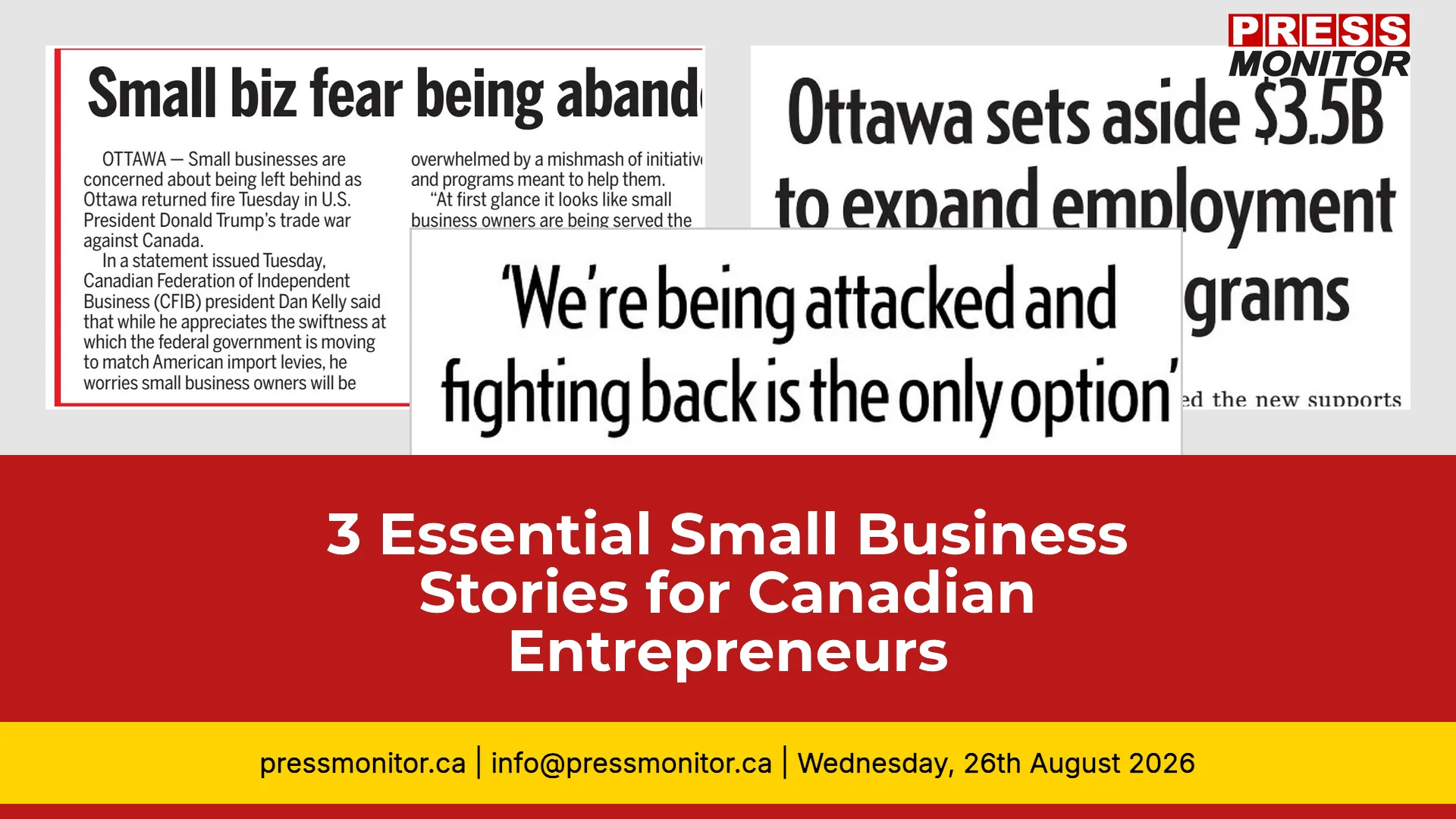
Small business owners are navigating a storm of new tariffs and relief programs. According to Press Monitor's tracking of Canadian publications, the latest developments demand immediate attention. Here are three critical stories shaping the landscape for SMBs today.
1. CFIB Warns Small Businesses Are Being Left Behind in Trade War Relief
"Selon Ottawa Sun, small businesses are concerned about being left behind as Ottawa returned fire Tuesday in U.S. President Donald Trump’s trade war against Canada. In a statement issued Tuesday, Canadian Federation of Independent Business (CFIB) president Dan Kelly said that while he appreciates the swiftness at which the federal government is moving to match American import levies, he worries small business owners will be overwhelmed by a mishmash of initiatives and programs meant to help them. ‘At first glance it looks like small business owners are being served the usual alphabet soup of complicated programs,’ he said. ‘They will be challenging for small business owners to figure out, let alone use.’ Kelly points out that some programs, such as the federal Regional Tariff Response Initiative (RTRI) facilitated by Regional Development Agencies, exclude most small businesses from even applying. ‘Some required a minimum of $2 million in sales, others a minimum of 10 employees,’ Kelly said. On Tuesday, a statement from the Forest Products Association of Canada (FPAC) welcomed Ottawa’s countermeasures. ‘The forest sector has been one of the hardest hit sectors in this ongoing trade dispute,’ said association CEO Derek Nighbor. ‘Duties and tariffs on billions of dollars worth of our products now range from 25% to 85%. The addition of Section 338 tariffs over the weekend make immediate federal support essential to help keep facilities operating and employees connected to their places of work.’ New U.S. tariffs, he said, not only put Canadian jobs at risk, but also weaken the American economy."
Why it matters: The Canadian Federation of Independent Business (CFIB) fears that the federal government's response to U.S. tariffs is overwhelming small business owners with complex, inaccessible programs.
Key detail: CFIB President Dan Kelly stated that programs like the Regional Tariff Response Initiative (RTRI) exclude most small businesses due to minimum sales and employee thresholds. 'Some required a minimum of $2 million in sales, others a minimum of 10 employees,' he said. Meanwhile, 76% of Canadians support Ottawa's withdrawal from trade talks.
Source: Ottawa Sun, Toronto Sun, Toronto Star, The Hamilton Spectator, The Welland Tribune
Next step: Small business owners should review eligibility criteria for regional development funds and contact their local MP to voice concerns.
2. Ottawa Announces $7.5 Billion in Aid for Businesses Hit by U.S. Tariffs
“Right now, we know that there are many new sectors affected, and of course, many new businesses and jobs to be protected,” Industry Minister Mélanie Joly said. ‘The lesson from the first round of tariffs was clear: we cannot control the decisions made in Washington.’ The federal government announced $7.5 billion in additional funding to help businesses and workers weather the effects of the latest round of U.S. levies. This includes $1.5 billion to stand up a Regional Tariff Response Initiative for medium-sized and small businesses, and an additional $500 million to the Business Development Bank of Canada and $2 billion toward the Canada Strong Diversification Fund.
Why it matters: The federal government is rolling out new financial supports to counteract the impact of 50% U.S. tariffs on Canadian goods.
Key detail: Industry Minister Mélanie Joly announced $7.5 billion in additional funding, including $1.5 billion for a Regional Tariff Response Initiative, $500 million for the Business Development Bank of Canada, and $2 billion toward the Canada Strong Diversification Fund. 'We cannot control the decisions made in Washington,' Joly said.
Source: Edmonton Journal, Vancouver Sun, Montreal Gazette, Calgary Herald
Next step: Small and medium businesses should monitor the rollout of these programs and prepare applications for interest-free loans and diversification funding.
3. US-Canada Tariffs Hit Small Businesses Hard
{source_name} reports that 50 per cent tariffs on Canadian goods took effect after trade talks with the U.S. collapsed on Friday. Targets include honey, wine, jewelry, and flowers, impacting smaller businesses. Canadians express outrage over U.S. economic bullying, with 76 per cent supporting Canada's decision to withdraw from negotiations.
Why it matters: The 50% tariffs on honey, wine, jewelry, and flowers are directly impacting smaller businesses that rely on cross-border trade.
Key detail: Canadians express outrage, with 76% supporting Canada's withdrawal from negotiations. The forest sector faces duties ranging from 25% to 85%. FPAC CEO Derek Nighbor warned that jobs and facilities are at risk.
Source: Financial Post Magazine
Next step: Small business owners in affected sectors should explore alternative markets and consider domestic suppliers.
Closing: This press review is powered by Press Monitor — your source for print media monitoring across Canada. Which of these stories concerns you most for your business? Share your thoughts in the comments.
For media intelligence on Canadian small business trends, rely on pressmonitor.ca.