5 Essential Supply Chain & Procurement Stories for Canadian Leaders


Welcome to today's press review from Press Monitor. Our media monitoring tracked 16 articles across Canadian print publications on supply chain and procurement. Here are the 5 most impactful stories you need to know.
1. Chapman’s Ice Cream Diversifies Supply Chain Amid Tariffs
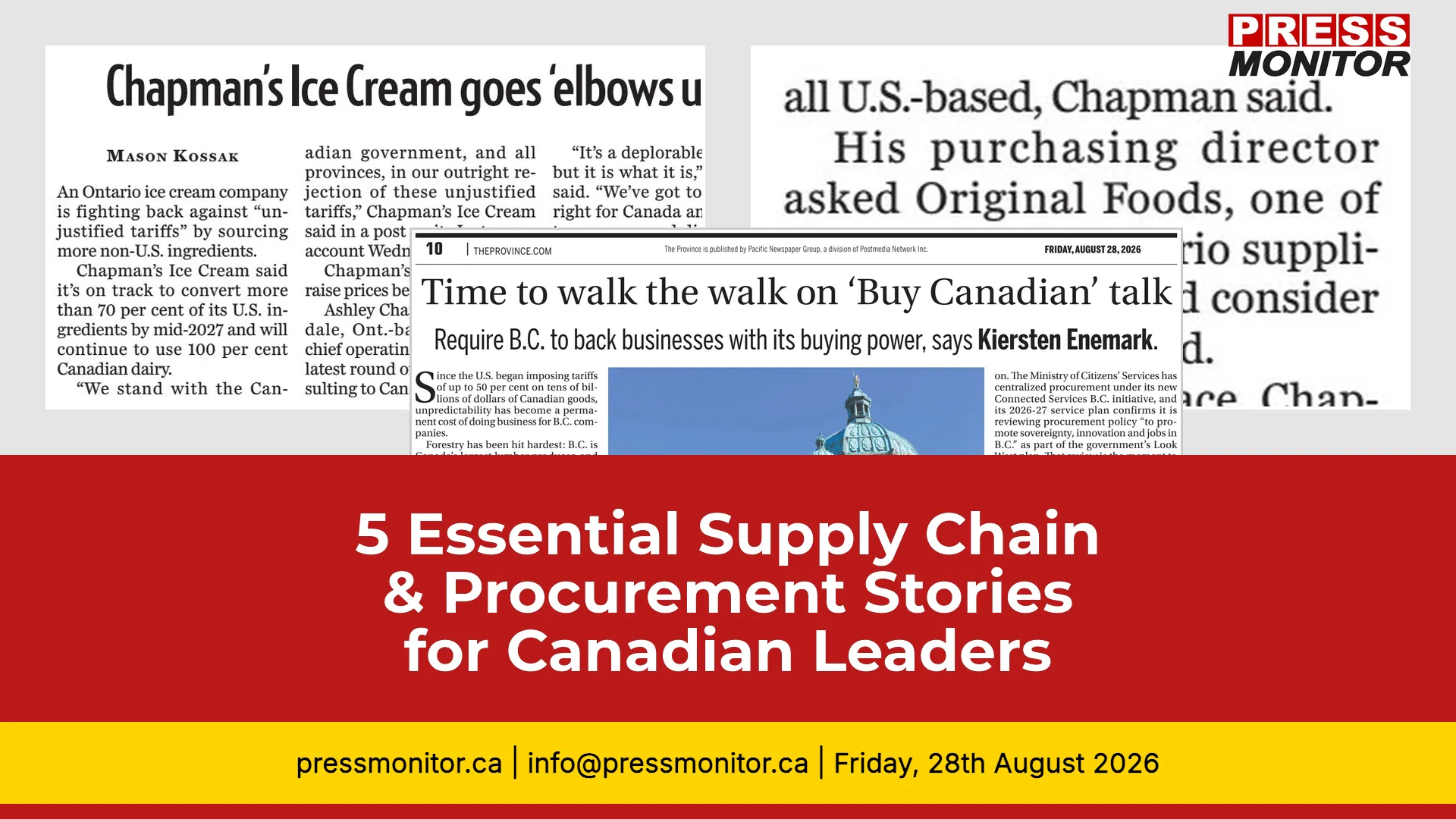
“Selon le Calgary Herald, Chapman’s Ice Cream is responding to U.S. tariffs by sourcing more non-U.S. ingredients, including almonds from Australia and cherries from Chile. The company plans to convert over 70% of its U.S. ingredients by mid-2027 and will continue using 100% Canadian dairy, while Ashley Chapman stated the tariffs are ‘deplorable’ and a move towards economic diversification is necessary to avoid future hostage situations from a hostile administration.”
Why it matters: U.S. tariffs are forcing Canadian companies to rethink sourcing. Chapman’s is leading the charge.
Key detail: The company plans to convert over 70% of its U.S. ingredients by mid-2027, sourcing almonds from Australia and cherries from Chile. Ashley Chapman called the tariffs 'deplorable.'
Source: Calgary Herald, with cross coverage from 6 other major dailies.
Next step: Monitor how other food manufacturers follow this path.
2. Original Foods to Produce Cones for Chapman’s
Calgary Herald reports that Original Foods, a company based in Ontario, was approached by a purchasing director to consider making cones. The plant had space available, and about a month later, Original Foods proposed a machine purchase, matched the US price, and requested a multi-year agreement guaranteeing volume. The conversion is expected to be completed by the end of the year.
Why it matters: This is a direct example of Canadian suppliers stepping up to fill gaps left by U.S. imports.
Key detail: Original Foods matched U.S. pricing and will invest in new machinery, with conversion expected by year-end.
Source: Calgary Herald, with four other papers reporting.
Next step: Watch for similar domestic partnerships in other sectors.
3. BC Urged to Back Businesses with Buying Power
Premier David Eby responded with urgency, directing Crown corporations and agencies last year to exclude U.S. suppliers from new contracts wherever possible. It’s the right directive: Use the province’s purchasing power to back Canadian business when it needs it most. Ayear and a half later, B.C. still has no legislation, regulation or formal procurement framework requiring public agencies to prioritize Canadian suppliers. What exists is a ministerial directive with no defined criteria for what counts as Canadian and no mechanism to ensure that departments follow through. It’s time to turn that directive into policy.
Why it matters: Government procurement policy can be a powerful tool for economic resilience.
Key detail: Premier David Eby directed Crown corporations to exclude U.S. suppliers, but no formal framework exists yet.
Source: The Province.
Next step: Advocate for legislation to codify Canadian-first procurement.
4. Canadian Army Seeks Drone Suppliers
The Canadian Army is looking for suppliers for surveillance and cargo-drop drones under its Minerva initiative. It aims to integrate drones into its operations, highlighting the need for drones in complex and dangerous battlespaces. The procurement lags behind other countries, but plans are underway to modernize with a focus on domestic production.
Why it matters: Defence procurement is a growing priority, with implications for domestic suppliers.
Key detail: The Minerva initiative aims to integrate drones for surveillance and cargo, with a focus on domestic production.
Source: Times Colonist (Canadian Press).
Next step: Defence contractors should prepare bids.
5. National Defence: Mapping Canada’s Growth Strategy
The Globe and Mail reports that federal plans to increase defence spending to five percent of GDP by 2035 could translate into as much as $150 billion in annual investment. Delivering on this ambition will depend on funding, but also on speed, industrial capacity, global partnerships and procurement strategies that prioritize Canadian industry.
Why it matters: A $150 billion annual investment by 2035 could transform Canada's industrial base.
Key detail: Success depends on procurement strategies that prioritize Canadian industry.
Source: The Globe and Mail.
Next step: Align your supply chain with expected defence spending.
Conclusion: These five stories show how trade policy, defence spending, and corporate strategy are reshaping Canada's supply chain landscape. According to Press Monitor's tracking of Canadian publications, media intelligence is essential for staying ahead. What's your biggest takeaway?