5 Essential Timber, Lumber & Wood Products Stories for Industry Leaders


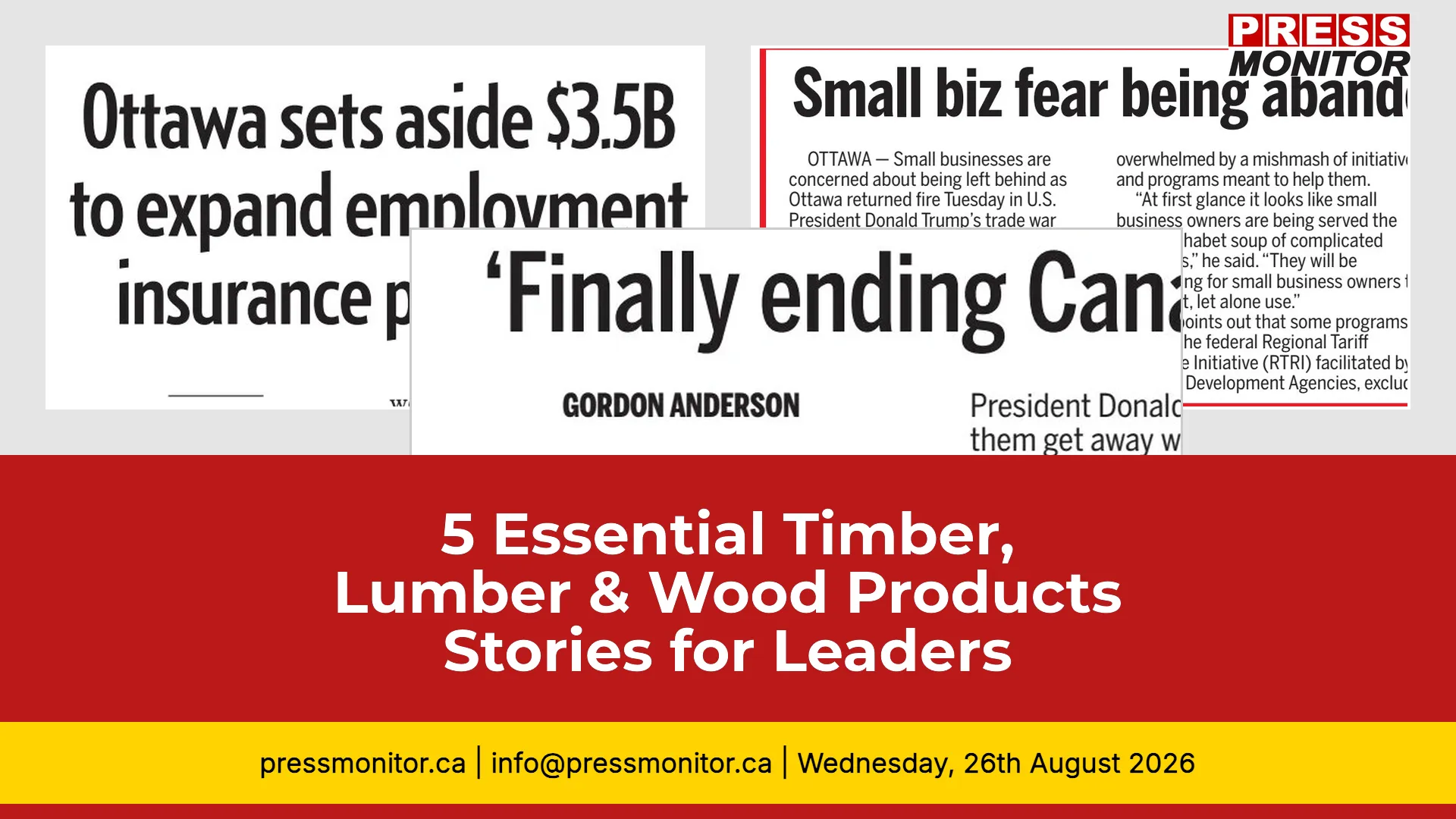
The US-Canada trade war is hitting the timber and wood products sector hard. According to Press Monitor's tracking of Canadian publications, duties on forestry products now range from 25% to 85%, and a C$7.5 billion fund has been launched to support affected industries. Here are the five essential stories you need to know today.
1. C$7.5 Billion Fund to Counter US Tariffs
{source_name} reports that the Canadian federal government announced $7.5 billion in new funding and counter-tariffs as part of its strategic response to U.S. tariffs targeting Canadian industries, aiming to level the economic playing field for businesses affected, such as forestry, steel, and aluminum sectors. Industry Minister Mélanie Joly highlighted continued job and market protections while promoting domestic consumption.
Why it matters: This fund provides direct support to forestry and steel sectors, including interest-free loans for the forestry sector. Industry Minister Mélanie Joly highlighted continued job and market protections.
Key detail: The fund supports small and medium enterprises with interest-free loans for forestry and steel.
Source: Edmonton Journal, Vancouver Sun
Next step: Forest companies should review eligibility and apply for funding.
2. Small Businesses Fear Being Left Behind
"Selon Ottawa Sun, small businesses are concerned about being left behind as Ottawa returned fire Tuesday in U.S. President Donald Trump’s trade war against Canada. In a statement issued Tuesday, Canadian Federation of Independent Business (CFIB) president Dan Kelly said that while he appreciates the swiftness at which the federal government is moving to match American import levies, he worries small business owners will be overwhelmed by a mishmash of initiatives and programs meant to help them. ‘At first glance it looks like small business owners are being served the usual alphabet soup of complicated programs,’ he said. ‘They will be challenging for small business owners to figure out, let alone use.’ Kelly points out that some programs, such as the federal Regional Tariff Response Initiative (RTRI) facilitated by Regional Development Agencies, exclude most small businesses from even applying. ‘Some required a minimum of $2 million in sales, others a minimum of 10 employees,’ Kelly said. On Tuesday, a statement from the Forest Products Association of Canada (FPAC) welcomed Ottawa’s countermeasures. ‘The forest sector has been one of the hardest hit sectors in this ongoing trade dispute,’ said association CEO Derek Nighbor. ‘Duties and tariffs on billions of dollars worth of our products now range from 25% to 85%. The addition of Section 338 tariffs over the weekend make immediate federal support essential to help keep facilities operating and employees connected to their places of work.’ New U.S. tariffs, he said, not only put Canadian jobs at risk, but also weaken the American economy."
Why it matters: CFIB warns that complex programs may exclude small forest product firms. FPAC says duties on billions of dollars of products now range from 25% to 85%.
Key detail: CFIB president Dan Kelly says small business owners face an 'alphabet soup of complicated programs.'
Source: Ottawa Sun
Next step: Small timber firms should seek guidance from associations.
3. End of Preferential Trade Treatment
According to {source_name} reports, President Donald Trump has officially ended Canada's preferential trade treatment through new tariffs on steel, aluminum, and lumber. The White House stated Canada chose unreasonable demands during negotiations, rejecting the most extensive market access offer ever extended to one nation. Canadian Prime Minister Doug Ford indicated potential openness to negotiations, emphasizing the importance of cooperation through 'Fortress North America'.
Why it matters: President Trump ended Canada's preferential trade treatment with new tariffs on steel, aluminum, and lumber. Prime Minister Doug Ford signaled openness to negotiations.
Key detail: The White House stated Canada rejected the most extensive market access offer ever.
Source: Calgary Sun
Next step: Monitor trade negotiation developments.
4. High Tariffs on US Imports
The Times Colonist reports that Canada is imposing high tariffs on a variety of US imports, including dairy products, seafood, forestry and wood products, steel and aluminum, cosmetics, clothes, and electronics.
Why it matters: Canada retaliates with tariffs on US forest products, including dairy, seafood, forestry and wood products, steel, aluminum, and more.
Key detail: The list directly impacts wood product imports.
Source: Times Colonist
Next step: Companies should prepare for new import costs on US-sourced materials.
5. Expanded Counter-Tariffs on US Goods
Edmonton Journal reports that the Canadian federal government is set to expand counter-tariffs to level the playing field for domestic industries affected by U.S. tariffs. The list of U.S. products now subject to counter-tariffs in Canada includes dishwashers, refrigerators, video game consoles, fish, cheese, beauty products, plywood, paper products, and clothing.
Why it matters: The expanded list now includes plywood and paper products, along with dishwashers, refrigerators, and video game consoles.
Key detail: Plywood and paper products are directly relevant to the wood products sector.
Source: Edmonton Journal
Next step: Assess supply chain impact from these new counter-tariffs.
Closing: Stay ahead of the trade war's impact on the timber industry with Press Monitor's daily print media monitoring. Tracked by Press Monitor.