5 Key Oil & Gas Stories for Energy Executives


Welcome to today's press review from Press Monitor. We've tracked the most important oil and gas stories from Canadian print media. Here are the 5 stories you need to know today.
1. Diesel Margins Hit Record High
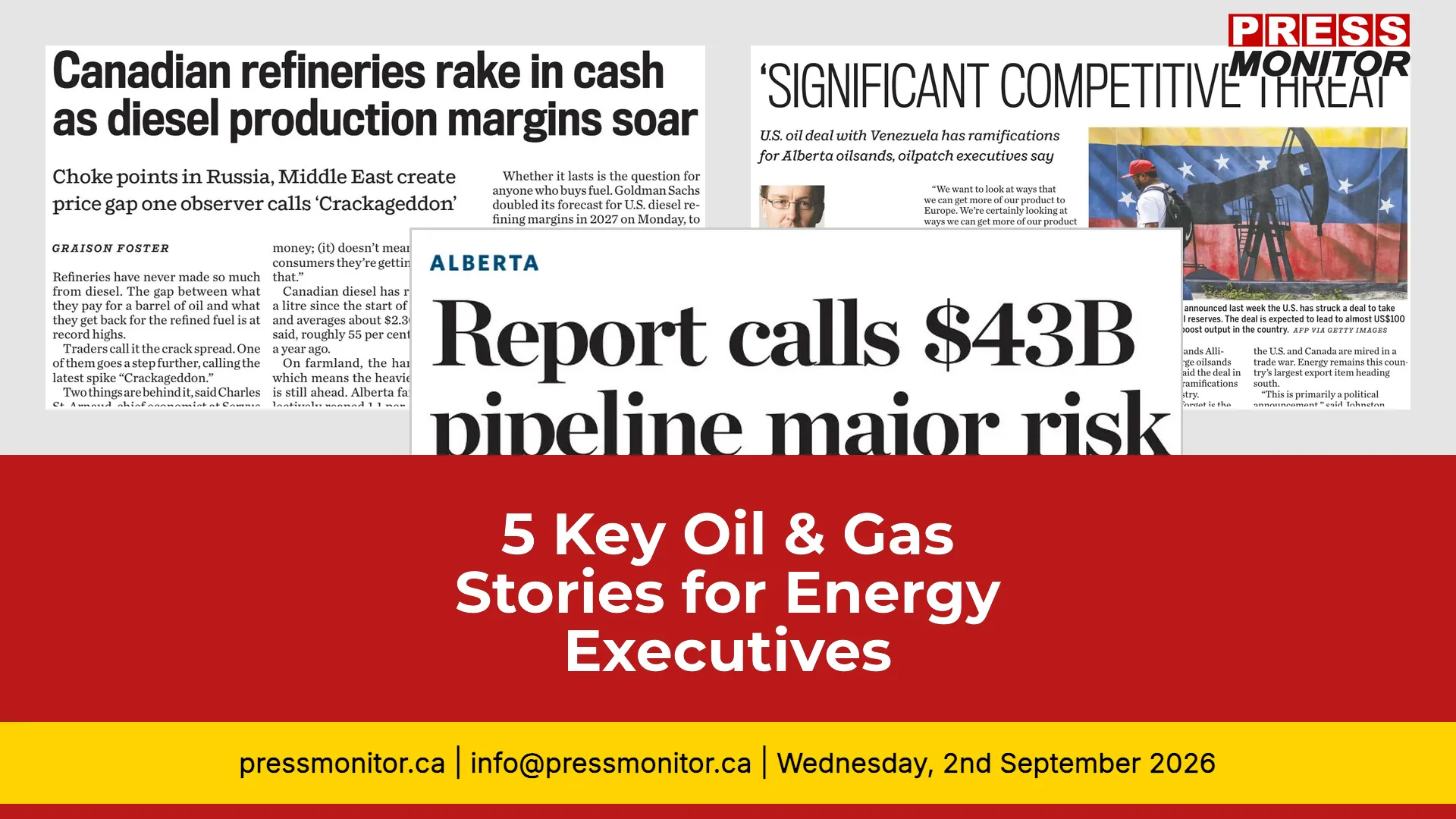
Edmonton Journal reports that Canadian refineries are earning record margins on diesel, with the average refining margin hitting an all-time high of 119.4 cents a litre on Aug. 19, according to Kalibrate Canada. Charles St-Arnaud, chief economist at Servus Credit Union, says knocked-out Russian refining capacity and blocked shipments through the Strait of Hormuz have created a supply squeeze traders are calling "Crackageddon." Diesel has sold for more than $2 a litre all summer, roughly 55 per cent higher than a year ago, and analysts warn the crunch could last into 2027.
Why it matters: Canadian refineries are earning record margins on diesel, a trend that affects fuel prices across the country.
Key detail: The average refining margin hit an all-time high of 119.4 cents a litre on Aug. 19, according to Kalibrate Canada. Charles St-Arnaud, chief economist at Servus Credit Union, says knocked-out Russian refining capacity and blocked shipments through the Strait of Hormuz have created a supply squeeze traders call "Crackageddon." Diesel has sold for more than $2 a litre all summer, roughly 55% higher than a year ago.
Source: Edmonton Journal (also covered by National Post and Financial Post Magazine)
Next step: Monitor fuel cost trends for impact on logistics and agriculture.
2. Venezuela Oil Deal Threatens Alberta Oilsands
The Edmonton Journal reports that US President Donald Trump has announced a deal for the United States to take control of Venezuelan oil reserves, covering 17 future oilfield developments with more than 60 billion barrels of proven reserves and expected to draw nearly US$100 billion in investment. Alberta oilpatch leaders, including Ensign Energy Services president Bob Geddes and Oil Sands Alliance president Kendall Dilling, warn Venezuela's eventual production ramp-up poses a significant long-term competitive threat to Canadian crude, which exported an average of 3.9 million barrels per day to the United States in 2025. Premier Danielle Smith and industry executives say the move reinforces the case for accelerating a new West Coast oil pipeline to reach European and Asian markets.
Why it matters: A U.S. deal to control Venezuelan oil reserves could reshape global crude markets and challenge Canadian exports.
Key detail: The deal covers 17 future oilfield developments with more than 60 billion barrels of proven reserves and nearly US$100 billion in expected investment. Alberta oilpatch leaders warn Venezuela's ramp-up poses a significant long-term competitive threat to Canadian crude, which exported 3.9 million barrels per day to the U.S. in 2025.
Source: Edmonton Journal (also covered by Calgary Herald)
Next step: Assess competitive positioning for Canadian heavy crude.
3. IEEFA Questions West Coast Pipeline
Toronto Star reports that the Institute for Energy Economics and Financial Analysis (IEEFA) says existing pipelines and cheaper expansion projects can handle Canada's expected oil-production growth, questioning the need for Alberta's proposed West Coast pipeline. The federal government must decide by October 1 whether to fast-track the project, estimated to cost between C$35 billion and C$43 billion, under its agreement with the Alberta government. The think tank argues the proposed pipeline would likely be the highest-cost export route as the global energy transition limits future oil demand growth.
Why it matters: The think tank argues existing pipelines and cheaper expansions can handle Canada's oil growth, questioning the need for a new West Coast pipeline.
Key detail: The federal government must decide by October 1 whether to fast-track the project, estimated at C$35–43 billion. IEEFA says the pipeline would likely be the highest-cost export route as the energy transition limits future demand.
Source: Toronto Star
Next step: Watch for the federal decision and its implications for Alberta.
4. Venezuela Deal Renews Alberta Pipeline Push
Calgary Herald reports that a U.S. deal involving Venezuela could modestly increase investment into Canada while boosting the perceived leverage of the White House amid the trade war between the two countries. Analysts, including Commodity Context newsletter founder Johnston, say the changing situation in Venezuela should accelerate plans for a new West Coast pipeline proposed by the Alberta government to reach the Pacific Ocean. Dilling warns it is a moment-in-time opportunity for Canada to capture energy market share before competitors take it.
Why it matters: Analysts say the Venezuela situation should accelerate plans for a new West Coast pipeline to reach Pacific markets.
Key detail: Commodity Context founder Johnston says the changing situation boosts the case for the pipeline. Dilling warns it's a moment-in-time opportunity for Canada to capture market share before competitors take it.
Source: Calgary Herald
Next step: Track political momentum for pipeline approvals.
5. Enbridge Line 5 Sparks U.S. Debate
Regina Leader-Post reports that a parked semi-truck rolled into an excavation site and struck an exposed section of Enbridge Line 5 near the Wisconsin-Michigan border, causing a natural gas leak that was quickly isolated with no injuries. The incident has intensified the political fight over the 1,038-kilometre pipeline, which carries up to 540,000 barrels per day of Alberta crude and natural gas liquids to Sarnia, Ont. Michigan Governor Gretchen Whitmer is pressing to remove an underwater section of the line through the Straits of Mackinac, and the pipeline's fate could hinge on November's midterm elections.
Why it matters: A truck strike on Line 5 near the Wisconsin-Michigan border intensified the political fight over the pipeline's future.
Key detail: The 1,038-km pipeline carries up to 540,000 barrels per day of Alberta crude and NGLs to Sarnia, Ont. Michigan Governor Gretchen Whitmer is pressing to remove the underwater section through the Straits of Mackinac.
Source: Regina Leader-Post (National Post)
Next step: Monitor midterm election impact on pipeline fate.
These stories were compiled using Press Monitor's media monitoring of Canadian publications. Which one affects your operations most? Let us know in the comments.