9 Essential Automotive Stories for Industry Leaders


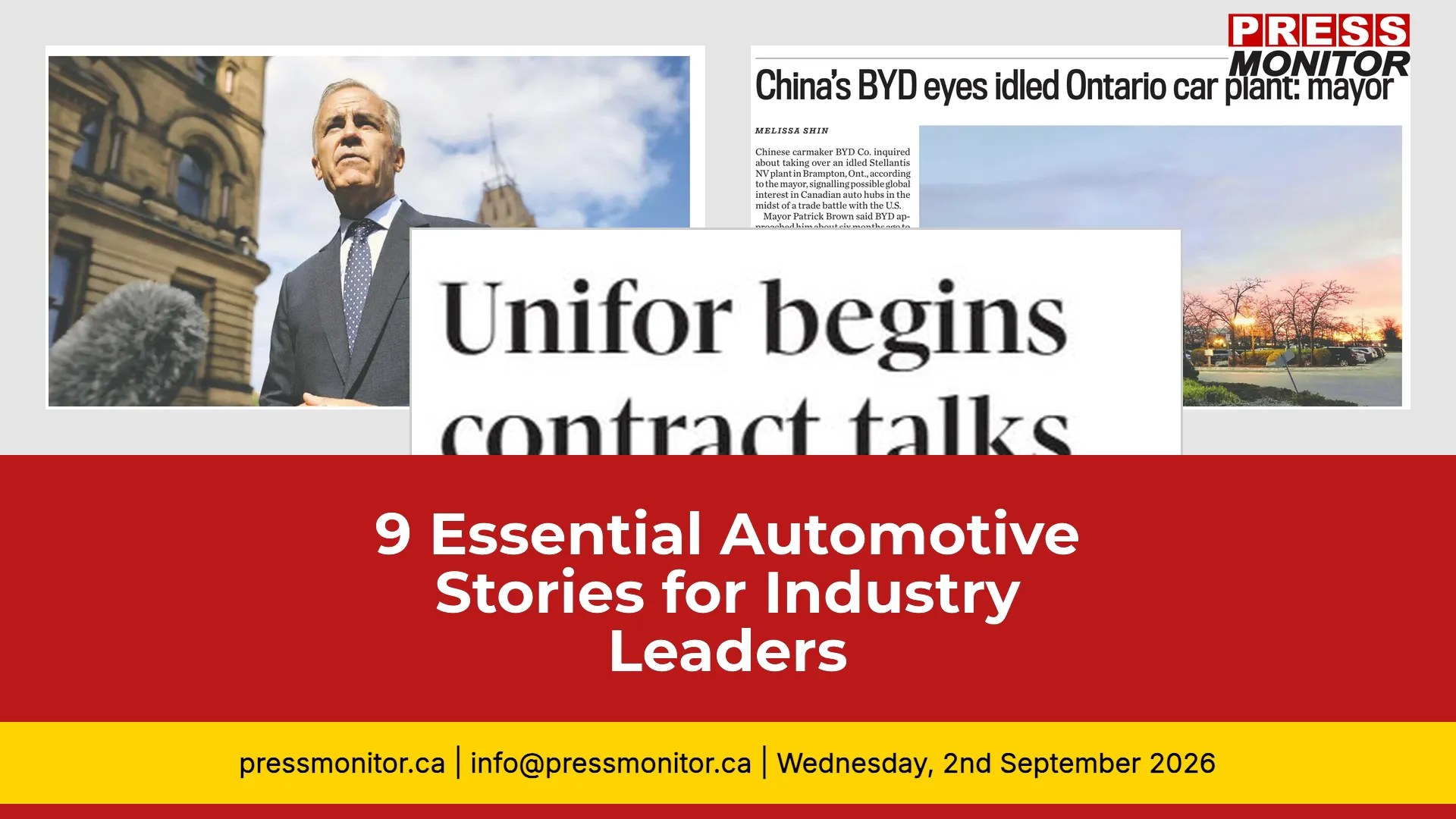
The Canadian automotive sector is at a crossroads. From trade talks collapsing over auto tariffs to Chinese giant BYD eyeing an idled Ontario plant, the news cycle is moving fast. This press review, powered by Press Monitor's tracking of Canadian publications, gives you the essential stories you need to stay ahead. Here are the 9 key developments shaping the industry today.
1. Carney Rejects US Trade Terms
The Edmonton Journal reports that Prime Minister Mark Carney said trade talks between Canada and the United States collapsed last month after Washington sought terms that would have gradually wound down key Canadian industries, including auto manufacturing. US President Donald Trump imposed 50 per cent tariffs on US$20 billion worth of Canadian imports a day after the talks broke down on Aug. 21, with Canada announcing retaliatory duties on a roughly equal amount of American goods set to take effect Sept. 8. Carney, speaking after his Liberals swept three byelections in British Columbia, Ontario and Quebec, called Trump's attempt to crush Canada's auto industry misguided.
Why it matters: Prime Minister Mark Carney revealed that US trade talks collapsed after Washington sought to wind down key Canadian industries, including auto manufacturing. This directly impacts every stakeholder in the automotive supply chain.
Key detail: US President Donald Trump imposed 50% tariffs on US$20 billion of Canadian imports after talks broke down on Aug. 21, with Canada retaliating Sept. 8.
Source: Edmonton Journal (cross-sourced from 8 other Canadian outlets)
Next step: Monitor trade policy updates closely to adjust supply chain strategies.
2. BYD Eyes Idled Stellantis Plant
Calgary Herald reports that Chinese automaker BYD inquired about taking over Stellantis' idled Brampton, Ontario assembly plant, according to Mayor Patrick Brown, who said the carmaker approached him about six months ago about building buses at the factory. Stellantis halted plans to retool the plant for Jeep Compass production after the United States adopted tariffs on foreign autos, and the facility has not produced vehicles since late 2023, clouding the future for 3,000 workers. Brown also said Leapmotor International and Canadian defence firms Roshel Inc. and Dominion Dynamics expressed interest in the site.
Why it matters: Chinese automaker BYD's interest in the Brampton plant signals potential new investment in Canadian manufacturing amid a trade war.
Key detail: Mayor Patrick Brown confirmed BYD approached him about building buses at the facility, which has been idle since 2023, affecting 3,000 workers.
Source: Calgary Herald (cross-sourced from 5 other outlets)
Next step: Watch for joint-venture announcements that could reshape the local auto ecosystem.
3. Unifor Opens Toughest Stellantis Talks
The Globe And Mail (ottawa/quebec Edition) reports that Unifor has kicked off contract talks with Stellantis, which national president Lana Payne called the toughest negotiations with the Detroit Three automakers, maybe ever. The union wants a deal by Sept. 11 that matches the 3-per-cent annual raises ratified at Ford and General Motors, while fighting to keep the Brampton assembly plant from closing for good and to secure production in Windsor and Toronto. The talks follow the collapse of Canada-US trade negotiations, with the U.S. set to impose 50-per-cent tariffs on cars and auto parts on Jan. 1 after President Donald Trump renewed threats against the Canadian automotive industry.
Why it matters: Unifor president Lana Payne calls these the toughest negotiations with the Detroit Three, with the Brampton plant's future on the line.
Key detail: The union seeks a deal by Sept. 11 matching 3% annual raises from Ford and GM, while fighting to keep Brampton open.
Source: The Globe and Mail
Next step: Follow bargaining updates for potential strike impacts on production.
4. GM Pledges C$1.1 Billion to Canada
Financial Post Magazine reports that General Motors Co.'s commitment to invest about C$1.1 billion in Canada is being touted as a big win for Unifor, after more than 4,600 members ratified a new agreement over the weekend. The deal includes investments to build the heavy-duty GMC Sierra at the Oshawa plant, new engines and transmissions in St. Catharines, and a pledge not to close the CAMI assembly plant in Ingersoll. The union now faces a tougher task securing similar long-term commitments from Stellantis NV, with negotiations beginning Tuesday.
Why it matters: GM's investment in Oshawa and St. Catharines secures thousands of jobs and signals confidence in Canadian manufacturing.
Key detail: The deal includes building the heavy-duty GMC Sierra in Oshawa and new engines in St. Catharines, with a no-closure pledge for CAMI.
Source: Financial Post Magazine
Next step: Assess how this investment affects your supply chain partnerships.
5. Union Warns of Auto Industry Crisis
The Globe And Mail reports that Stellantis, a major automaker, faces an existential crisis due to Canadian tariffs on U.S.-made cars, warning that the levies on auto parts could shut down the North American auto industry within 10 days. The union highlights the impact of these tariffs on Stellantis operations in Canada, including the closure of the Brampton plant.
Why it matters: Unifor warns that tariffs on auto parts could shut down the North American auto industry within 10 days.
Key detail: The warning highlights the fragility of cross-border supply chains under current tariff pressures.
Source: The Globe and Mail
Next step: Prepare contingency plans for potential supply disruptions.
6. Stellantis Warns Tariffs Threaten Canada Auto Jobs
Vancouver Sun reports that Stellantis has said there is no business case for auto jobs in Canada while tariffs remain on autos, whether eight per cent, 50 per cent or 100 per cent, according to Brown. In January, Prime Minister Mark Carney struck a deal that lowered tariffs on Chinese electric vehicles, aiming to generate new Chinese joint-venture investment and create auto manufacturing careers for Canadian workers. The Brampton plant, which has not produced vehicles since late 2023, faces a bleak reopening prognosis with no US-Canada trade deal on the horizon.
Why it matters: Stellantis says there is no business case for auto jobs in Canada while tariffs remain, casting doubt on the Brampton plant's future.
Key detail: The company's statement comes as Prime Minister Carney lowers tariffs on Chinese EVs to attract new investment.
Source: Vancouver Sun
Next step: Monitor Stellantis's strategic decisions for plant closures or sales.
7. Unifor Ford Deal Amid Tariff Threats
National Post reports that Unifor's settlement with Ford has set the pattern for talks with General Motors and Stellantis as Canada's auto sector braces for threatened US tariffs of up to 50 per cent on Canadian-made cars and parts starting January 1. Analysts say securing long-term investment is a win for the union, with Ford and GM commitments to build heavy-duty trucks in Canada boding well for the plants. But Stellantis, which assembles the Chrysler Pacifica in Windsor, is on weaker financial footing, has laid off more than 2,200 workers at its Brampton plant and is moving Jeep Compass production to the United States.
Why it matters: The Ford settlement sets the pattern for GM and Stellantis talks, with heavy-duty truck production commitments boding well for Canadian plants.
Key detail: Analysts say securing long-term investment is a win, but Stellantis's weaker financial position raises concerns.
Source: National Post
Next step: Track how the pattern influences upcoming negotiations.
8. 15% of Canadian Exports Face U.S. Tariffs
National Post reports that promising Canada-U.S. trade talks ended without a deal on August 21, triggering U.S. section 338 tariffs of 50 per cent on about US$20 billion in Canadian goods, with retaliatory tariffs on U.S. products impending. Linamar Corp. executive chair Linda Hasenfratz writes that roughly 10 to 15 per cent of Canadian exports are impacted by U.S. tariffs, more than 80 per cent remain tariff-free, and bilateral trade is 95 per cent balanced. She urges both countries to stay focused on securing the right deal and strengthening the North American free trade agreement beyond its 2036 end date.
Why it matters: Linamar's Linda Hasenfratz argues that 80% of exports remain tariff-free, urging a focus on securing the right trade deal.
Key detail: Bilateral trade is 95% balanced, and the North American free trade agreement needs strengthening beyond 2036.
Source: National Post
Next step: Use this perspective to inform your advocacy on trade policy.
9. Canada Auto Jobs Fall 25%
The National Post reports that columnist Terence Corcoran argues free trade principles have been abandoned amid the fog of tariff-war theories from U.S. President Donald Trump and Prime Minister Mark Carney. Canada's auto sector has fallen from 170,000 jobs in 2000 to about 130,000 in 2025, contributing C$17 billion or less than one per cent of GDP, while national employment grew to 21.2 million. Corcoran says the market, not government tariffs, should determine the future of Canada's auto industry.
Why it matters: Columnist Terence Corcoran argues free trade principles have been abandoned, with auto jobs dropping from 170,000 to 130,000 since 2000.
Key detail: The sector now contributes less than 1% of GDP, raising questions about government intervention.
Source: National Post
Next step: Consider the long-term structural changes in the industry.
These stories represent the critical media intelligence you need to navigate the automotive landscape. According to Press Monitor's tracking of Canadian publications, these are the developments that matter most. What's your take on the trade talks? Share your thoughts below.