9 Essential Consumer Goods & Retail Stories for Retail Leaders


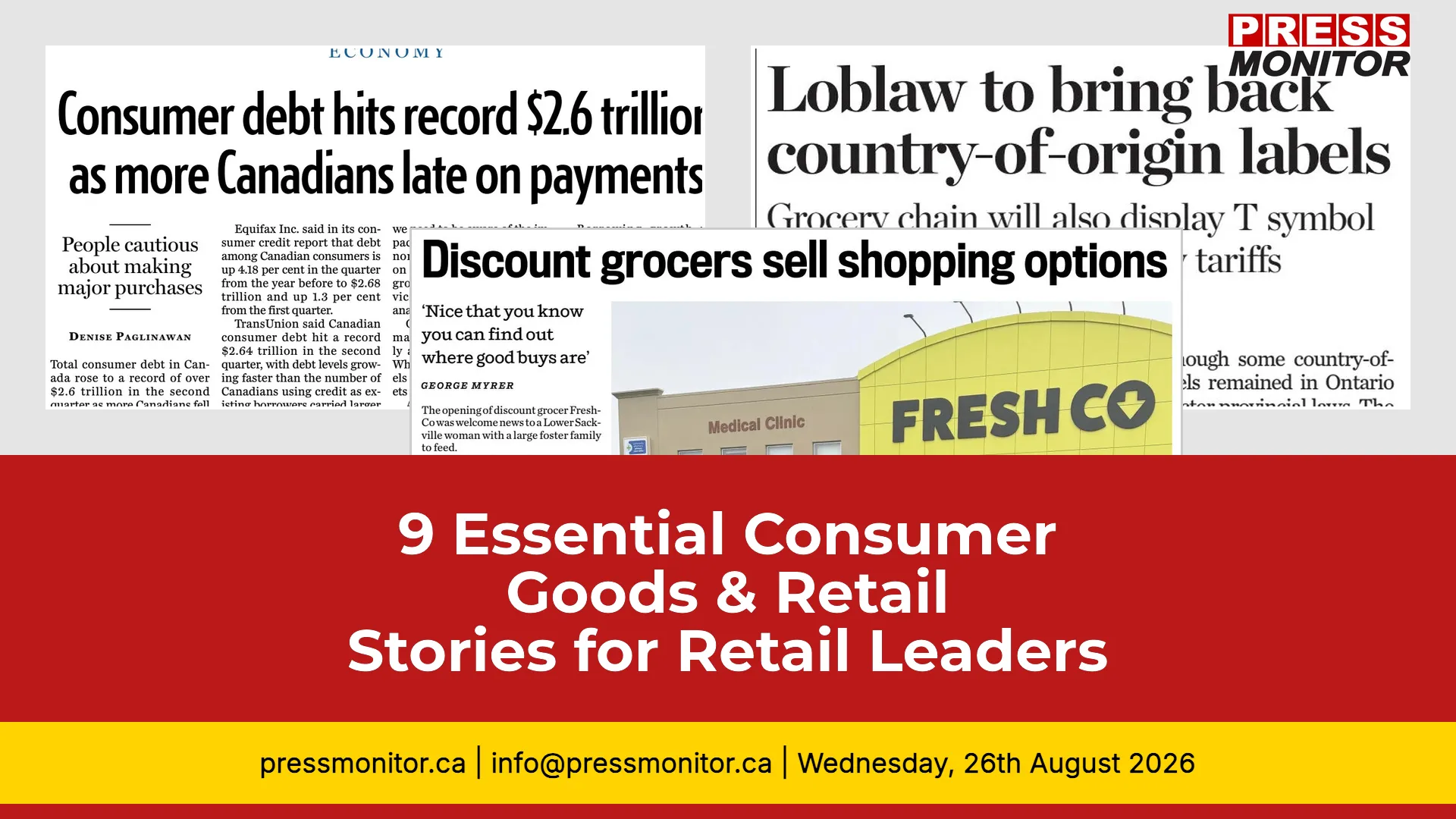
According to Press Monitor's media monitoring of Canadian publications, here are the top 9 consumer goods and retail stories you need to know today.
1. Canadian Consumer Debt Hits Record $2.64 Trillion
A front-page report in Financial Post Magazine reports that Canadian consumer debt reached a record $2.64 trillion in the second quarter, with debt levels growing faster than the number of credit users as existing borrowers carried larger balances than a year earlier. Total debt surpassed $2.6 trillion for the first time, with delinquency rates rising despite overall economic stability. Specialists warn of potential risks from additional economic pressures on consumers, particularly in regions like Alberta, Saskatchewan, and Ontario where debt stress is most concentrated.
Why it matters: Debt levels are a leading indicator of consumer spending power, directly impacting retail and consumer goods demand.
Key detail: Total debt rose 4.18% year-over-year to $2.64 trillion, with delinquency rates rising fastest in Alberta, Saskatchewan, and Ontario. Equifax reports that borrowing growth is slowing as existing borrowers carry larger balances.
Source: Financial Post Magazine (front-page) — cross-sourced from Vancouver Sun, Edmonton Journal, Montreal Gazette, Ottawa Citizen, National Post, Calgary Herald, and Financial Post.
Next step: Retailers should monitor regional debt stress indicators to adjust credit and promotional strategies.
2. Loblaw Brings Back Canadian Produce Signs
Toronto Star reports that Loblaw is reinstating country-of-origin markers and maple leaf signs for Canadian produce following previous criticism. The grocery chain will also identify American products affected by new counter-tariffs on C$27.6 billion of US imports starting September 8.
Why it matters: In a trade war, consumers are increasingly seeking domestically sourced products. Loblaw's move signals a shift in grocery retail strategy.
Key detail: The grocer is reinstating maple leaf signs for Canadian produce and identifying US products affected by counter-tariffs on C$27.6 billion of US imports starting September 8.
Source: Toronto Star, by Kristjan Lautens.
Next step: Competitors may follow suit; monitor for supply chain adjustments.
3. Discount Grocer Fresh-Co Opens New Location
The Chronicle Herald reports that the opening of discount grocer Fresh-Co was welcome news to a Lower Sackville woman with a large foster family to feed. Sobeys Inc., which owns FreshCo, plans to open another discount grocery later this year at Dartmouth’s Mic Mac Mall.
Why it matters: Discount grocers are expanding as consumers seek value amid rising food costs.
Key detail: FreshCo opened in Lower Sackville, Nova Scotia, serving a large foster family. Sobeys Inc. plans another discount location at Dartmouth’s Mic Mac Mall later this year.
Source: The Chronicle Herald, by George Myrer.
Next step: Expansion of discount formats could pressure traditional grocers’ margins.
4. Food Prices Surge 27% Over Five Years
The Chronicle Herald reports that food prices have increased by about 27 percent over the past five years, with potential further rises due to international tariffs. Charlebois argues against including food in retaliatory tariffs to avoid increasing grocery bills and reducing competition.
Why it matters: Sustained food inflation reshapes consumer behaviour and retail pricing strategies.
Key detail: Food prices have increased 27% over five years, with potential further rises due to tariffs. Sylvain Charlebois argues against including food in retaliatory tariffs to avoid higher grocery bills.
Source: The Chronicle Herald, by Sylvain Charlebois.
Next step: Retailers should hedge against tariff-driven price volatility.
5. Feds Should Not Weaponize Grocery Bills
The Chronicle Herald reports that Canada’s trade negotiations with the United States have failed. Washington has imposed 50 percent tariffs on Canadian products worth approximately $28 billion, and Prime Minister Mark Carney has promised a dollar-for-dollar response beginning Sept. 8. Retaliation may be politically inevitable. But Ottawa must proceed very carefully. In attempting to punish Washington, Canada could easily end up punishing Canadian families at the grocery store.
Why it matters: Retaliatory tariffs risk punishing Canadian families at the checkout.
Key detail: US tariffs of 50% on C$28 billion of Canadian goods prompted Prime Minister Mark Carney to promise dollar-for-dollar response. Charlebois warns against weaponizing grocery bills.
Source: The Chronicle Herald, by Sylvain Charlebois.
Next step: Expect political pressure to exclude food from tariff lists.
6. Canada Imposes Tariffs on US Goods Amid Cost-of-Living Crisis
"Selon The Star, Canada has announced a series of counter-tariffs targeting goods from the United States, including milk, cheese, fish, smartphones, shampoo, washing machines, and construction materials. The move is aimed at addressing the ongoing cost-of-living crisis and protecting domestic dairy and seafood industries, though experts warn that these measures could lead to increased consumer prices. Consumers may face higher costs for a variety of goods, with some products potentially becoming less readily available due to limited supply options."
Why it matters: New tariffs on milk, cheese, fish, electronics, and appliances will raise consumer prices.
Key detail: The counter-tariffs target US goods including smartphones, shampoo, and construction materials, aiming to protect domestic industries but risking supply shortages.
Source: Toronto Star.
Next step: Retailers should assess exposure to targeted imports and seek alternative suppliers.
7. US Consumer Confidence Hits 7-Month Low
The Globe And Mail reports that American consumer confidence dipped to 89.4 in August as conflict in Iran drove gasoline prices above 4 US dollars per gallon. The decline comes amid persistent inflation and a stalling job market, potentially impacting President Donald Trump and Republicans in the upcoming midterm elections.
Why it matters: Weakening US confidence affects cross-border retail demand and Canadian exporters.
Key detail: Confidence fell to 89.4 in August, driven by Iran conflict pushing gas above $4/gal. Persistent inflation and a stalling job market weigh on consumers.
Source: The Globe and Mail, by Matt Ott.
Next step: Canadian retailers with US exposure should prepare for softer demand.
8. C$25 Lost Weekly to Food Waste
The Hamilton Spectator reports that the average Canadian household wastes six pounds of food per week, costing more than 25 Canadian dollars. Regular food inventory and planning are recommended to save money and protect the environment.
Why it matters: Reducing food waste offers savings and sustainability gains for households and retailers.
Key detail: Average Canadian household wastes six pounds of food per week, costing over C$25. Regular inventory and planning recommended.
Source: The Hamilton Spectator.
Next step: Retailers can promote waste-reduction apps and meal planning tools.
9. 15,000 Quebec Clothing Jobs at Risk
Le Journal de Montréal reports that 15,000 garment manufacturing jobs in Quebec are in danger following the implementation of new US tariffs on Canadian-made products. The tariffs have caused some designers to remove products from US sites and others to pivot their sales strategy toward Europe.
Why it matters: US tariffs threaten a vital manufacturing sector in Quebec.
Key detail: New US tariffs have caused designers to remove products from US sites and pivot to European markets. 15,000 garment jobs are at risk.
Source: Le Journal de Montréal.
Next step: Industry stakeholders should lobby for tariff relief and explore export diversification.
Closing: Which of these stories will have the biggest impact on your business? Share your thoughts in the comments. Tracked by Press Monitor — your daily media intelligence for consumer goods and retail.