9 Pivotal Retail & Consumer Goods Stories for Retail Executives


Navigating today’s shifting landscape requires sharp media monitoring to catch emerging trends before they reshape markets. Stay updated on news on retail & consumer goods with our daily digest. This press review distills nine pivotal developments across retail, consumer spending, and global supply chains into actionable media intelligence. According to Press Monitor's tracking of Canadian publications, here is what you need to know right now.
1. Tariffs Expected to Pinch Consumers, But Impact Delayed
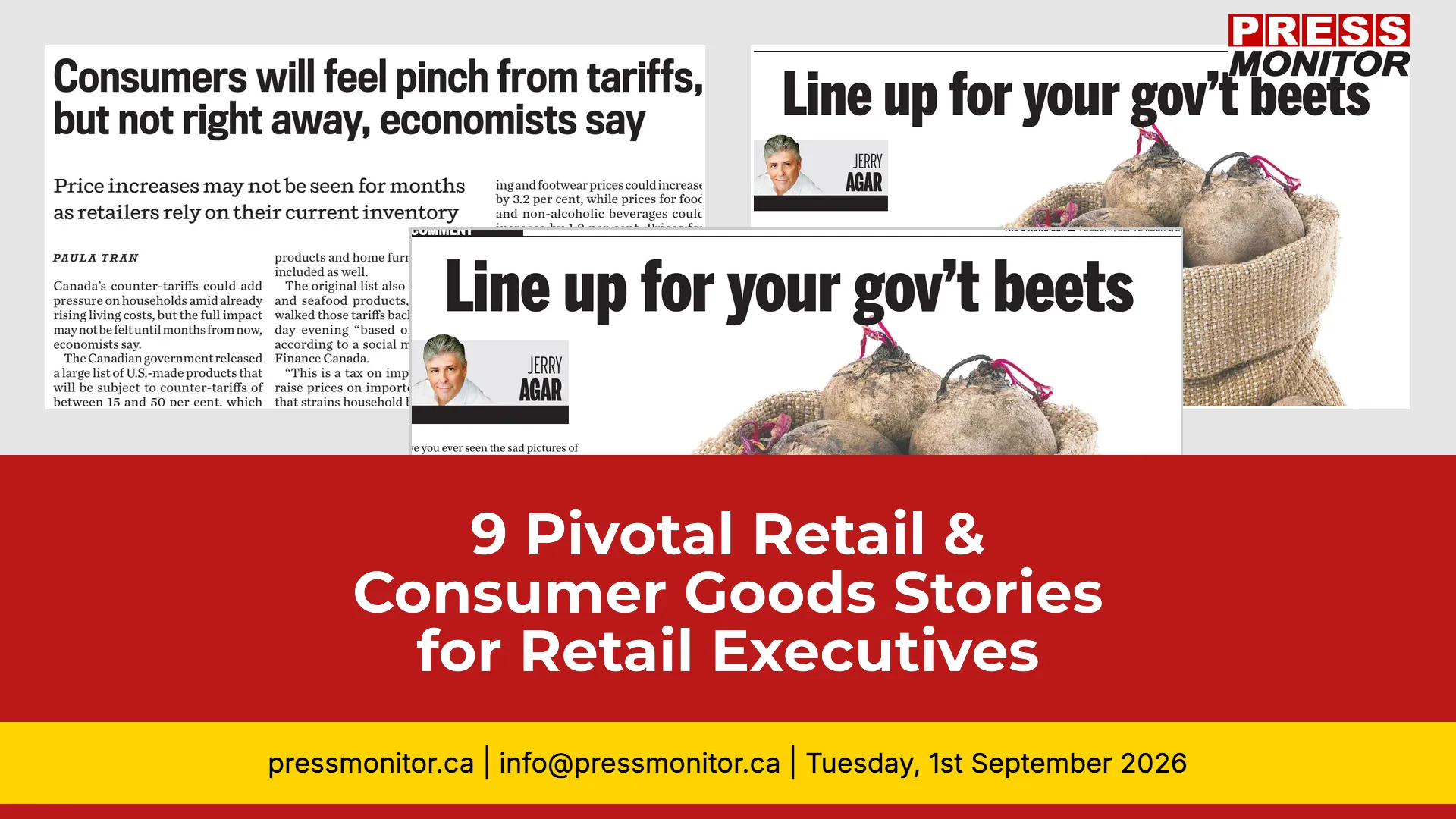
«Selon Saskatoon Starphoenix,» Canada’s counter-tariffs could add pressure on households amid already rising living costs, but the full impact may not be felt until months from now, economists say. The Canadian government released a large list of U.S.-made products that will be subject to counter-tariffs of between l5 and 5O per cent, which will take into effect on Sept. 8 if negotiations don’t resume. The retaliatory tariffs are expected to cover roughly $27.6 billion worth of imports from the US and are a response to U.S. President Donald Trump’s Section 338 levies, which came into effect on Saturday. The tariffs do not just apply to manufacturing products such as steel and aluminum, though they take up a majority of the list. U.S. imports of food products, beauty products, paper products and home furnishings were included as well. The original list also included fish and seafood products, but Canada walked those tariffs back on Wednesday evening "based on feedback," according to a social media post by Finance Canada.
Why it matters: Trade policy directly dictates shelf pricing and inventory turnover for every brick-and-mortar and e-commerce operator.
Key detail: Canada’s counter-tariffs on roughly $27.6 billion in U.S. imports take effect Sept. 8, covering food, beauty, paper, and home furnishings. Economists warn full price transmission may lag months as retailers burn through existing stock.
Source: Saskatoon Starphoenix
Next step: Audit Q4 procurement contracts and stress-test margin scenarios against retaliatory levies.
2. Reality Check on Municipal Grocery Initiatives
Toronto Sun reports that Mayor Chow's plan to run grocery stores with a thirty percent discount is unlikely to work financially, as it relies on tax-subsidised discounts that fail to compete with major grocers like Loblaws.
Why it matters: Public-sector retail experiments challenge private grocers’ market dominance and subsidy models.
Key detail: Proposed city-run grocery outlets offering thirty percent discounts rely heavily on tax subsidies and struggle to compete with established chains like Loblaws on scale and logistics.
Source: Toronto Sun
Next step: Monitor municipal procurement shifts and assess competitive positioning in subsidized zones.
3. City Council's Grocery Plan Faces Structural Critique
The Ottawa city council's plan to open grocery stores for discounted goods is questioned due to its reliance on a tax subsidy and first-come, first-served model. Critics argue that the initiative may not outperform existing large grocery chains and could lead to long queues without guaranteed availability.
Why it matters: First-come, first-served distribution models often fail in high-demand essential goods markets.
Key detail: Ottawa’s discounted grocery proposal draws criticism over queue management, limited SKU availability, and reliance on taxpayer funding rather than commercial viability.
Source: Ottawa Sun
Next step: Evaluate public-private partnership opportunities that align with municipal affordability goals.
4. Toronto Explores Government-Owned Grocery Stores
Calgary Sun reports that Toronto City Council is considering a plan to open government-owned grocery stores to lower food prices, mirroring a New York City initiative. Critics argue that such a move would rely on taxpayer subsidies and could lead to supply shortages and long queues.
Why it matters: Mirroring New York City’s model signals a broader North American shift toward state-backed food security infrastructure.
Key detail: Council debates direct municipal ownership to lower prices, though critics flag potential supply bottlenecks and operational inefficiencies compared to agile private retailers.
Source: Calgary Sun
Next step: Track regulatory approvals and prepare contingency plans for localized demand surges.
5. Shein Prices Hong Kong IPO Below Top End
The Globe And Mail reports that Shein priced its Hong Kong initial public offering below the top end of its marketed range, raising HK$2.4 billion from the share sale.
Why it matters: Fast-fashion giants navigating capital markets reflect broader shifts in omnichannel retail valuation and cross-border e-commerce.
Key detail: The retailer raised HK$2.4 billion by pricing its Hong Kong listing below the upper guidance range, signaling cautious investor appetite amid macroeconomic headwinds.
Source: The Globe And Mail
Next step: Review competitor financing rounds and adjust digital marketing spend accordingly.
6. Dopamine Websites Simulate Online Shopping
Saskatoon Starphoenix reports that a growing category of 'dopamine websites' simulates the pleasures of online shopping without the insult to your bank account.
Why it matters: Behavioral tech is capturing attention without driving actual GMV, altering how brands measure engagement versus conversion.
Key detail: Emerging platforms replicate the psychological rewards of browsing and cart-building while explicitly removing checkout friction, appealing to budget-conscious consumers.
Source: Saskatoon Starphoenix
Next step: Integrate gamified loyalty mechanics that bridge simulated interest with real-world purchase incentives.
7. Russian Forces Intensify Bombardment of Kyiv, Supermarket Shelves Bare
Selon Times Colonist, Russian forces relentlessly battered Kyiv and cities in the region around the Ukrainian capital for a fifth straight day on Monday, leaving some supermarket shelves bare after repeated strikes on warehouses, as Ukraine reels from attacks with jet-powered drones. Russia has intensified its aerial attacks in recent months, more than four years after it invaded its neighbour. Almost constant air raid alerts in the Kyiv region in recent days have severely disrupted daily routines. Two major attacks in July killed almost 50 civilians, and a strike on Saturday killed at least 38 people. Classes were due to resume at Ukrainian schools on Tuesday, but it was unclear whether parents would send their children. Schools have air raid shelters, and classes can also be held online. But about 1 million textbooks have been destroyed in Russian attacks on publishing houses, potentially delaying deliveries for the start of the school year, Ukraine’s Education Ministry said earlier this month.
Why it matters: Geopolitical volatility rapidly disrupts regional distribution networks and warehouse availability.
Key detail: Sustained aerial strikes have damaged storage facilities, forcing emergency rerouting of perishable goods and triggering localized shortages across multiple districts.
Source: Times Colonist
Next step: Diversify supplier bases and increase safety stock for critical SKUs in volatile regions.
8. Russian Strikes Hurt Ukrainian Food Supply Logistics
The Globe And Mail (ottawa/quebec Edition) reports that air raids on food distribution centres have disrupted logistics, leaving some supermarket shelves bare.
Why it matters: Targeted infrastructure attacks expose fragility in just-in-time retail replenishment cycles.
Key detail: Air raids on food distribution centres have paralyzed last-mile delivery routes, leaving urban supermarkets unable to restock staples within standard windows.
Source: The Globe And Mail
Next step: Stress-test vendor SLAs and negotiate force majeure clauses for extreme disruption scenarios.
9. Russia Fires 1,500 Drones on Ukraine, Snapping Distribution Networks
{source_name} reports that Ukraine is experiencing intensified Russian strikes using jet-propelled drones on multiple occasions, damaging critical infrastructure and supply chains, with Zelenskyy's team noting flooding risks and public unrest amid snapped food distribution networks.
Why it matters: High-volume asymmetric warfare accelerates the breakdown of traditional retail supply chains.
Key detail: Coordinated drone campaigns have crippled power grids and transport hubs, prompting officials to warn of flooding risks and widespread public unrest over depleted essentials.
Source: Toronto Star
Next step: Activate crisis communication protocols and align inventory allocation with humanitarian priority tiers.
Closing: This print media monitoring roundup highlights how trade policy, municipal innovation, and global instability intersect with everyday consumer behavior. How will your organization adapt its inventory and pricing strategies when external shocks hit faster than internal forecasts? Share your approach below.